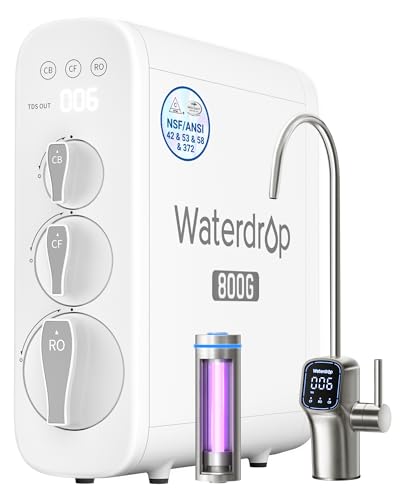
The Waterdrop G3P800 is certified by IAPMO R&T to NSF/ANSI 58 for lead, fluoride and dissolved solids, and to NSF/ANSI 53 for PFOA/PFOS. It’s the only tankless system among the reverse osmosis systems we score, and Waterdrop rates it at 800 gallons a day with three cups of filtered water for every cup of wastewater.
The catch: It needs an outlet under the sink, and it’s our only tankless pick: every other RO system we score has a tank.
Health information, not medical advice. Guidance differs for infants, pregnancy, and existing conditions. Test your own water and speak to a doctor or your local health authority. We may earn a commission when you buy through our links; it never affects our scores.
Which reverse osmosis systems are actually tankless?
Of the ten reverse osmosis systems we score, only the Waterdrop G3P800 is tankless by its maker’s own description: Waterdrop’s product page calls it a tankless reverse osmosis system. We checked every other system against its maker’s product page. The under-sink ones store water in a tank, and the countertop ones are units you fill by hand. Culligan also sells an Aquasential Tankless RO, but WQA certifies it for dissolved solids only, so it isn’t one of our picks.
| System | Where it goes | Tank or tankless, per the maker |
|---|---|---|
| Waterdrop G3P800 | Under the sink | Tankless |
| Aquasana SmartFlow RO | Under the sink | 3.2-gallon holding tank |
| APEC RO-90 | Under the sink | 4-gallon tank |
| APEC ROES-50 | Under the sink | 4-gallon pressurized tank |
| iSpring RCC7AK | Under the sink | 3.2-gallon storage tank |
| Home Master TMAFC | Under the sink | 3.2-gallon storage tank |
| Culligan Aquasential RO | Under the sink, dealer-installed | 3-gallon tank |
| AquaTru Carafe and Classic | Countertop | Tap water tank you fill by hand, plus a clean water tank or carafe |
| Bluevua RO100ROPOT-Lite | Countertop | Tank you fill by hand, 40 oz glass carafe |
| Culligan Aquasential Tankless RO (not a pick) | Under the sink, dealer-installed | Tankless |
From each maker’s product page, checked 12 October 2026. Countertop units such as the AquaTru have no storage tank under the sink, but their makers don’t describe them as tankless, and they make water in batches rather than on demand.
How is a tankless system different from a tank system?
A tankless system filters on demand, while a tank system filters slowly into storage and serves you from the tank. A conventional under-sink system fills a pressurized tank, which University of Nebraska extension specialists say generally holds 2 to 5 gallons. When the tank runs low, you wait for it to refill. A tankless system uses a pump and a higher-output membrane instead: Culligan describes its tankless model as a four-stage system and credits its booster pump and high-volume membrane for its high flow rate.
The makers’ own figures show the gap. Culligan rates its tank-style Aquasential RO at 27.8 gallons a day into its storage tank, and its Tankless RO at 715 gallons a day. Aquasana rates the SmartFlow at 25.7 gallons a day, with 0.7 gallons a minute at the faucet from a 3.2-gallon tank that holds from about 1.4 to 3.2 usable gallons, depending on your water pressure. Waterdrop rates the G3P800 at 800 gallons a day and says it fills a 6-ounce cup in 5 seconds (maker’s claim).
Tank pressure matters too. The University of Nebraska notes that the incoming water pressure has to overcome both the osmotic pressure across the membrane and the back pressure from the storage tank. For the basics of the membrane, see how reverse osmosis works.
Does a tankless system save space under the sink?
Yes, because there’s no tank to fit. Waterdrop says the G3P800’s tankless design saves 70% of under-sink space (maker’s claim) and lists the unit at 18.11 by 5.67 by 17.73 inches. A tank system needs room for its filter housings plus the tank; APEC, for example, lists the ROES-50’s 4-gallon tank at 11 by 11 by 15 inches on its own. If your cabinet also holds a garbage disposal or cleaning supplies, measure before you buy either kind.
Does a tankless reverse osmosis system need electricity?
Yes. Waterdrop lists electricity as required for the G3P800 and includes a power adapter in the box, and Culligan’s Tankless RO runs on 120 volts AC. The pump that replaces the tank needs power, so you need an outlet under the sink or a qualified electrician to add one. Some tank systems need no power at all: ISpring says the RCC7AK operates without electricity, Culligan lists no power specification for its tank-style Aquasential RO, and Home Master says its permeate pump upgrade uses no electricity. If adding an outlet isn’t an option, a tank system is the simpler choice.
How much water does a tankless system waste?
Less than the tank systems whose makers publish a figure, going by those makers’ own numbers. Waterdrop says the G3P800 uses one cup of wastewater to make three cups of filtered water, about 0.33 gallons of waste per gallon. Culligan’s own pages give a direct comparison within one brand: A 58.4% recovery rate for its Tankless RO and 39.2% for its tank-style Aquasential RO. By our calculation from those rates, that’s about 0.7 gallons of waste per gallon for the tankless model and about 1.6 gallons for the tank model.
Tank systems vary. Home Master says to expect about a 1:1 ratio of filtered water to wastewater with its permeate pump upgrade, and iSpring says only that the waste ratio “can be reduced but not eliminated.” For context, the EPA estimates a typical point-of-use RO system wastes at least five gallons for every gallon it makes, and systems with the EPA’s WaterSense label waste 2.3 gallons or less. These ratios are the makers’ figures; we haven’t measured them.
Are tankless systems certified differently?
No, they’re certified to the same standard, NSF/ANSI 58, but the claims a given model carries can differ a lot. NSF International says every system certified to NSF/ANSI 58 must carry a TDS (total dissolved solids) reduction claim, and that claims such as lead, fluoride, arsenic and nitrate/nitrite are optional. Culligan shows why that matters: WQA certifies its tank-style Aquasential RO for a long list of contaminants, but its Tankless RO for dissolved solids only, which Culligan’s own Tankless product page confirms.
| Contaminant | Waterdrop G3P800 (tankless) | Culligan Aquasential Tankless RO | Culligan Aquasential RO (tank) |
|---|---|---|---|
| Total dissolved solids | Certified (NSF/ANSI 58) | Certified (NSF/ANSI 58) | Certified (NSF/ANSI 58) |
| Lead | Certified (NSF/ANSI 58) | No claim | Certified (NSF/ANSI 58) |
| Fluoride | Certified (NSF/ANSI 58) | No claim | Certified (NSF/ANSI 58) |
| Cadmium, barium, radium 226/228 | Certified (NSF/ANSI 58) | No claim | Certified (NSF/ANSI 58) |
| Arsenic (pentavalent) | No claim | No claim | Certified (NSF/ANSI 58) |
| Nitrate/nitrite | No claim | No claim | Certified (NSF/ANSI 58) |
| PFAS | PFOA/PFOS, Certified (NSF/ANSI 53) | No claim | Total PFAS, Certified (NSF/ANSI 53), with the Total Defense cartridge |
| Chlorine | Certified (NSF/ANSI 42) | No claim | Maker’s claim (NSF/ANSI 42) |
| Certifier | IAPMO R&T | WQA | WQA |
Waterdrop G3P800 (model WD-G3P800), listed to Qingdao Ecopure Filter Co.: IAPMO R&T files WC-13976 (NSF/ANSI 58, checked 11 October 2026), WC-14805 (NSF/ANSI 53) and WC-14301 (NSF/ANSI 42). Culligan Aquasential Tankless RO and Tankless RO with Mineral Boost+: WQA, NSF/ANSI 58, TDS only. Culligan Aquasential RO (tank): WQA listings for Culligan International under NSF/ANSI 58 and 53; the nitrate claim applies to the Aquasential RO and Smart RO Nitrate, not the plain Smart RO. Certification is by model, so check the exact model number before you buy.
Which tankless reverse osmosis system do we recommend?
The Waterdrop G3P800, and it’s the only one we can recommend today. It’s the one tankless system among the reverse osmosis systems we score, and its certified list covers lead, fluoride and PFOA/PFOS. We’d rather name one system we’ve checked than pad this page with tankless models whose certifications we haven’t confirmed. If a tank system or a countertop unit would suit you, our reverse osmosis roundup ranks every RO system we score. How we score
Waterdrop G3P800
Tankless reverse osmosis with certified lead, fluoride and PFOA/PFOS reduction from its own faucet. It needs a power outlet under the sink, and filters cost about $160 a year.
What does the G3P800 cost to run?
About $90 a year for its two prefilters, before the membrane. At Waterdrop’s prices, the CF sediment filter is $29.99 and lasts up to 6 months or 550 gallons, and the CB carbon filter is $29.99 and lasts up to 12 months or 1,100 gallons, which comes to $89.97 a year on the time schedule by our calculation. The RO membrane lasts up to 24 months, per Waterdrop. Waterdrop didn’t list a price for the membrane on its replacement filter page when we checked, so we haven’t included it. The faucet display shows dissolved solids and filter life, so you don’t have to track the dates yourself.
Can you install a tankless system yourself?
The G3P800, yes, according to Waterdrop, which describes a 30-minute DIY installation with an all-in-one kit that includes the faucet, tubing and a drain saddle (maker’s claim). Plan for three things: A spot for the faucet, a drain connection for the wastewater, and an outlet under the sink. Culligan’s Tankless RO is different: Culligan’s 2019 owner’s guide says it should only be installed and serviced by a Culligan dealer, following local plumbing codes. If you rent, an under-sink system of either kind may not be allowed; a countertop unit needs no plumbing. See our countertop roundup and the best water filters for apartments.
Tankless or tank: which should you buy?
Choose by your cabinet, your outlet and how much water you use.
Choose the G3P800 if
You have an outlet under the sink, want filtered water on demand with no tank to refill, and want certified lead, fluoride and PFOA/PFOS reduction. Our G3P800 review.
Choose a tank system if
There’s no outlet under the sink, or you need certified arsenic or nitrate reduction. Compare them in our under-sink roundup.
Skip the plumbing
Countertop RO plugs into an outlet on the counter and makes water in batches. See our countertop roundup.
Not sure you need RO?
If your water report shows only chlorine, lead or PFOA/PFOS, a certified carbon filter wastes no water. See how to choose a water filter.
What else do people ask about tankless RO?
Short answers on power, water waste, installation and filter changes.
What is the best tankless reverse osmosis system?
The Waterdrop G3P800. IAPMO R&T certifies it to NSF/ANSI 58 for lead, fluoride, cadmium, barium, radium and dissolved solids, and to NSF/ANSI 53 for PFOA/PFOS. It’s the only tankless model among the reverse osmosis systems we score, and Waterdrop rates it at 800 gallons a day.
Do tankless RO systems need electricity?
Yes. A pump replaces the storage tank, so the system needs power. Waterdrop lists electricity as required for the G3P800 and includes a power adapter, and Culligan’s Tankless RO runs on 120 volts AC. Check for an outlet under the sink before you buy, because many kitchens don’t have one there.
Do tankless RO systems waste less water?
The two we compared do, by their makers’ figures. Waterdrop rates the G3P800 at three cups of filtered water per cup of wastewater. Culligan lists a 58.4% recovery rate for its Tankless RO against 39.2% for its tank model. The EPA estimates a typical point-of-use RO system wastes at least five gallons per gallon.
Can renters install a tankless RO system?
Usually not without permission. The G3P800 needs a faucet, a drain connection and an outlet under the sink, so ask your landlord first. If that’s not possible, a countertop RO unit such as the AquaTru plugs into an outlet on the counter and needs no plumbing.
How often do you change the G3P800’s filters?
The CF sediment filter every 6 months or 550 gallons, the CB carbon filter every 12 months or 1,100 gallons, and the RO membrane every 24 months, per Waterdrop. The two prefilters come to $89.97 a year at Waterdrop’s prices. See how often to change a water filter.
Sources
- Waterdrop G3P800 product page
- Waterdrop G3P800 replacement filters
- IAPMO R&T product listing directory (Qingdao Ecopure Filter Co.: WC-13976, WC-14805, WC-14301)
- WQA certified product listings (Culligan International: Aquasential RO, Tankless RO)
- Culligan Aquasential Tankless RO product page
- Culligan Aquasential Tankless RO owner’s guide
- Culligan Aquasential reverse osmosis product page
- Aquasana SmartFlow Reverse Osmosis product page
- APEC RO-90 product page
- APEC ROES-50 product page
- iSpring RCC7AK product page
- Home Master TMAFC product page
- AquaTru Carafe product page
- AquaTru Classic product page
- Bluevua ROPOT-Lite product page
- NSF International: NSF/ANSI 58 reverse osmosis drinking water treatment systems
- University of Nebraska-Lincoln Extension: Drinking water treatment, reverse osmosis (G1490)
- EPA WaterSense: Guide to selecting water treatment systems (November 2024)
Prices as of October 14, 2026. Product prices and availability are accurate as of the date/time indicated and are subject to change. As an Amazon Associate we earn from qualifying purchases.