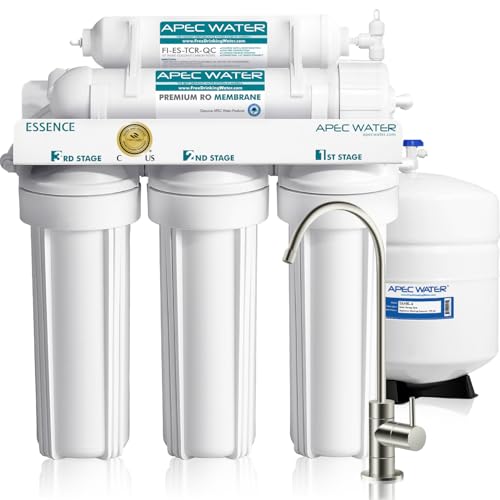
WQA certifies the ROES-50 to NSF/ANSI 58 for total dissolved solids (TDS). Its filters are inexpensive, and it’s a plain five-stage reverse osmosis system with no extras.
The catch: Lead, fluoride, arsenic and PFAS aren’t on its certification. For those, APEC’s RO-90 or the iSpring RCC7AK-BN cost little more.
Health information, not medical advice. Guidance differs for infants, pregnancy and existing conditions. Test your own water and speak to a doctor or your local health authority. We may earn a commission when you buy through our links; it never affects our scores.
Our verdict
The ROES-50 is APEC’s entry-level under-sink reverse osmosis system: a sediment filter, two carbon blocks, the RO membrane and a coconut-shell carbon polishing filter, feeding a 4-gallon tank and its own faucet. APEC rates it at 50 gallons a day at 60 psi, or 30 at 50 psi.
WQA certifies it to NSF/ANSI 58, but only for total dissolved solids. APEC’s product page lists lead, arsenic, fluoride and PFAS among the contaminants it says the system removes. Reverse osmosis membranes do reduce those in general, but none of them is on this model’s certification, so we don’t credit them. APEC’s own RO-90 is certified by WQA for lead, fluoride and arsenic, and so is the iSpring RCC7AK-BN by NSF International. Our NSF certification guide explains how to check a certifier’s listing yourself.
Where the ROES-50 does well is running cost. APEC sells the three pre-filters as a set for about $30, to change every 6 to 12 months, and the membrane for about $40, to change every 2 to 4 years. There’s no remineralization stage, so the water comes out with fewer minerals than your tap water, which some people find tastes flat.
You want low-cost reverse osmosis mainly to cut dissolved solids, and you don’t need certified lead or fluoride reduction.
You’re buying for lead, fluoride, arsenic or PFAS. The iSpring RCC7AK-BN and APEC’s RO-90 are certified for lead and fluoride.
How it scored
Contaminant reduction carries the most weight in the overall score. How we score filters
What it removes
WQA lists one reduction claim for the ROES-50. The other rows are what APEC claims, which we report but don’t score.
| Contaminant | ROES-50 | Certified to |
|---|---|---|
| Total dissolved solids (TDS) | Certified | NSF/ANSI 58 |
| Lead, fluoride, arsenic | APEC’s claim | Not certified |
| PFAS (PFOA, PFOS) | APEC’s claim | Not certified |
| Chlorine | Carbon stages, no claim listed | Not certified |
| Minerals (calcium, magnesium) | Removed, not added back | – |
WQA’s listing for APEC Water Systems, seen on 7 October 2026, gives the ROES-50 a single NSF/ANSI 58 claim: TDS. The ROES-100 and the alkaline ROES-PH75 carry the same single claim. The RO-90, RO-PH90 and RO-Hi carry the full list (arsenic V, barium, cadmium, copper, fluoride, chromium-6, lead, radium, selenium, TDS, trivalent chromium and turbidity). A separate WQA listing covers the ROES-50 under NSF/ANSI/CAN 372 for lead-free materials. We found no APEC listing at NSF International.
What it costs to run
APEC’s schedule is 6 to 12 months for the three pre-filters and 2 to 4 years for the membrane and the carbon post-filter. At APEC’s prices (pre-filter set $29.95, membrane $39.95, complete five-stage set $79.99), that’s roughly $45 to $90 a year. NSF/ANSI 58 doesn’t give reverse osmosis filters a gallon rating, so we can’t give a certified cost per gallon.
Pros and cons
Strengths
- Certified by WQA to NSF/ANSI 58 for TDS
- Inexpensive filters, about $45 to $90 a year
- Simple five-stage design with a 4-gallon tank
- Widely available filters and lifetime technical support (APEC)
What to know
- Not certified for lead, fluoride, arsenic or PFAS
- APEC’s page claims far more than WQA certifies
- No remineralization, so the water can taste flat
- Under-sink install; sends water to the drain
What owners say
Owners describe a dependable system that runs for years with little fuss. The recurring complaints are flat-tasting water and the install.
Often praised
- Long service life with few leaks
- A big drop on their TDS meters
- Easy filter changes and helpful support
Common complaints
- Flat or slightly acidic taste
- Tank refills slowly after heavy use
- Install takes time and cabinet space
Recurring themes across verified buyer reviews.
Specifications
- Type
- Under-sink reverse osmosis, 5 stages
- Stages
- Sediment, 2 carbon blocks, RO membrane, carbon post-filter
- Certifier
- WQA
- Certified to
- NSF/ANSI 58 (TDS); NSF/ANSI/CAN 372
- Rated output
- 50 gal a day at 60 psi; 30 at 50 psi (APEC)
- Tank
- 4 gallons
- Filter life
- Pre-filters 6 to 12 months; membrane and post-filter 2 to 4 years (APEC)
- Remineralization
- None
Alternatives worth considering
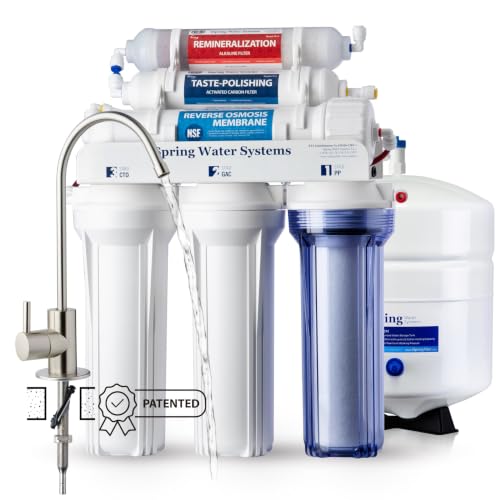
iSpring RCC7AK-BN
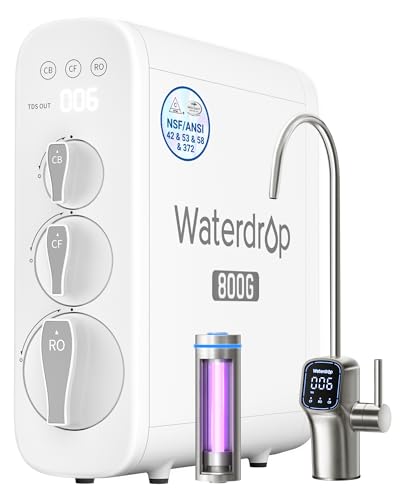
Waterdrop G3P800
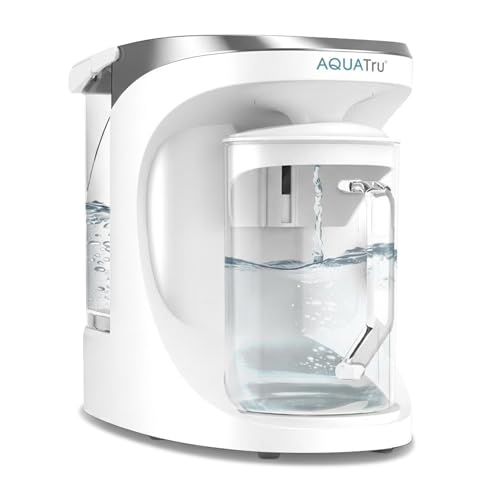
AquaTru Carafe
Common questions
Is the APEC ROES-50 certified?
Yes, by WQA to NSF/ANSI 58, but only for total dissolved solids (TDS). It also carries NSF/ANSI/CAN 372 for lead-free materials. APEC’s claims for lead, fluoride, arsenic and PFAS aren’t part of its certification.
Does the ROES-50 remove fluoride or lead?
Reverse osmosis generally reduces both, but the ROES-50 isn’t certified for either. If you’re buying for fluoride or lead, choose a certified system such as the iSpring RCC7AK-BN or APEC’s RO-90. See our fluoride guide.
ROES-50 or RO-90?
WQA certifies the RO-90 for lead, fluoride, arsenic V, chromium-6 and other metals, plus TDS. The ROES-50 is certified for TDS only. The RO-90 costs more, but it’s the one to buy if any of those contaminants is your reason for filtering.
What about the ROES-50X or ROES-PH75?
WQA doesn’t list the ROES-50X. The ROES-PH75 adds a mineral stage for taste, but WQA certifies it for TDS only, like the ROES-50.
How often do the filters need changing?
APEC says every 6 to 12 months for the three pre-filters and every 2 to 4 years for the membrane and carbon post-filter, depending on your water and use.
The bottom line
The APEC ROES-50 is a simple, cheap-to-run reverse osmosis system, but WQA certifies it for dissolved solids only. If lead or fluoride is why you’re filtering, the iSpring RCC7AK-BN costs about the same and is certified for both, and APEC’s RO-90 adds arsenic. Compare them all in our reverse osmosis guide.
- Certifier listings: WQA, APEC Water Systems, NSF/ANSI 58: ROES-50 (systems with storage tank), claim TDS only. Same for ROES-100 and ROES-PH75. Separate WQA listing for NSF/ANSI/CAN 372.
- Also searched: NSF International (APEC): no listing.
- Maker documents: APEC ROES-50 product page, APEC FAQ filter schedule, APEC replacement filter prices.
- Independent lab tests: None used.
Sources
Prices as of October 14, 2026. Product prices and availability are accurate as of the date/time indicated and are subject to change. As an Amazon Associate we earn from qualifying purchases.