We checked seven brands against the NSF, IAPMO and WQA databases to find out which water filters are actually certified to reduce microplastics. Seven products carry the claim, and only one of them is a pitcher.
Certification records checked directly with NSF International, IAPMO R&T and WQA on 7 September 2026
AquaTru
Certified for microplastics across every form factor: countertop, countertop reverse osmosis and under-sink, alongside fifteen other named compounds.
Jump to pick ›Culligan MaxClear
A gravity element certified for microplastics plus lead, total PFAS, four pharmaceuticals and three pesticides. No plumbing, no outlet.
Jump to pick ›British Berkefeld
Certified for microplastics alongside cysts and turbidity, with no rated service cycle because ceramic candles are cleaned rather than replaced.
Jump to pick ›Seven products hold a certified microplastics claim that we could verify: AquaTru, Culligan MaxClear, ProOne, British Berkefeld, Doulton’s inline elements, Brita’s pitcher filters and Brita’s commercial Total360 line.
Brita is the only pitcher on that list, and its certification is issued by WQA rather than NSF, which is why it does not appear in NSF’s database. ZeroWater, Clearly Filtered, Epic, Waterdrop and Purewell carry no microplastics claim on any pour-through product. Several are certified to the same standard microplastics sits under, which is where most of the confusion comes from.
Why “NSF/ANSI 401 certified” does not mean microplastics
Microplastics reduction is certified under NSF/ANSI 401, the standard covering emerging compounds and incidental contaminants. The thing almost nobody explains is that 401 is a menu, not a single test. A manufacturer picks which substances to certify against, and the certificate names only those.
The clearest illustration sits in two certificates we pulled on the same day. Culligan’s ZeroWater pitchers are certified to NSF/ANSI 401 for thirteen substances: atenolol, bisphenol A, carbamazepine, DEET, estrone, ibuprofen, linuron, meprobamate, metolachlor, naproxen, nonylphenol, phenytoin and trimethoprim. Microplastics is not among them. Culligan’s MaxClear gravity element is certified to the same standard for eight substances, and microplastics is one of them.
Both are genuinely 401 certified. Only one is certified for microplastics. So a listing that says “NSF/ANSI 401 certified” tells you nothing at all about microplastics until you read which claims are on the certificate.
What is certified for microplastics, and what is not
Every row below comes from a certificate we opened, not from a product listing or a manufacturer page.
| Product | Type | Certifier | Microplastics | Also certified for |
|---|---|---|---|---|
| AquaTruModels AT2000 to AT2050, AT100 to AT140, ATU100, ATU200 | Countertop, countertop RO, under-sink | IAPMO R&T | Certified | Fifteen further compounds under 401, plus VOC, PFOA and PFOS under 53 |
| Culligan MaxClearElement MCF701, Venture and Scout systems | Gravity | IAPMO R&T | Certified | Lead, total PFAS, four pharmaceuticals, three pesticides |
| ProOneElement G3.0, Big+ and Traveler+ systems | Gravity | IAPMO R&T | Certified | Lead, total PFAS, chlorine, chloramine |
| British BerkefeldUltra Sterasyl candle W9121226 | Gravity | NSF International | Certified | Cysts, turbidity, nominal particulate class I |
| Doulton Biotect Ultra and UltracarbInline elements, 600 gallons | Under-sink inline | NSF International | Certified | Cysts, lead, turbidity, chlorine |
| Brita Total360BRDPFS, BRDWPS, BRDWPST | Plumbed-in, commercial | NSF International | Certified | Lead, cysts, benzene, mercury depending on model |
| Culligan ZeroWaterTen pitcher and dispenser models | Pitcher | IAPMO R&T | Not certified | Thirteen pharmaceuticals and compounds under 401 |
| Brita pitcher filtersListed as Brita LP | Pitcher | WQA | Certified | Nineteen claims under 53 including lead and mercury, fifteen more under 401 |
| Clearly FilteredFiltered Water Pitcher | Pitcher | NSF International | Not certified | Chlorine, taste and odour, lead-free materials |
| Epic Water FiltersOnly model EWFESS4-DC is listed | Under-sink | IAPMO R&T | Not certified | Lead, cysts, asbestos, mercury, VOC. Pitchers carry no listing |
| Waterdrop and PurewellPour-through models, 60 gallons | Pitcher | NSF International | Not certified | Chlorine, taste and odour only |
Searched by brand and by company name in the NSF listings database, the IAPMO R&T product listing directory and the WQA product listings on 7 September 2026. All three bodies certify against NSF/ANSI standards, so a product missing from one database may be certified by another. Certificates are often held under a manufacturer’s legal name rather than the brand: Epic files as Epic Life Inc., Brita’s products sit across four separate legal entities, and Phoenix Gravity’s certificate belongs to an Indian manufacturer. A brand-name search alone will miss listings.
The filters actually certified for microplastics

AquaTru
The most complete answer on this page. AquaTru’s certificate covers microplastics across its countertop, countertop reverse osmosis and under-sink lines, which means you can pick the form factor that suits your kitchen without losing the claim. Certified capacities run from 300 to 600 gallons depending on model, so filter life is measured in months rather than weeks.
The Carafe is the AT100 family on the certificate, rated 300 gallons, and the Classic is the AT2000 family at 600 gallons. Both carry the microplastics claim. AquaTru’s lead and fluoride certifications sit on its NSF/ANSI 58 reverse osmosis file rather than the 53 file, alongside arsenic, radium, perchlorate and nitrate, so the full picture spans three certificates.
The Carafe suits one or two people and a smaller counter. If you want the larger 600-gallon certified capacity, the AquaTru Classic is the AT2000 family, and we have a full Classic review as well.

Culligan MaxClear
The answer if you have no outlet and no plumbing. It is the only gravity option certified for microplastics, lead and total PFAS together, which makes it the broadest claim set in that category by some distance.
The certified capacity is 50 gallons per filter, which for a household drinking two gallons a day is under four weeks. And the claims were certified in Culligan’s own Venture and Scout systems with this element named as the component, so using it in a Berkey housing is outside what the certificate covers even though it fits. Our gravity filter guide goes through that in detail.
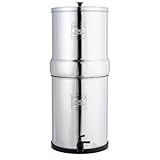
British Berkefeld with Ultra Sterasyl candles
Ceramic works by mechanical exclusion rather than adsorption, which is why NSF applies no rated service cycle to it: the candles are cleaned and reused rather than replaced on a gallon count. For microplastics specifically, physical exclusion is a sensible mechanism, and this is the only ceramic system we found with the claim certified.
Check the candles. The certification attaches to Ultra Sterasyl, and several British Berkefeld systems ship with Super Sterasyl instead, a different element not covered by that listing.

ProOne Big+, three filters
The same claim set as MaxClear on the health side, and the advantage here is that you are buying the certified system rather than dropping an element into another maker’s housing. The three-filter configuration triples the certified capacity for the same certification.
ProOne is being brought under the Culligan MaxClear brand, so this is the outgoing line. The certificates remain active and the filters remain available, but it is worth knowing before you commit to a platform.
Which water pitcher removes microplastics?
None that we could find is certified for it. We checked the six biggest pitcher brands in the NSF and IAPMO databases and not one carries a microplastics claim on a pour-through product.
That is not the same as saying pitchers do nothing. Most of them filter particles, and some certainly reduce microplastics to some degree. What none of them has is a third party verifying that reduction and auditing the factory that makes them. If a pitcher listing tells you it removes microplastics, that claim rests on the manufacturer’s own testing.
What the pitcher brands are certified for
ZeroWater holds the widest 401 certificate of any pitcher we found, covering thirteen pharmaceuticals and industrial compounds including bisphenol A, ibuprofen and naproxen. Microplastics is simply not on the list. If pharmaceuticals are your concern rather than plastics, it is a genuinely strong certified choice, and our ZeroWater review covers it.
Brita is the exception, and it took three databases to find it. Brita LP holds WQA certification under NSF/ANSI 401 for microplastics alongside fifteen other compounds, plus nineteen claims under NSF/ANSI 53 and six under 42. None of it appears in NSF’s own database, because WQA is a separate certification body working to the same standards. See our Brita Elite review.
Clearly Filtered holds two records only: chlorine and taste and odour under NSF/ANSI 42, and lead-free materials under 372. Its widely advertised reduction figures come from third-party lab testing rather than certification. Our Clearly Filtered review has the detail.
Epic Water Filters has one certified product, the plumbed-in EWFESS4-DC, covered for lead, cysts, asbestos, mercury and VOC. Its pitchers carry no listing at all.
If a pitcher is the only format that works for you, buy it for what it is certified to do and treat microplastics as an unverified extra. If microplastics are the reason you are filtering, the certified options on this page are countertop, gravity or under-sink.
Does reverse osmosis remove microplastics?
Almost certainly, and mostly it is not certified for it. Reverse osmosis membranes reject particles far smaller than any microplastic, so the physics is not in question. The certification question is separate.
Reverse osmosis systems are certified under NSF/ANSI 58, and that standard has no microplastics claim in it at all. Its claim list covers arsenic, barium, cadmium, chromium, copper, fluoride, lead, nitrate, radium, selenium, TDS and turbidity. So a system can be fully certified to 58 and still hold no certified microplastics claim, because the standard does not offer one.
AquaTru is the exception on this page because it holds a separate NSF/ANSI 401 certificate alongside its 58 listing. Most reverse osmosis makers do not bother, which is why our reverse osmosis guide ranks on the claims each system actually carries rather than on the technology.
Match the format to your kitchen
You have an outlet and counter space
AquaTru is the only countertop system we found with a certified microplastics claim, and it covers a longer list of compounds than anything else here.
No power, no plumbing
Culligan MaxClear and ProOne both carry microplastics alongside lead and total PFAS. British Berkefeld carries microplastics with cysts, which suits untreated sources better.
You want it hidden under the sink
AquaTru’s under-sink models and Doulton’s Biotect Ultra and Ultracarb inline elements both carry the claim, the Doulton at 600 gallons per element.
It has to be a pitcher
Brita’s pitcher filters are WQA certified for microplastics, the only pour-through product we found with the claim. ZeroWater is not, though it is certified for thirteen other compounds and for Total PFAS.
Common questions
What is the best water filter for microplastics?
AquaTru, because its IAPMO R&T certificate covers microplastics across countertop, countertop reverse osmosis and under-sink models, alongside fifteen other named compounds. If you need something that works without power, Culligan MaxClear and ProOne both carry certified microplastics claims in gravity systems.
Which water pitcher removes microplastics?
Brita, and it is the only one we found. Brita LP holds WQA certification under NSF/ANSI 401 for microplastics. ZeroWater, Clearly Filtered, Epic, Waterdrop and Purewell carry no microplastics claim on any pour-through product. Note that Brita’s certification is issued by WQA rather than NSF, so it does not appear in NSF’s database.
My filter says it is NSF/ANSI 401 certified. Does that cover microplastics?
Not necessarily. NSF/ANSI 401 is a menu of elective claims and a manufacturer chooses which to certify against. ZeroWater is certified to 401 for thirteen substances and microplastics is not one of them; Culligan MaxClear is certified to the same standard for eight, and microplastics is included. Read the reduction claims on the certificate, not the standard number.
Does boiling water remove microplastics?
No. Boiling addresses microorganisms, not particles. Some research suggests boiling hard water can cause microplastics to become trapped in scale, but that is not a treatment method and it is not something any certification covers. Filtration is the reliable route.
How small are microplastics, and does micron rating matter?
Microplastics span a wide size range, and a micron rating on its own is not a substitute for a certified claim. Certification tests a specific reduction under defined conditions across a stated volume of water, which a nominal micron figure does not. Our microplastics guide covers what they are and where they come from.
How do I verify a certification claim myself?
Search the model number in the certifier’s own database, NSF or IAPMO R&T, and read the reduction claims column. Search by company as well as brand, since certificates are frequently held under a manufacturer’s legal name. Our NSF certification guide explains what each standard verifies.
Sources
- IAPMO R&T Product Listing Directory: files W-10195 and W-10193 (AquaTru), W-17176 to W-17179 (Culligan MaxClear), W-17156 (Culligan ZeroWater), W-16838 (ProOne), WP-10570 and WP-10571 (Epic Life Inc.), all current as of 7 September 2026
- NSF International Certified Products and Systems: Doulton Water Filters and British Berkefeld, Brita Total360 via Water Channel Partners, Clearly Filtered, Waterdrop and Purewell, checked 7 September 2026
- WQA product listings: Brita LP, certifications under NSF/ANSI 42, 53, 401 and NSF/ANSI/CAN 372, checked 7 September 2026