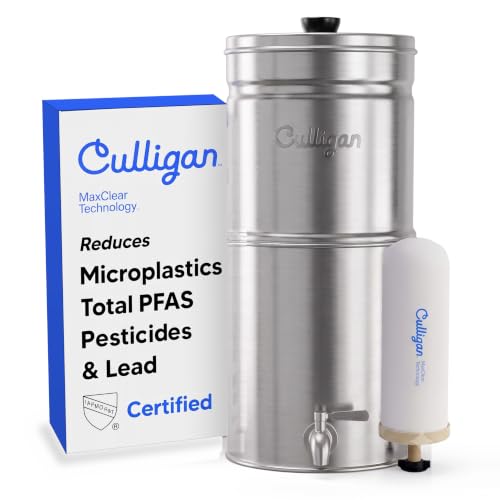
IAPMO R&T certifies the MaxClear Venture and Scout for lead and Total PFAS under NSF/ANSI 53, plus microplastics and chlorine. We found no other gravity system certified for both.
The catch: Each MCF701 filter is certified for 50 gallons and costs about $79, roughly $1.58 a gallon.
Health information, not medical advice. Guidance differs for infants, pregnancy and existing conditions. Test your own water and speak to a doctor or your local health authority. We may earn a commission when you buy through our links; it never affects our scores.
Our verdict
The MaxClear is Culligan’s stainless gravity system, sold as the Venture (3 gallons) and the Scout (2.25 gallons). You pour tap water into the top chamber and it drips through a ceramic-shelled carbon filter (the MCF701) into the bottom one. It needs no power or plumbing, and Culligan says the filter needs no priming and doesn’t have to be kept wet.
What sets it apart is certification. IAPMO R&T lists all four models (Venture and Scout, brushed or polished) with the MCF701 filter under NSF/ANSI 53 for lead and Total PFAS, NSF/ANSI 401 for microplastics and seven other compounds, and NSF/ANSI 42 for chlorine and chloramine. The Berkey’s Phoenix elements are certified for chlorine only, so for certified lead and PFAS reduction without power, this is the gravity system to buy.
The cost is the filter. IAPMO R&T certifies each MCF701 for 50 gallons. Culligan’s marketing says “up to 6 months”, but at a gallon a day, 50 gallons lasts under two months. At about $79 for a single filter on Amazon, that’s roughly $1.58 a gallon, the highest filter cost on our site.
You want certified lead and PFAS reduction with no power or plumbing, and you drink modest amounts or accept a high filter cost.
You need fluoride reduced, drink a lot of filtered water, or want the lowest running cost. Countertop reverse osmosis costs far less per gallon.
How it scored
Contaminant reduction carries the most weight in the overall score. How we score filters
What it removes
Every row below is certified by IAPMO R&T for the Venture and Scout with the MCF701 filter. The figures are from Culligan’s performance data sheet.
| Contaminant | Reduction | Certified to |
|---|---|---|
| Lead | 99.2% / 99.1% | NSF/ANSI 53 |
| Total PFAS | 99.6% | NSF/ANSI 53 |
| Microplastics | 96.5% | NSF/ANSI 401 |
| Atenolol, carbamazepine, DEET, linuron, meprobamate, metolachlor, trimethoprim | Reduced | NSF/ANSI 401 |
| Chlorine, chloramine | 99.4% / 99.6% | NSF/ANSI 42 |
| Fluoride, arsenic, nitrate, bacteria, viruses | – | No claim |
Lead figures are at pH 6.5 and 8.5. IAPMO R&T files W-17176 (NSF/ANSI 42), W-17177 (NSF/ANSI 53) and W-17178 (NSF/ANSI 401), issued to Culligan International (MaxClear), list models MCVB, MCVP, MCSB and MCSP with the MCF701 filter at 50 gallons; all were active on 7 October 2026, as was W-17179 for lead-free materials. Culligan sells the MCF701 as fitting Berkey and other housings, but the certification covers it only in the Venture and Scout. It’s for drinking water that’s already microbiologically safe.
What it costs to run
IAPMO R&T certifies each MCF701 for 50 gallons; Culligan’s data sheet adds that two filters give 100 gallons and three give 150. A single filter costs about $79 on Amazon, so the filter cost is roughly $1.58 a gallon however many you fit. At a gallon a day, that’s over $500 a year. For comparison, Berkey’s Phoenix elements work out to $0.02 to $0.11 a gallon and the AquaTru Carafe about $0.33.
Pros and cons
Strengths
- Certified by IAPMO R&T for lead and Total PFAS
- Also certified for microplastics, chlorine and chloramine
- No power, plumbing or priming
- Stainless steel, with a 5-year warranty on the system (Culligan)
What to know
- 50 certified gallons per filter, about $1.58 a gallon
- “Up to 6 months” marketing doesn’t match the certified capacity
- No fluoride, arsenic or nitrate reduction
- Certified only in Culligan’s own Venture and Scout
What owners say
Owners like the taste and the simple setup. The main complaint is the cost and frequency of filter changes.
Often praised
- Clean, neutral taste
- No priming or plumbing
- Solid stainless build
Common complaints
- High replacement filter cost
- Slow filling
- Unclear when to change the filter
Recurring themes across verified buyer reviews.
Specifications
- Models
- Venture 3 gal (MCVB, MCVP), Scout 2.25 gal (MCSB, MCSP)
- Filter
- MCF701, ceramic shell with carbon
- Certifier
- IAPMO R&T
- Certified to
- NSF/ANSI 42, 53 and 401; NSF/ANSI/CAN 372
- Certified capacity
- 50 gal per filter
- Filters
- Venture up to 3, Scout up to 2
- Weight
- Venture 5.5 lb, Scout 3.95 lb
- Water
- Cold, 40 to 85°F, microbiologically safe
- Warranty
- 5 years on the system, none on filters (Culligan)
Alternatives worth considering
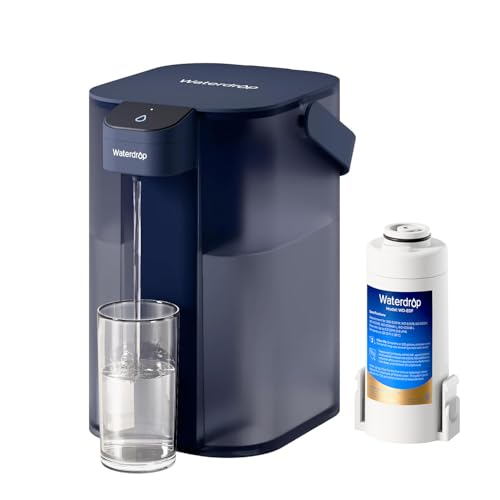
Waterdrop ED01

Big Berkey with Phoenix elements
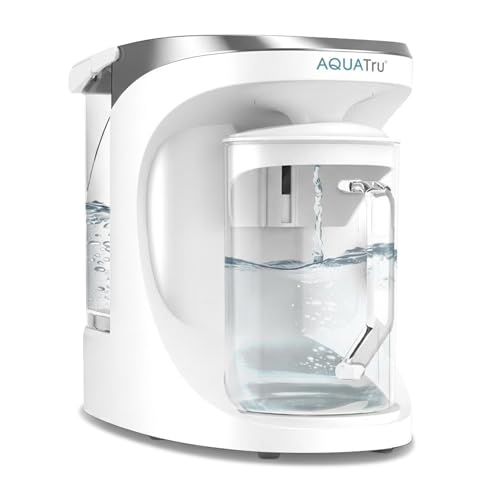
AquaTru Carafe
Common questions
Is the Culligan MaxClear NSF certified?
It’s certified to NSF/ANSI 42, 53 and 401 by IAPMO R&T, not NSF International, so you won’t find it in NSF’s database. Both certify to the same standards. The files are W-17176, W-17177 and W-17178.
Does it remove lead and PFAS?
Yes. IAPMO R&T certifies it under NSF/ANSI 53 for lead (99.2% at pH 6.5) and Total PFAS (99.6%). See our lead guide and PFAS guide.
How long does a filter last?
The certified capacity is 50 gallons per filter. Culligan’s “up to 6 months” assumes light use; at a gallon a day, plan on replacing it in under two months.
Will MaxClear filters fit my Berkey?
Culligan says they fit Berkey, ProOne, Boroux and other gravity housings. The certification, though, covers them only in Culligan’s Venture and Scout, so in a Berkey the certified claims don’t apply.
Does it remove fluoride?
No. It has no fluoride claim. For certified fluoride reduction without plumbing, see the AquaTru Carafe or our fluoride guide.
Is it the same as ProOne?
Culligan is replacing ProOne with the MaxClear. ProOne’s lead and PFAS figures were lab results; the MaxClear’s are certified.
The bottom line
Buy the MaxClear if you want certified lead and PFAS reduction with no power or plumbing, and you can live with about $1.58 a gallon in filters. If cost matters more, the Waterdrop ED01 is certified for lead at a fraction of the filter cost, and the AquaTru Carafe adds fluoride. Compare them all in our gravity filter guide.
- Certifier listings: IAPMO R&T, Culligan International (MaxClear): W-17176 (NSF/ANSI 42: chlorine, chloramine, particulates), W-17177 (NSF/ANSI 53: lead, Total PFAS), W-17178 (NSF/ANSI 401: microplastics and 7 compounds), W-17179 (NSF/ANSI/CAN 372), all active. Models MCVB, MCVP, MCSB, MCSP with MCF701, 50 gal.
- Also searched: NSF International (Culligan): no MaxClear listing. WQA (Culligan): no MaxClear listing.
- Maker documents: Culligan MaxClear performance data sheet, Venture and Scout product pages, MCF701 filter price on Amazon.
- Independent lab tests: None used.
Sources
Prices as of October 19, 2026. Product prices and availability are accurate as of the date/time indicated and are subject to change. As an Amazon Associate we earn from qualifying purchases.