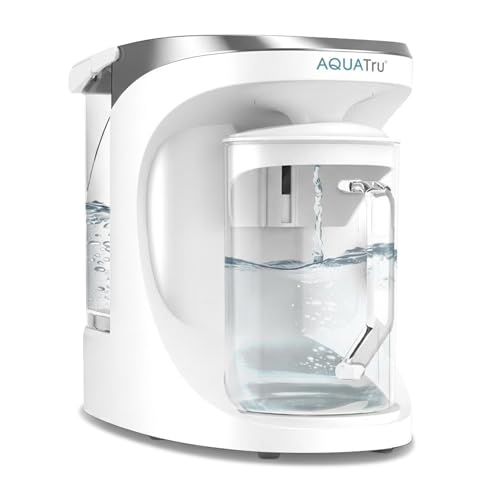
The best reverse osmosis system for well water is the AquaTru Carafe: certified by IAPMO R&T to NSF/ANSI 58 for arsenic V, nitrate/nitrite, radium 226/228, fluoride, lead, and TDS, with no plumbing. Under the sink, the Aquasana SmartFlow carries arsenic V and nitrate too.
The catch: Reverse osmosis isn’t recommended for treating bacteria, and AquaTru sets limits of 10 grains per gallon of hardness and under 0.1 mg/L of iron and manganese, so your well may need treatment before it.
Health information, not medical advice. Guidance differs for infants, pregnancy and existing conditions. Test your own water and speak to a doctor or your local health authority. We may earn a commission when you buy through our links; it never affects our scores.
What is the best reverse osmosis system for well water?
The AquaTru Carafe, certified by IAPMO R&T to NSF/ANSI 58 for the well contaminants reverse osmosis handles best: arsenic V, nitrate and nitrite, radium 226/228, fluoride, lead, and dissolved solids. It sits on the counter, so there’s nothing to plumb. If you want filtered water on tap, the Aquasana SmartFlow RO is certified by WQA for the same well-relevant list under the sink (lead under NSF/ANSI 53).
Reverse osmosis is a drinking-water filter, not a whole well system. It isn’t recommended for treating bacteria, and iron, manganese, hardness, and sediment foul its membrane. So test first, fix what the test shows at the point of entry, and use RO at the kitchen tap for the dissolved contaminants it removes.
What should you test your well for first?
Test for bacteria, nitrate, and arsenic at a minimum, plus whatever your health department flags locally. Private well owners are responsible for the safety of their water, and private wells aren’t regulated by the federal government under the Safe Drinking Water Act. The CDC recommends testing at least once a year for total coliform bacteria, nitrates, total dissolved solids, and pH, using a state-certified laboratory.
The CDC also says to test more often if there are problems with wells in your area, after flooding or nearby land disturbance, when you repair the well, when the water’s taste, color, or smell changes, or when someone in the home becomes pregnant or a child moves in. For arsenic, ask the lab for speciation: Maryland’s Department of the Environment notes that labs report total arsenic unless you ask for a specific method, and the form matters for RO, as the next sections explain.
What does reverse osmosis remove from well water?
Dissolved inorganic contaminants. Reverse osmosis effectively reduces ions and metals such as nitrate and arsenic, and household RO units also remove radium, fluoride, lead, and total dissolved solids. A certification tells you which of those a specific model has proven, so check the listing for each contaminant on your test.
| System | Arsenic | Nitrate/nitrite | Radium 226/228 | Fluoride | Lead | TDS |
|---|---|---|---|---|---|---|
| AquaTru CarafeIAPMO R&T | CertifiedArsenic V, NSF/ANSI 58 | CertifiedNSF/ANSI 58 | CertifiedNSF/ANSI 58 | CertifiedNSF/ANSI 58 | CertifiedNSF/ANSI 58 | CertifiedNSF/ANSI 58 |
| AquaTru ClassicIAPMO R&T | CertifiedArsenic V up to 50 ppb, NSF/ANSI 58 | CertifiedNSF/ANSI 58 | CertifiedNSF/ANSI 58 | CertifiedNSF/ANSI 58 | CertifiedNSF/ANSI 58 | CertifiedNSF/ANSI 58 |
| Waterdrop G3P800IAPMO R&T | No claim | No claim | CertifiedNSF/ANSI 58 | CertifiedNSF/ANSI 58 | CertifiedNSF/ANSI 58 | CertifiedNSF/ANSI 58 |
| APEC RO-90WQA | CertifiedArsenic V at 300 ppb, NSF/ANSI 58 | No claim | CertifiedNSF/ANSI 58 | CertifiedNSF/ANSI 58 | CertifiedNSF/ANSI 58 | CertifiedNSF/ANSI 58 |
| Aquasana SmartFlow ROWQA | CertifiedArsenic V at 50 ppb, NSF/ANSI 58 | CertifiedNSF/ANSI 58 | CertifiedNSF/ANSI 58 | CertifiedNSF/ANSI 58 | CertifiedNSF/ANSI 53 | CertifiedNSF/ANSI 58 |
| Culligan Aquasential ROWQA | CertifiedArsenic V, NSF/ANSI 58; arsenic III and V, NSF/ANSI 53 with Culligan’s AS3 cartridge | Certified on some modelsNSF/ANSI 58; see note | CertifiedNSF/ANSI 58 | CertifiedNSF/ANSI 58 | CertifiedNSF/ANSI 58 | CertifiedNSF/ANSI 58 |
IAPMO R&T file W-10194 (NSF/ANSI 58) lists the AquaTru Carafe (AT100 to AT140) and Classic (AT2000 to AT2050); file WC-13976 (NSF/ANSI 58) lists the Waterdrop WD-G3P800 under Qingdao Ecopure Filter Co. WQA’s NSF/ANSI 58 listings cover the APEC RO-90, the Aquasana AQ-SFRO and AQ-SFRO2 (lead under NSF/ANSI 53), and the Culligan International Aquasential models; WQA lists nitrate and nitrite only on the Aquasential RO, RO (2 yr), Smart RO Nitrate and Smart RO (2yr) Nitrate, not the plain Smart RO models; its Tankless models are certified for TDS only. The Aquasana and Culligan nitrate claims apply to water with no more than 27 mg/L nitrate and 3 mg/L nitrite, at 40 psi or more. AquaTru and Culligan say their radium claims use barium as a surrogate.
For reference, the EPA’s limits are 0.010 mg/L (10 ppb) for arsenic, 10 mg/L for nitrate measured as nitrogen, 4.0 mg/L for fluoride, and 5 pCi/L for combined radium 226 and 228. If nitrate is your main problem, see our best water filters for nitrates.
Does reverse osmosis remove arsenic III?
Not well. RO removes about 60 to 65% of arsenic III and 95 to 98% of arsenic V, and removal varies by manufacturer and with the water’s pH and mineral content. AquaTru’s Carafe data sheet says the same: RO systems don’t remove trivalent arsenic very well, and the Carafe won’t convert arsenic III to arsenic V. Every arsenic claim in our table covers arsenic V only, apart from Culligan’s, which WQA also certifies for arsenic III under NSF/ANSI 53 (Culligan fits its AS3 cartridge for this).
The fix is to oxidize arsenic III to arsenic V before the membrane. AquaTru and Culligan both say a free chlorine residual converts it rapidly, and AquaTru says chloramine isn’t enough. Their arsenic claims assume a detectable free chlorine residual at the inlet, so if your well isn’t chlorinated, get a speciation test first. Chlorine damages thin-film composite membranes, though, so have a water treatment professional design any pre-oxidation step. Culligan’s optional AS3 cartridge, installed after the membrane, is the one option here certified for arsenic III, by WQA under NSF/ANSI 53.
Does reverse osmosis kill bacteria in well water?
Don’t rely on it to: State and extension guidance advises against using RO alone to treat bacteria. Nebraska Extension says RO can remove microorganisms but isn’t recommended for that use, and that only coliform-free water should be fed to an RO system, because bacteria can deteriorate the membrane and contamination can get through pinhole leaks. AquaTru, Aquasana, APEC, and Culligan all warn against using their systems on water that is microbiologically unsafe or of unknown quality without adequate disinfection before or after the system.
WQA certifies the Aquasential RO tank models to NSF Protocol P231 for bacteria, viruses, and cysts; Culligan says this applies with its Advanced Post Tank Filter. That’s a point-of-use barrier at one tap, not a treatment for the whole well. If your test finds coliform bacteria, disinfect the whole supply. For UV, the certification is NSF/ANSI 55 Class A: ANSI describes Class A systems as designed to disinfect contaminated water at 40 mJ/cm², while Class B systems, at 16 mJ/cm², are for supplemental treatment of water a health agency already considers acceptable.
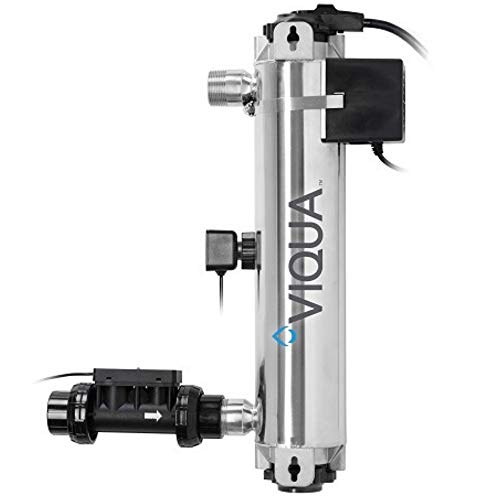
NSF International lists the Viqua PRO10 (lamp 602854, 10 gpm, point of entry) for Disinfection Performance, Class A under NSF/ANSI 55, current as of 12 October 2026.
Why do iron, manganese, and hardness matter for RO?
They foul or clog the membrane and shorten its life. Iron and manganese reduce RO efficiency, particles such as iron can clog the membrane and cut the flow, and a point-of-entry device may be needed to treat them. Sediment also fouls RO membranes, while softening relatively hard water first can increase membrane life.
Makers set their own limits. AquaTru’s Carafe data sheet calls for under 0.1 mg/L each of iron, manganese, and sulfide, no more than 10 grains per gallon of hardness (171 mg/L), and turbidity of 5 NTU or less. Culligan’s Aquasential guide allows up to 10 gpg of hardness and 1 mg/L of iron, and strongly recommends a softener above 10 gpg. APEC’s RO-90 manual says pre-filters on private wells may need changing sooner than every 12 months, and that overloaded pre-filters let sediment through to clog the membrane. Compare your test results with the limits for the exact model before you buy.
What pretreatment does a well need before reverse osmosis?
Whatever your test calls for, and on many wells that’s more than one system. Use this as a starting point, then size equipment to your results.
| If your test shows | Add before RO | Why |
|---|---|---|
| Sediment, cloudiness | Sediment filter | Sediment fouls the membrane |
| Iron, manganese | Iron filter at the point of entry | They reduce RO efficiency and clog the membrane |
| Hardness over 10 gpg | Water softener certified to NSF/ANSI 44 | Softening extends membrane life; AquaTru and Culligan set 10 gpg limits |
| Coliform bacteria | Disinfection, such as UV certified to NSF/ANSI 55 Class A | Feed RO only coliform-free water |
| Arsenic III | Pre-oxidation, or a cartridge certified for arsenic III | RO removes only 60 to 65% of arsenic III |
For iron, sulfur, and manganese equipment, see how to remove manganese from water and sulfur smell in well water. Our well water guide covers whole-house systems.
How do the RO systems compare?
Six reverse osmosis systems, ranked by our overall score. Each is certified to NSF/ANSI 58; check the table above for the well contaminants each one carries. How we score
| # | System | Score | Certified by | Lead | PFAS | Fluoride | Running cost | Price |
|---|---|---|---|---|---|---|---|---|
| 01 | AquaTru CarafeBest overall, no plumbingCountertop RO | 4.6 | IAPMO R&T | Certified | Certified | Certified | $0.33/gal | $356.25on Amazon › |
| 02 | AquaTru ClassicBigger countertop batchesCountertop RO | 4.5 | IAPMO R&T | Certified | Certified | Certified | $0.17/gal | $451.25on Amazon › |
| 03 | Waterdrop G3P800Tankless, no arsenic or nitrate claimUnder-sink RO | 4.3 | IAPMO R&T | Certified | Certified | Certified | About $160/yr | $849.00on Amazon › |
| 04 | APEC RO-90Arsenic V at 300 ppbUnder-sink RO | 4.2 | WQA | Certified | No | Certified | $60 to $75/yr | $219.16on Amazon › |
| 05 | Aquasana SmartFlow ROArsenic V and nitrate under the sinkUnder-sink RO | 4.1 | WQA | Certified | Certified | Certified | $0.49+/gal | $239.99on Amazon › |
| 06 | Culligan Aquasential RODealer-installed, arsenic III optionUnder-sink RO | 3.9 | WQA | Certified | Certified | Certified | Dealer-priced | Get a quoteat Culligan › |
Certified: Certified by an independent body (named in each pick). Lab test: Tested by a named independent lab, not certified. Claim: The maker's claim, not certified. No: No claim. PFAS means PFOA/PFOS, or Total PFAS where the pick says so.
Our six picks in detail
What each system is certified for, who certifies it, and who it suits.
AquaTru Carafe
One of the broadest certified claim lists we've seen, including fluoride and arsenic, with no plumbing. It needs an outlet and makes half a gallon at a time, and its filters work out to about $0.33 a gallon at AquaTru's prices.

AquaTru Classic
The same certified reverse osmosis claim list as the Carafe in a bigger countertop unit, about a gallon per batch. It needs a power outlet, and filters cost about $130 a year.
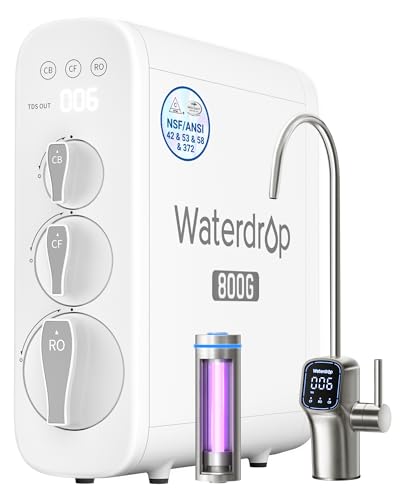
Waterdrop G3P800
Tankless reverse osmosis with certified lead, fluoride and PFOA/PFOS reduction from its own faucet. It needs a power outlet under the sink, and filters cost about $160 a year.

APEC RO-90
One of the broadest certified claim lists in under-sink RO, including lead, fluoride and arsenic V, and filters cost about $60 to $75 a year. No PFAS claim and no mineral stage.
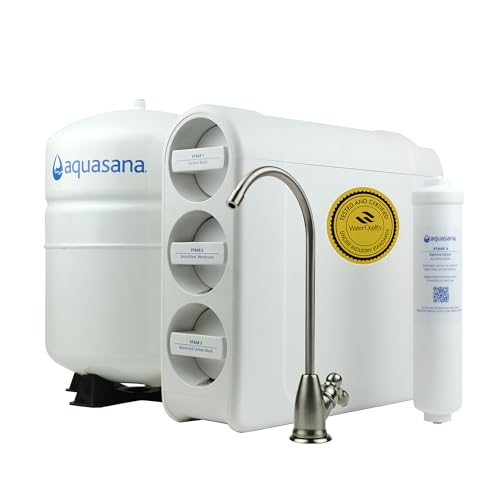
Aquasana SmartFlow RO
One of the most broadly certified under-sink RO systems we've checked, with minerals added back. The cost is the carbon blocks: $91.99 every 6 months or 250 gallons, plus the remineralizer and a yearly membrane.
Culligan Aquasential RO
One of the broadest certified claim lists we've seen, installed and serviced by a local dealer. There's no public price, and the claims depend on the configuration, so ask for the tank model with the Total Defense cartridge.
How do you choose an RO system for a well?
Start from your test results, then weigh where the system goes. These are the decisions that matter most on a well.
Match the listing to your test
Arsenic and nitrate are where the picks differ. The Waterdrop G3P800 has no arsenic or nitrate claim, and the APEC RO-90 has no nitrate claim.
Check your water pressure
Higher pressure across the membrane improves rejection. The Aquasana and Culligan nitrate claims apply only at 40 psi or more.
Countertop or under-sink
The AquaTru units need only an outlet. Under-sink systems need a faucet hole and a drain line. Compare them all in our reverse osmosis guide.
Think about the septic system
Under-sink RO sends reject water down the drain. The Connecticut DPH recommends keeping RO discharge to a septic system under 30 gallons a day.
Common questions
How much water does reverse osmosis waste on a well?
Often more than it makes. The Connecticut DPH says about 75% of the water entering a typical RO unit is discarded, and recommends keeping discharge to a septic system under 30 gallons a day. AquaTru rates the Carafe’s efficiency at 63%, meaning 63% of the water you put in comes out filtered.
How often do you change RO filters on well water?
Sooner than on city water. APEC’s RO-90 manual says pre-filters on a private well may need replacing before the usual 12 months, and puts membrane life on well water at 2 to 3 years, depending on water quality and pre-filter maintenance.
Do I need whole-house treatment or just RO?
Often both. RO is a point-of-use system for drinking and cooking water, certified for contaminants like arsenic V and nitrate. Bacteria, iron, manganese, and hardness may need point-of-entry treatment, such as UV, an iron filter, or a softener. See whole house vs point of use.
Can renters on a well use reverse osmosis?
Yes. The AquaTru Carafe and AquaTru Classic need no installation or plumbing, only a 120-volt outlet, and both are certified by IAPMO R&T to NSF/ANSI 58 for arsenic V and nitrate. Check their feed-water limits against your landlord’s latest well test.
Will reverse osmosis make high-nitrate well water safe for a baby?
Only within its certified range, so test the filtered water. The Aquasana SmartFlow and Culligan nitrate claims cover up to 27 mg/L nitrate and 3 mg/L nitrite. The EPA warns that infants under six months who drink water above its 10 mg/L limit could become seriously ill. Nebraska Extension gives an example where RO output still exceeded that limit.
Sources
- EPA: Private drinking water wells
- CDC: Guidelines for testing well water
- EPA: National primary drinking water regulations
- University of Nebraska-Lincoln Extension, G1490: Reverse osmosis
- Connecticut Department of Public Health: Reverse osmosis treatment of private drinking water systems
- Connecticut Department of Public Health: Arsenic in private well water (2024)
- Maryland Department of the Environment: Arsenic water treatment for individual wells
- ANSI: NSF/ANSI 55-2024, ultraviolet water treatment
- NSF International drinking water treatment unit listings: Standards index (NSF 44 cation exchange water softeners, NSF 55 UV)
- NSF International listings, NSF/ANSI 55 (Viqua PRO10)
- AquaTru Carafe performance data sheet
- Aquasana AQ-SFRO2 performance data sheet
- APEC RO-90 owner’s manual
- Culligan Aquasential RO and Smart RO owner’s guide
- IAPMO R&T product listing directory (AquaTru W-10194; Qingdao Ecopure WC-13976)
- WQA certified product listings (APEC Water Systems, Aquasana, Culligan International)
Prices as of October 14, 2026. Product prices and availability are accurate as of the date/time indicated and are subject to change. As an Amazon Associate we earn from qualifying purchases.