Health information, not medical advice. Guidance differs for infants, pregnancy, and existing conditions. Test your own water and speak to a doctor or your local health authority. We may earn a commission when you buy through our links; it never affects our scores.
The short answer
Manganese in drinking water is a natural metal found mostly in groundwater, so it’s mainly a private well issue. At low levels it causes black staining and a bitter taste; at higher levels, health agencies advise limits, especially for infants on formula. There’s no enforceable federal limit, only an EPA guideline and health advisory. Water softeners, oxidizing filters, and reverse osmosis can reduce it; boiling can’t.
Where does manganese in water come from?
Manganese dissolves into groundwater from rock and soil. The USGS found it above its 300 microgram per liter health benchmark in about 7 percent of domestic wells it sampled, affecting an estimated 2.6 million people, and notes it’s noticeable at concentrations as low as 50 micrograms per liter.
What are the signs of manganese in water?
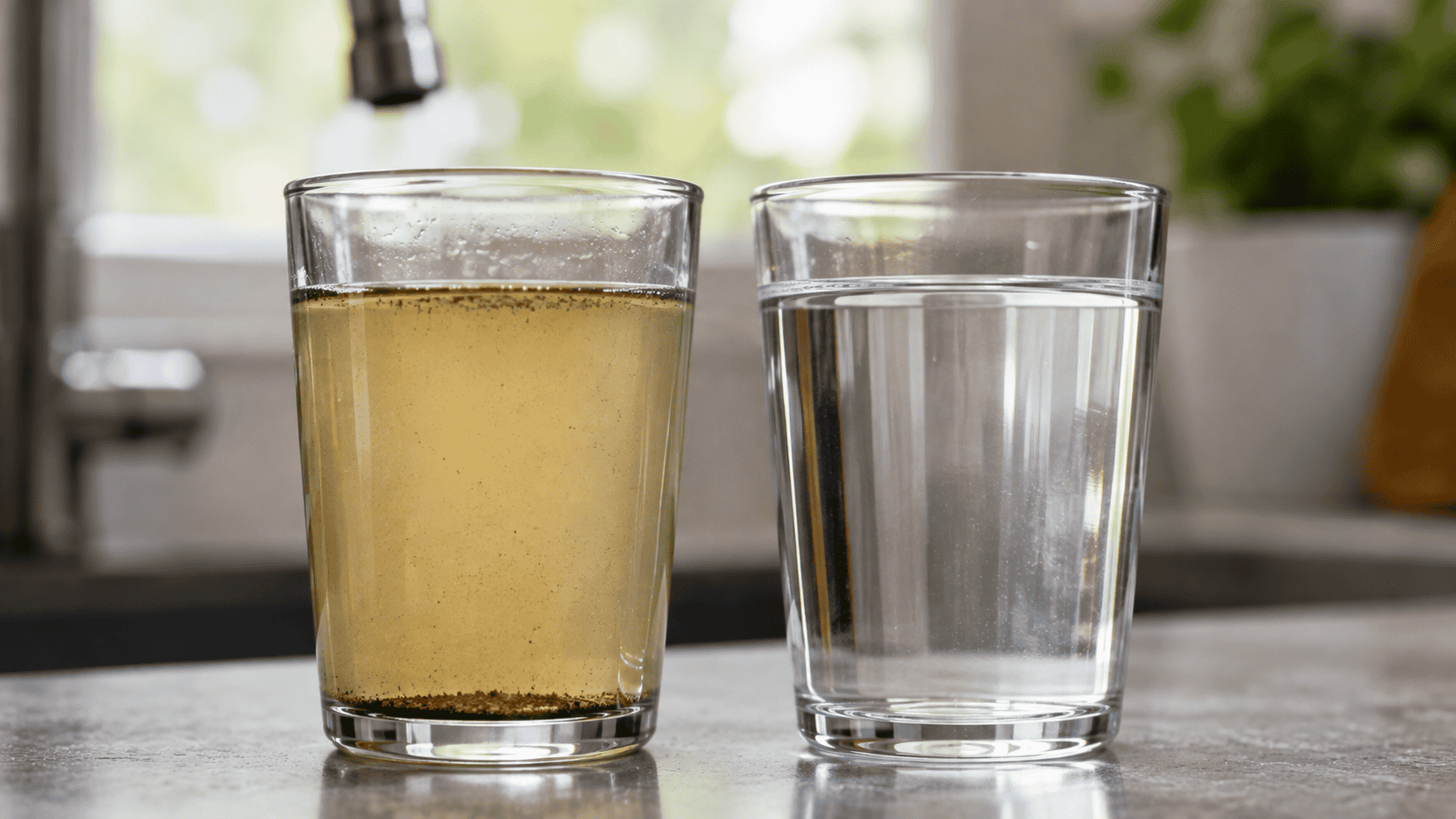
Black to brown color, black staining on fixtures and laundry, and a bitter metallic taste, the effects behind the EPA’s 0.05 mg/L guideline. The WHO notes complaints about discolored water can start above 0.02 mg/L.
Is manganese in water harmful?
Manganese is an essential nutrient, but too much can affect the nervous system. Infants younger than 12 months are potentially most susceptible, and formula made with tap water can be an important source of exposure for bottle-fed infants. A study of 362 Quebec children found that manganese at levels common in groundwater was associated with intellectual impairment. Minnesota says effects can include memory, attention, and motor skills.
What are the limits for manganese in drinking water?
Agencies disagree, partly because the evidence is still developing.
| Agency | Value | What it’s for |
|---|---|---|
| EPA | 0.05 mg/L | Staining and taste; not enforceable |
| EPA health advisory | 0.3 mg/L lifetime; 1 mg/L for 1 to 10 days | Neurological effects; for infants under 6 months, use 0.3 mg/L even short term |
| WHO | 0.08 mg/L | Provisional, set to protect bottle-fed infants |
| Health Canada | 0.12 mg/L (aesthetic 0.02 mg/L) | Maximum acceptable concentration, 2019 |
| Minnesota | 0.1 mg/L for infants; 0.3 mg/L for others | State health guidance |
How do you test for manganese?
Use a state-certified lab, especially on a private well, and test before preparing infant formula with well water. See our well water guide.

Tap Score Advanced Home Water Test
How do you remove manganese from water?
- Water softeners can reduce manganese, generally when the water pH is above 6.7.
- Oxidizing filters use chlorine, potassium permanganate, or hydrogen peroxide to turn dissolved manganese into particles that can be filtered.
- Reverse osmosis works at the tap.
- Carbon filters alone remove manganese poorly, and boiling won’t remove it and can concentrate it.
Certification for manganese is limited. NSF/ANSI 42 includes manganese as an aesthetic claim, not a health claim, and Health Canada noted in 2019 that no residential units were certified specifically for it. Check any manganese claim against the certifier’s listing. Step-by-step options are in how to remove manganese from water.
SpringWell WS
Common questions
Is manganese in well water dangerous?
At high levels it can be, especially for infants. The EPA advises 0.3 mg/L for infants under 6 months even short term, and Minnesota advises 0.1 mg/L for infants. Test your well with a certified lab.
Does boiling remove manganese?
No. Boiling won’t remove manganese, and prolonged boiling can concentrate it.
What causes black stains in my sink?
Often manganese, which causes black to brown staining at levels above the EPA’s 0.05 mg/L guideline.
Does a water softener remove manganese?
It can, in water with a pH above about 6.7. Have a water professional size it to your test results.
Is there an EPA limit for manganese?
Not an enforceable one. The EPA has a 0.05 mg/L secondary guideline for staining and taste and a 0.3 mg/L health advisory.
Sources
Prices as of November 1, 2026. Product prices and availability are accurate as of the date/time indicated and are subject to change. As an Amazon Associate we earn from qualifying purchases.