The short version
These two are not competing products, they answer different questions, and the deciding factor is whether your contaminant is volatile. Chlorine, chloramine and disinfection by-products reach you mostly through your skin and lungs in the shower, so a whole-house system genuinely lowers your total exposure. Lead, PFAS, fluoride, nitrate and arsenic only matter when you swallow them, and lead in particular enters the water after a whole-house filter, from your own pipes. The certification picture follows the same split: the standards cover both, but so few whole-house systems are independently certified for health claims that you usually cannot verify one. Most households that need treatment need a whole-house unit for the water they wash in and a certified point-of-use filter for the water they drink.
Skip to what we recommend ›What Each One Actually Is
A whole-house system, properly called point-of-entry or POE, is plumbed into the main line before water reaches any fixture. Every tap, shower, toilet, washing machine and outside hose runs through it. A point-of-use system, or POU, treats water at one place, almost always the kitchen sink, and everything else in the house is untouched.
The standards bodies define the category by flow rather than by position. NSF/ANSI 330, which the EPA works from, defines a point-of-entry system as one treating the supply at the entry of a building for drinking and for washing, flushing and other non-consumption use, with a minimum initial clean-system flow rate of at least 4 gallons per minute at 15 psig of pressure drop.
That four-gallon floor explains most of what follows. A point-of-use cartridge treats a few gallons a day at one tap, slowly, through a dense carbon block. A point-of-entry system has to keep a shower and a washing machine running at once. You cannot get point-of-use contact time at point-of-entry flow rates without a very large vessel, and that difference in contact time is why the two categories remove different things.
Is Your Contaminant Volatile?
This is the question that settles the argument, and almost nobody asks it. Some contaminants leave the water and reach you through your skin and your lungs. The rest only reach you if you swallow them.
Chloroform and the other trihalomethanes, the disinfection by-products formed when chlorine meets organic matter, are volatile and skin-permeable. Studies measuring blood and breath concentrations before and after controlled household activities consistently find that showering and bathing raise blood THM levels sharply, while drinking a litre of the same water produces only a small increase. The World Health Organization notes that chloroform is readily absorbed through skin, that hydration of the skin accelerates it, and that tissues outside the liver receive a higher dose from the inhaled and dermal routes than from the ingested one.
That is a genuine argument for whole-house treatment, and it is the strongest one there is. It does not transfer to anything else. Lead, PFAS, fluoride, nitrate and arsenic are non-volatile dissolved solids. They do not evaporate in a hot shower and they are not absorbed through intact skin in meaningful amounts. For those, the only exposure route that matters is the glass.
| Contaminant | Main exposure route | Right tool |
|---|---|---|
| Chlorine & chloramine | Skin, lungs, taste | Whole-house |
| Trihalomethanes (DBPs) | Shower and bath | Whole-house |
| Sediment, iron, manganese, sulfur | Every fixture | Whole-house |
| Hardness and scale | Pipes and appliances | Whole-house |
| Lead | Drinking, from your own pipes | Point-of-use only |
| PFAS | Drinking | Point-of-use |
| Fluoride, nitrate, arsenic | Drinking | Point-of-use |
| Microplastics | Drinking | Point-of-use |
A whole-house filter cannot protect you from lead. Lead almost never arrives in the water your utility sends out. It dissolves out of the lead service line, the solder and the brass fixtures between the water main and your tap, which is downstream of where a point-of-entry system sits. A whole-house unit is physically upstream of the problem. Our lead guide covers the testing and the certified point-of-use options.
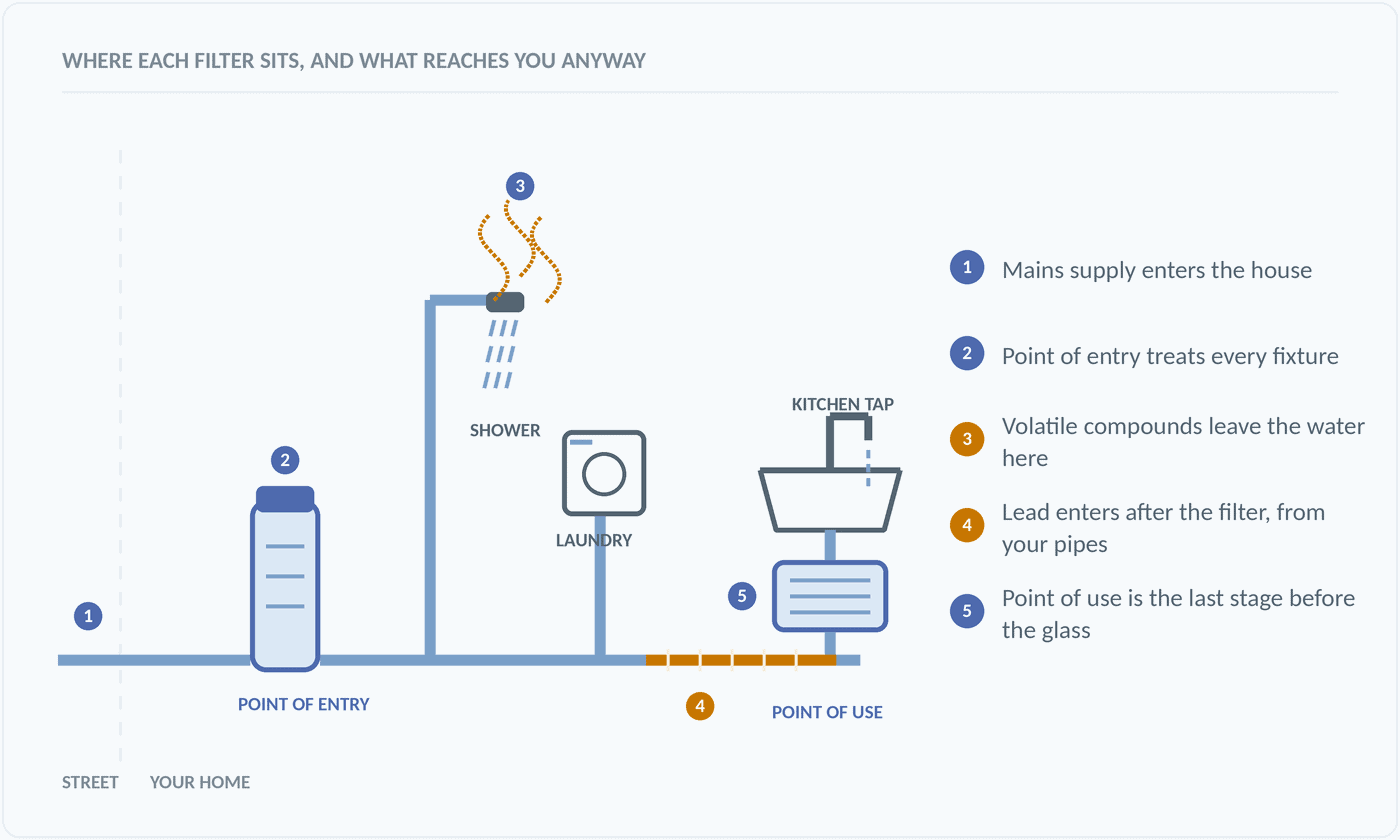
The two things a whole-house filter cannot reach: what leaves the water at the shower, and what the pipes add after the filter.
Why Almost No Whole-House System Is Certified for Health Claims
Here is something that surprises people, including some of the people selling these systems. The standards do not exclude whole-house units. NSF/ANSI 42 for aesthetic effects, NSF/ANSI 53 for health effects and NSF/ANSI 401 for emerging contaminants all explicitly cover point-of-entry as well as point-of-use systems. There is no technical bar.
The bar is economic. The Water Quality Association has explained it plainly: every contaminant a company wants certified has to be tested individually, and because point-of-entry systems carry very high capacity claims, the cost of that testing becomes prohibitive against the number of units the company expects to sell. Point-of-use filters sell in far greater volume, so the certification cost is recovered. Whole-house systems do not, so the claims stay uncertified.
Two things follow, and you need both of them.
- An uncertified whole-house system is not necessarily a bad one. The absence of a listing is usually a commercial decision, not a failed test. Treat it as unverified rather than as disproved.
- You still cannot verify the claim. “Removes 97% of chlorine for 1,000,000 gallons” with no certification behind it is a manufacturer’s number, tested by the manufacturer, with no independent check on either the percentage or the capacity. On a $1,500 purchase that is a lot to take on trust.
Certified point-of-entry systems do exist, and the claims tend to cluster in a narrow band. The WQA has certified POE devices for chlorine, iron, manganese, hydrogen sulfide, VOCs and total trihalomethanes under NSF/ANSI 42 and 53 and its own S-200 standard. Water softeners are covered separately under NSF/ANSI 44, and whole-house UV under NSF/ANSI 55. If a whole-house system you are considering holds any of those, that is meaningful and worth paying for.
One detail worth knowing if chlorine is your reason for buying. Under Standard 42, chlorine reduction is graded: Class I means 75% reduction or better, Class II means 50 to 74%, and Class III means 25 to 49%. A system certified for chlorine reduction at Class III is certified, and is also removing less than half of it. Our guide to reading water filter certifications covers how to check a listing rather than a box.
Where a Whole-House System Genuinely Earns Its Money
Set the health-claim argument aside and there are four jobs a point-of-use filter simply cannot do, because it only treats one tap.
- Chlorine and chloramine across every fixture. This is the shower exposure argument above, plus the practical benefits: less chlorine smell, less dryness for skin and hair, and no bleaching of laundry.
- Sediment, iron, manganese and sulfur. On well water these cause staining, smell and abrasion at every fixture, and a point-of-use filter at the kitchen does nothing for the bathroom or the washing machine.
- Hardness and scale. Scale damages water heaters, dishwashers and boilers, which is a plumbing problem rather than a drinking problem, and it has to be solved before the water splits off to the appliances. See our hard water guide.
- Protecting the point-of-use filter itself. Sediment and chlorine shorten the life of an RO membrane. A whole-house prefilter can pay for part of itself in cartridge life downstream.
Of our reviewed systems, the Aquasana Rhino EQ-1000 and the SpringWell CF1 cover the municipal chlorine and chloramine case, and the SpringWell softener handles scale, though it is a salt-free conditioner that prevents scale rather than removing hardness.
Where Point-of-Use Is the Only Answer
Everything you drink. Point-of-use is where the certified contaminant claims live, where reverse osmosis is practical, and where the contact time exists to do fine work on dissolved contaminants.
Reverse osmosis is the clearest example. An RO membrane needs pressure and time and produces a few gallons a day into a tank, which is exactly the wrong shape for treating a whole house. Under NSF/ANSI 58, TDS reduction is mandatory for every certified RO system and the other claims are optional and model-specific, which is why you check the listing rather than the category. That is how fluoride, nitrate, arsenic and total PFAS get removed with evidence behind them. Our reverse osmosis roundup covers the field, and the PFAS guide explains which certifications actually cover forever chemicals.
It is also cheaper by a wide margin, because you are treating the two or three gallons a day you actually drink rather than the 300 you flush, wash and water the garden with.
Most Households Need Both, In a Specific Order
The two systems are complements, and the sequence matters. Water enters the house, passes through the point-of-entry system, then reaches the kitchen where the point-of-use system does the fine work on what remains.
How to decide what you need:
- On municipal water with no specific contaminant problem, start with point-of-use. A certified filter at the kitchen tap addresses the water you drink for a fraction of the cost, and it is the only half with certified health claims behind it.
- On municipal water where the chlorine is strong, or where skin and hair are the complaint, add whole-house carbon. This is the case where the shower exposure evidence does real work.
- On well water, whole-house first and almost always. Sediment, iron, manganese and bacteria are house-wide problems, and an untreated well can foul a point-of-use system quickly. Test before you buy anything.
- With hard water, a softener or conditioner is a separate purchase from a filter, solving a plumbing problem rather than a drinking one.
If you can only buy one, buy the point-of-use filter. It costs a tenth as much, it is where the certified claims are, and it covers the exposure route that carries the contaminants with the clearest health evidence behind them. Whole-house is the upgrade, not the foundation. Compare the certified options in our best home water filters roundup.
Sizing and Pressure, Where Most Whole-House Purchases Fail
Contaminant claims are what people compare and flow rate is what they regret. A system rated below your household’s peak demand produces a noticeable pressure drop when a shower and an appliance run at once, and no amount of filtration quality fixes that.
Work from the 4 gallons per minute at 15 psig that defines the category as an absolute floor, not a target. A single shower draws roughly 2 gpm, so a three-bathroom house needs considerably more headroom than a one-bathroom apartment. Check the manufacturer’s stated service flow rate and the pressure drop at that rate, not just the tank size.
There is also no federal efficiency specification to lean on. The EPA’s WaterSense specification released in November 2024 covers point-of-use systems only, by explicit choice, so whole-house efficiency claims are unregulated and unstandardised. Filter life is the other figure to interrogate: divide the cartridge or media price by the stated capacity and you have the real running cost, the same arithmetic that exposes pricing at the tap. Our guide to how often to change a water filter covers the capacity question in more detail.
What We Recommend
One whole-house system for the water you wash in, and a certified point-of-use filter for the water you drink. If the budget only covers one, it is the second one.
When you buy through the links below we may earn a commission, at no extra cost to you. It never affects our rankings, see our affiliate disclosure.
APEC ROES-50
AquaTru Carafe
SpringWell CF1
The APEC ROES-50 is the point-of-use starting point because it is certified as a finished system rather than by component, though the Gold Seal covers TDS reduction rather than a named contaminant list. If you rent or cannot plumb anything in, the AquaTru Carafe carries the broader certified list and needs no install at all. On the whole-house side, the SpringWell CF1 and the Aquasana Rhino EQ-1000 both target the chlorine and chloramine case that the shower exposure evidence supports.
Frequently Asked Questions
Do I need a whole-house filter if I already have one under the sink?
Only if your reason is something you wash in rather than drink. An under-sink filter already handles the drinking water, and that is where lead, PFAS, fluoride and nitrate matter. Add whole-house if chlorine smell, skin and hair dryness, sediment, iron or scale are the problem, since none of those are solved at one tap.
Will a whole-house filter remove lead?
No, and this is the most expensive misunderstanding in the category. Lead is picked up from the service line, solder and brass fixtures inside your own plumbing, which sit downstream of a point-of-entry system. Filtering at the main line cannot catch something that gets in afterwards. Use a certified point-of-use filter at the kitchen tap.
Why are so few whole-house systems NSF certified?
Not because the standards exclude them. Standards 42, 53 and 401 all cover point-of-entry systems. The Water Quality Association has explained that each contaminant claim must be tested individually, and for the very high capacity claims whole-house systems carry, that testing costs more than the manufacturer expects to recover in sales. So the claims go untested rather than failing a test, which means you cannot verify them either way.
Is the shower chlorine argument real or marketing?
Real, for volatile compounds specifically. Controlled studies measuring blood and breath find that showering and bathing raise trihalomethane levels considerably more than drinking a litre of the same water, and the WHO notes that chloroform is readily absorbed through hydrated skin. It does not extend to lead, PFAS, fluoride or nitrate, which are non-volatile and are not absorbed through skin in meaningful amounts.
Which should I buy first?
Point-of-use, unless you are on a well. It costs a fraction as much, it is where the certified health claims are, and it treats the water you actually swallow. The exception is untreated well water, where sediment, iron and bacteria are house-wide problems and can foul a point-of-use system quickly.
Does a water softener filter my water?
No. A softener exchanges calcium and magnesium for sodium or potassium to stop scale forming, which protects pipes, water heaters and appliances. It is not a filter and removes no contaminants of health concern. Softeners are certified under their own standard, NSF/ANSI 44, and are a separate purchase from filtration.
Sources
- NSF International, Standards for Water Treatment Systems, scope of 42, 53, 44, 55, 58, 62 and 401 across point-of-use and point-of-entry
- World Health Organization, Trihalomethanes in Drinking-water, dermal absorption and exposure routes
- Influence of Tap Water Quality and Household Water Use Activities on Indoor Air and Internal Dose Levels of Trihalomethanes, Environmental Health Perspectives
- California OEHHA, Public Health Goals for Trihalomethanes in Drinking Water
- Water Quality Association response on point-of-entry certification economics and certified POE claim types