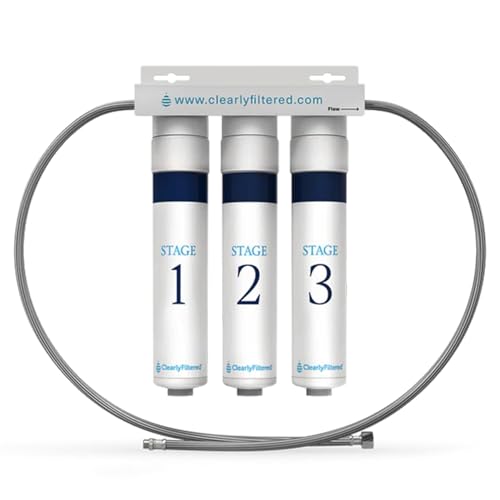
It connects to the cold-water line and filters through your existing faucet, keeps minerals and wastes no water. In lab tests it cut lead, PFAS, fluoride and arsenic by 90% or more.
The catch: Only its chlorine claim is certified, by WQA. The rest are lab results, and filters cost about $455 a set.
Health information, not medical advice. Guidance differs for infants, pregnancy and existing conditions. Test your own water and speak to a doctor or your local health authority. We may earn a commission when you buy through our links; it never affects our scores.
Our verdict
The Clearly Filtered 3-Stage Under Sink puts the brand’s Affinity filtration on your cold-water line. There’s no separate faucet, no drilling and no tank: water runs through three cartridges and out of the faucet you already have. Clearly Filtered says it takes under 10 minutes to install with a wrench.
Its lab results are broad. QFT, the lab now operating as IAPMO New Jersey, tested it over 2,000 gallons and found lead down more than 99%, PFOA and PFOS more than 99.6%, fluoride more than 90%, arsenic 94%, chromium-6 more than 99% and most pharmaceuticals tested above 90%. Because it isn’t reverse osmosis, it keeps calcium and magnesium.
What’s certified is narrower. WQA certifies it to NSF/ANSI 42 for chlorine, taste and odor at 2,000 gallons. The health-effects results are from that lab testing, not a certification, so we give them half credit. The filter set costs $455 (or $409.50 on subscription), about $0.23 a gallon, and because it filters all the cold water from your kitchen faucet, washing-up water counts toward the 2,000 gallons too. Our NSF certification guide explains how to check a certifier’s listing yourself.
You want broad filtration at the kitchen tap with no drilling, no tank and no wastewater, and you’re comfortable with lab-tested rather than certified health claims.
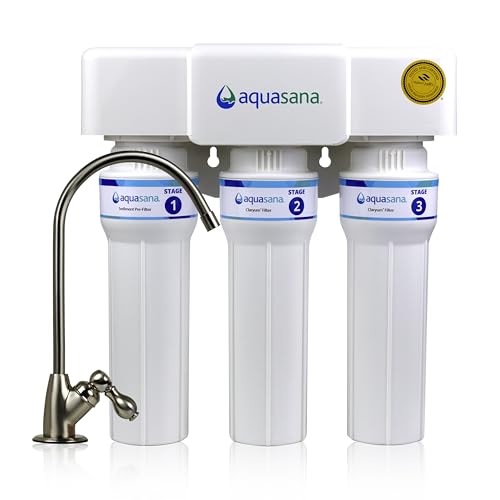
You want certified lead and PFAS reduction for less. The Aquasana Claryum Max Flow is certified by WQA for both, with filters at about $0.11 a gallon.
How it scored
Contaminant reduction carries the most weight in the overall score. How we score filters
What it removes
Chlorine is certified by WQA. Every other figure is from Clearly Filtered’s published lab results, which report the maximum removal seen.
| Contaminant | Reduction | Basis |
|---|---|---|
| Chlorine, taste and odor | >98.6% | Certified, NSF/ANSI 42 |
| Lead | >99.3% | Lab test |
| PFOA / PFOSplus 7 other PFAS | >99.6% / >99.8% | Lab test |
| Fluoride | >90.6% | Lab test |
| Arsenic | 94.3% | Lab test |
| Chromium-6, copper, cadmium, mercury | 91.8–99.9% | Lab test |
| Chloramine | >95.3% | Lab test |
| Pharmaceuticals23 compounds | 79–99% | Lab test |
| Nitrate, bacteria, viruses | – | No result listed |
WQA’s NSF/ANSI 42 listing for Clearly Filtered, seen on 7 October 2026, covers the under-sink filter (replacement “Under Sink Filter – R”) at 2,000 gallons for chlorine, taste and odor. Lab testing was completed on 17 April 2018 by QFT, now IAPMO New Jersey, on element CF-UTSF over 2,000 gallons. Testosterone (79%) was the lowest pharmaceutical result. We found no Clearly Filtered listing at IAPMO R&T, and NSF International lists only the pitcher. The system is meant for treated city water.
What it costs to run
A replacement set costs $455, or $409.50 on Clearly Filtered’s subscription, and is rated for 2,000 gallons: about $0.23 a gallon. Clearly Filtered offers delivery every 9, 12 or 15 months. There’s no filter-life indicator, so you track it yourself.
Pros and cons
Strengths
- Uses your existing faucet; no drilling or tank
- Keeps minerals and wastes no water
- Lab results over 99% for lead and PFOA/PFOS
- Limited lifetime warranty (Clearly Filtered)
What to know
- Only chlorine is certified
- Filters cost about $455 a set
- Cold-water flow drops 25% to 35%
- All cold water at the tap uses up filter capacity
What owners say
Owners like the taste and the easy install. The common complaints are filter prices and lower water pressure.
Often praised
- Clean taste with minerals kept
- Quick install with no drilling
- Filtered water from the normal faucet
Common complaints
- Expensive replacement filters
- Weaker flow than before
- No reminder when filters are due
Recurring themes across verified buyer reviews.
Specifications
- Type
- Under-sink inline filter, 3 stages
- Faucet
- Uses your existing faucet
- Certifier
- WQA
- Certified to
- NSF/ANSI 42 (chlorine, taste and odor)
- Certified capacity
- 2,000 gal
- Lab testing
- QFT, now IAPMO New Jersey (2018)
- Fittings
- 3/8-inch cold-water line
- Warranty
- Limited lifetime (Clearly Filtered)
Alternatives worth considering
Aquasana Claryum Max Flow
Aquasana SmartFlow RO
Clearly Filtered Pitcher
Common questions
Is the Clearly Filtered under-sink certified?
Yes, but only for chlorine, taste and odor: WQA certifies it to NSF/ANSI 42 at 2,000 gallons. Its lead, PFAS, fluoride and arsenic figures come from QFT (now IAPMO New Jersey) lab testing.
Does it remove fluoride?
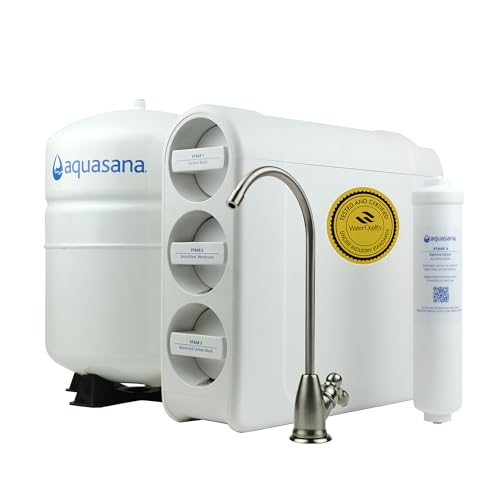
In lab testing it cut fluoride by more than 90%, but that result isn’t certified. For certified fluoride reduction, look at reverse osmosis such as the Aquasana SmartFlow. See our fluoride guide.
Does it remove PFAS?
Lab tests showed more than 99.6% for PFOA and PFOS and similar results for seven other PFAS. None is certified. See our PFAS guide.
Do I need a separate faucet?
No. It connects to the 3/8-inch cold-water line and filters through your existing faucet.
Is it better than the Clearly Filtered pitcher?
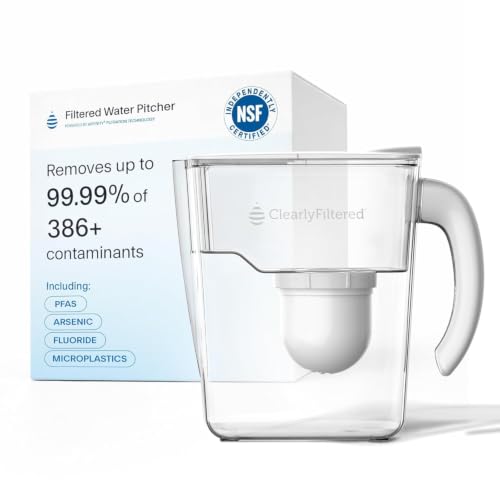
It uses the same Affinity filtration with water on tap instead of a slow pour. It costs much more to buy and run. See our pitcher review.
The bottom line
Buy the Clearly Filtered Under Sink if you want broad filtration through your own faucet, with no drilling, tank or wastewater, and you’re happy relying on lab results for everything but chlorine. If you want certified lead and PFOA/PFOS reduction for less, the Aquasana Claryum Max Flow costs far less to run. Compare them all in our under-sink filter guide.
- Certifier listings: WQA, Clearly Filtered, Inc., NSF/ANSI 42: "Affinity Filtration - Under Sink Filter", replacement "Under Sink Filter - R", 2,000 gal, chlorine, taste and odor. Also NSF/ANSI/CAN 372 (pitcher).
- Also searched: IAPMO R&T (Clearly Filtered): no listing. NSF International: pitcher only, NSF/ANSI 42.
- Maker documents: Clearly Filtered under-sink performance data page (QFT, now IAPMO New Jersey, completed 17 April 2018, 2,000 gallons, element CF-UTSF), product and replacement filter pages.
- Independent lab tests: QFT (now IAPMO New Jersey), credited at half points per our rubric.
Sources
Prices as of October 14, 2026. Product prices and availability are accurate as of the date/time indicated and are subject to change. As an Amazon Associate we earn from qualifying purchases.