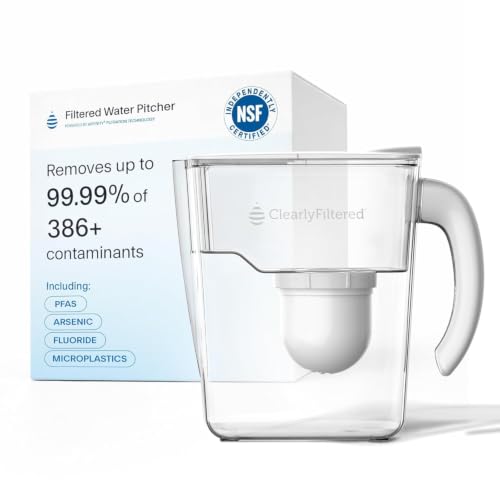
Lab tests show it reducing fluoride, lead, PFOA/PFOS and arsenic by 98% or more. Only its chlorine claim is certified, by NSF International and WQA.
The catch: It pours slowly and costs $0.50 to $0.65 a gallon in filters.
Health information, not medical advice. Guidance differs for infants, pregnancy and existing conditions. Test your own water and speak to a doctor or your local health authority. We may earn a commission when you buy through our links; it never affects our scores.
Our verdict
The Clearly Filtered pitcher publishes a long list of lab results. In testing by IAPMO New Jersey (formerly QFT), an ISO 17025 lab, its filter cut fluoride by more than 99.5%, lead by 99.3%, PFOA by 99.6%, PFOS by more than 99.8% and arsenic by 98%. Clearly Filtered says it targets more than 386 contaminants.
The catch is certification. NSF International and WQA both certify the pitcher to NSF/ANSI 42, for chlorine and taste and odor, and to NSF/ANSI/CAN 372 for lead-free materials. Everything else is lab-tested, not certified. Clearly Filtered says it is pursuing NSF/ANSI 53 and 401 certification, but neither has been granted. If you want certified fluoride reduction from a pitcher, the Culligan ZeroWater has it. The Clearly Filtered also pours slowly and is expensive to run. Our NSF certification guide explains how to check a certifier’s listing yourself.
You want a long list of lab-tested reductions from a pitcher, lab-tested results are enough for you, and you can live with a slow pour.
You want certified lead, PFAS or fluoride reduction, or you need a full pitcher quickly.
How it scored
Contaminant reduction carries the most weight in the overall score. How we score filters
What it removes
Only the first row is certified. The rest are Clearly Filtered’s published lab results, which we list so you can see them, labelled for what they are.
| Contaminant | Reduction | Verification |
|---|---|---|
| ChlorineNSF/ANSI 42 | 98.2% | Certified by NSF International and WQA |
| Fluoride | >99.5% | Lab-tested only |
| Lead | 99.3% | Lab-tested only |
| PFOA / PFOS | 99.6% / >99.8% | Lab-tested only |
| Arsenic | 98.0% | Lab-tested only |
| Microplastics | >99.99% | Lab-tested only |
| Chromium-6, nitrate | 99.7% / >99.9% | Lab-tested only |
Lab results are from IAPMO New Jersey (formerly QFT), an independent ISO 17025 laboratory. Clearly Filtered reports the maximum reduction it measured, and says some contaminants had no NSF/ANSI test protocol when they were tested. Lab testing is not certification: a certifier also audits the factory and retests over time. The certified chlorine figure (98.2%) and the lab result (>99.5%) come from different tests.
What it costs to run
Each filter is rated for 100 gallons, which Clearly Filtered says is about every 3 to 4 months for most households. At clearlyfiltered.com prices, a single filter is $65 ($0.65 a gallon), a 3-pack is $180 ($0.60) and a 6-pack is $335 (about $0.56). A filter subscription brings that down to about $0.50 to $0.59 a gallon.
Pros and cons
Strengths
- Long list of published lab results
- Lab-tested for fluoride, arsenic and PFOA/PFOS
- 100-gallon filter life
- Made in the US from Tritan, free of BPA and BPS
What to know
- Only chlorine is certified; the health claims are lab-tested
- Slow: 5 to 35 minutes to empty the upper reservoir
- Filters cost $0.50 to $0.65 a gallon
- Expensive pitcher next to Brita or PUR
What owners say
Owners like the taste and the long list of what it reduces. The complaints are about speed and the price of filters.
Often praised
- Clean taste
- Confidence in the broad reduction list
- Solid, well-made pitcher
Common complaints
- Slow filtering
- Expensive replacement filters
- Fiddly spout flap
Recurring themes across verified buyer reviews.
Specifications
- Model
- Filtered Water Pitcher (P-V3), filter P-RF
- Capacity
- 10 cups (80 oz)
- Filter life
- 100 gal, about 3 to 4 months
- Certifiers
- NSF International, WQA
- Certified to
- NSF/ANSI 42 (chlorine), NSF/ANSI/CAN 372
- Lab-tested by
- IAPMO New Jersey (formerly QFT)
- Fill time
- 5 to 35 minutes per upper reservoir
- Replacement filters
- $65 single, $180 3-pack at clearlyfiltered.com
Alternatives worth considering
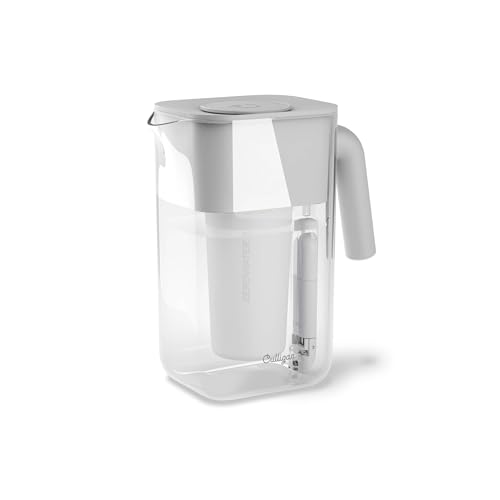
Culligan ZeroWater

PUR PLUS Pitcher
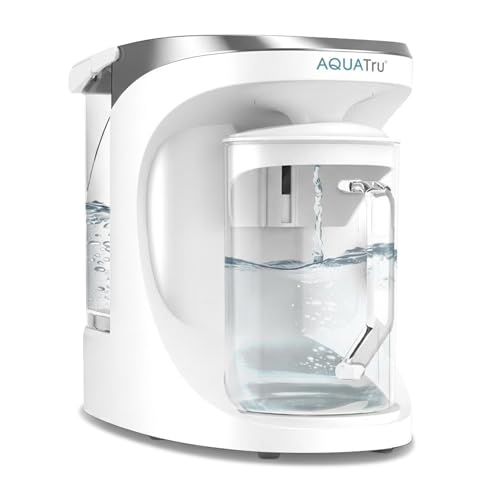
AquaTru Carafe
Common questions
Is the Clearly Filtered pitcher certified?
Partly. NSF International and WQA both certify it to NSF/ANSI 42 for chlorine and taste and odor, and to NSF/ANSI/CAN 372 for lead-free materials. Its fluoride, lead, PFAS and arsenic results are lab-tested by IAPMO New Jersey, not certified. Clearly Filtered says it is pursuing NSF/ANSI 53 and 401 certification.
Does it remove fluoride?
In Clearly Filtered’s lab testing it reduced fluoride by more than 99.5%, but that result isn’t certified. For certified fluoride reduction from a pitcher, see the Culligan ZeroWater, or step up to reverse osmosis. See our fluoride guide.
Why is it so slow?
The dense filter media that captures so much also slows the water. Clearly Filtered says a working filter takes 5 to 35 minutes to pass a full upper reservoir, and that a new filter taking longer may need more priming.
How often do I change the filter?
Every 100 gallons. Clearly Filtered puts that at about every 3 to 4 months for most households: sooner for three or more people, later for one.
The bottom line
Buy the Clearly Filtered pitcher if you want a long list of lab-tested reductions in a pitcher and you’re comfortable that, apart from chlorine, those results aren’t certified. If certification matters, the PUR PLUS is certified for lead and Total PFAS and costs far less to run, and the Culligan ZeroWater for fluoride. Compare them in our best water filter pitchers guide.
Sources
- NSF International listing for Clearly Filtered
- WQA certified product listings (search “Clearly Filtered”)
- Clearly Filtered performance data sheet (NSF/ANSI 42)
- Clearly Filtered pitcher lab results
- Clearly Filtered: are your products certified?
- Pitcher filter instructions
- Clearly Filtered replacement filters
Prices as of October 14, 2026. Product prices and availability are accurate as of the date/time indicated and are subject to change. As an Amazon Associate we earn from qualifying purchases.