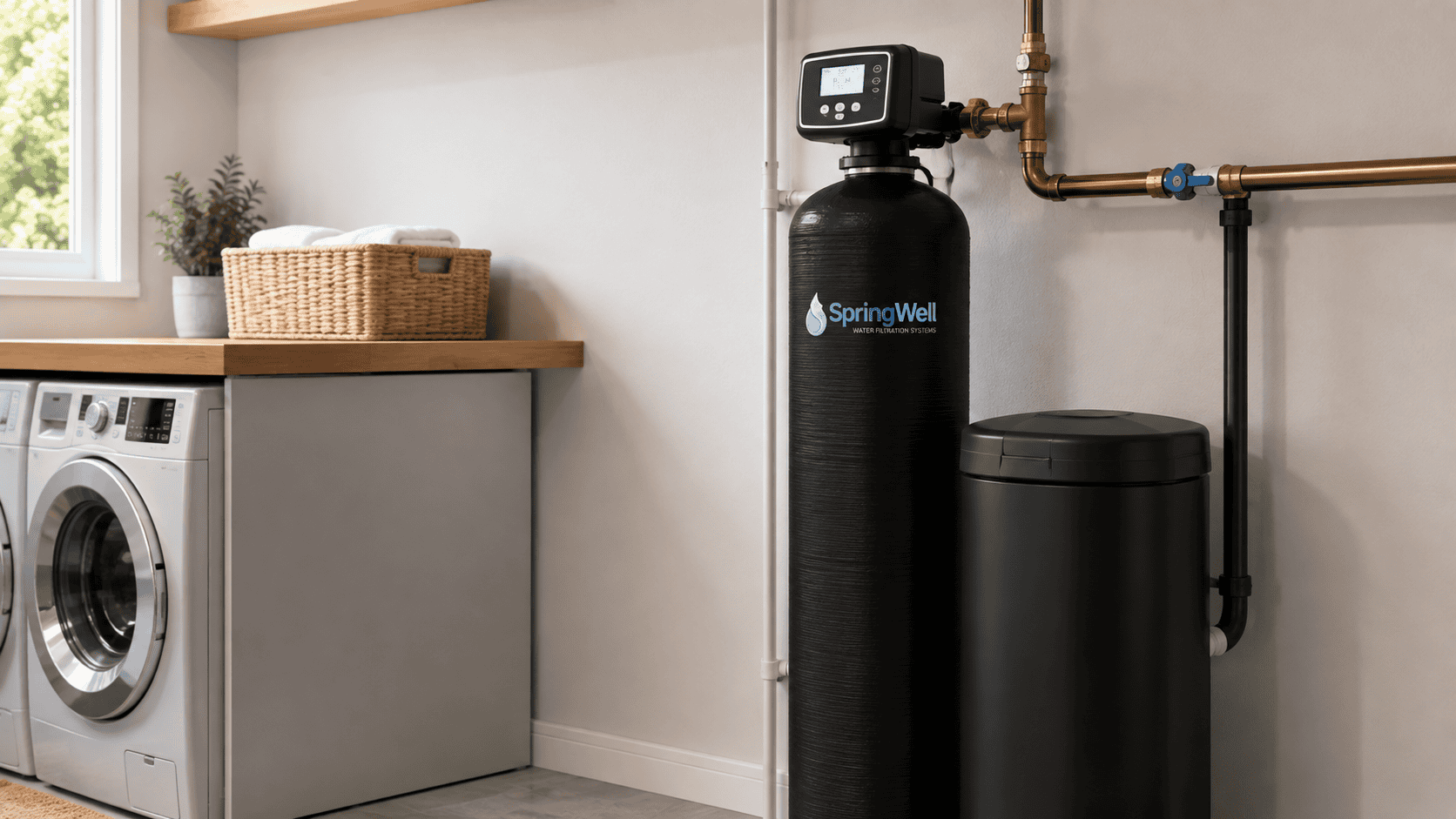
A template-assisted crystallization conditioner with no salt, no power and no drain, rated for hardness up to 81 grains per gallon. SpringWell says it prevents up to 95% of scale.
The catch: It conditions rather than softens, and no certifier we checked has verified its scale claim.
Health information, not medical advice. Guidance differs for infants, pregnancy and existing conditions. Test your own water and speak to a doctor or your local health authority. We may earn a commission when you buy through our links; it never affects our scores.
Our verdict
The SpringWell FutureSoft is a salt-free water conditioner, not a softener. A salt softener removes calcium and magnesium. FutureSoft uses template-assisted crystallization (TAC), which turns those minerals into tiny crystals that stay in the water instead of forming scale. Your hardness reading doesn’t change, and you won’t get the slippery feel of softened water. What it aims to do is stop scale building up in pipes, water heaters and fixtures.
It needs no salt, no electricity and no drain line, and it doesn’t backwash, so it wastes no water. SpringWell says it prevents up to 95% of scale buildup, but it doesn’t say where that figure comes from, and NSF International, WQA and IAPMO R&T don’t list FutureSoft. That’s why it scores at our floor for treatment performance. It also has limits: SpringWell says it can’t handle iron, manganese, hydrogen sulfide, oils or copper above 1.3 mg/L, and it needs a pH of 7.0 to 9.5. Our NSF certification guide explains how to check a certifier’s listing yourself.
You’re on city water, want less scale without salt or wastewater, and are fine with water that still tests hard.
You want truly soft water, or you’re on a well with iron, manganese or sulfur.
How it scored
Contaminant reduction carries the most weight in the overall score. How we score filters
Treatment performance sits at our 1.5 floor because no certifier lists the FutureSoft. How we checked · How we score
What it does
Nothing below is certified. The scale figure is SpringWell’s claim.
| What you want | FutureSoft | Notes |
|---|---|---|
| Less scale in pipes and appliances | Up to 95% (claim) | SpringWell claim, source not given |
| No salt, power or wastewater | Yes | Design feature |
| Soft water feel, no spots | No | Conditions, doesn’t soften |
| Chlorine, lead, PFAS | No | Not a filter |
| Iron, manganese, sulfur | Can’t handle them | Treat them first |
Pros and cons
Strengths
- No salt, electricity, drain or wastewater
- 12 to 20 gpm depending on model
- Rated for hardness up to 81 grains per gallon
- Lifetime warranty against defects
What to know
- Scale claim isn’t certified or sourced
- Doesn’t soften: no soft-water feel
- Doesn’t filter anything
- Not for water with iron, manganese or sulfur
What owners say
Owners who bought it to cut scale without salt are mostly happy. The disappointed reviews come from people who expected softened water.
Often praised
- Less crust on fixtures over time
- No salt to buy or carry
- No drop in pressure
Common complaints
- Water still feels hard and glasses still spot
- High upfront cost
- Weaker results on very hard water
Recurring themes across verified buyer reviews.
Specifications
- Models
- FS1, FS4, FS+
- Sized for
- 1 to 3, 4 to 6, 7+ bathrooms
- Flow rate
- 12, 15, 20 gpm
- Technology
- Template-assisted crystallization
- Max hardness
- 81 grains per gallon
- Water limits
- pH 7.0 to 9.5; chlorine up to 3 ppm; no iron, manganese, sulfur
- Certification
- None for scale
- Warranty
- Lifetime against defects
Alternatives worth considering
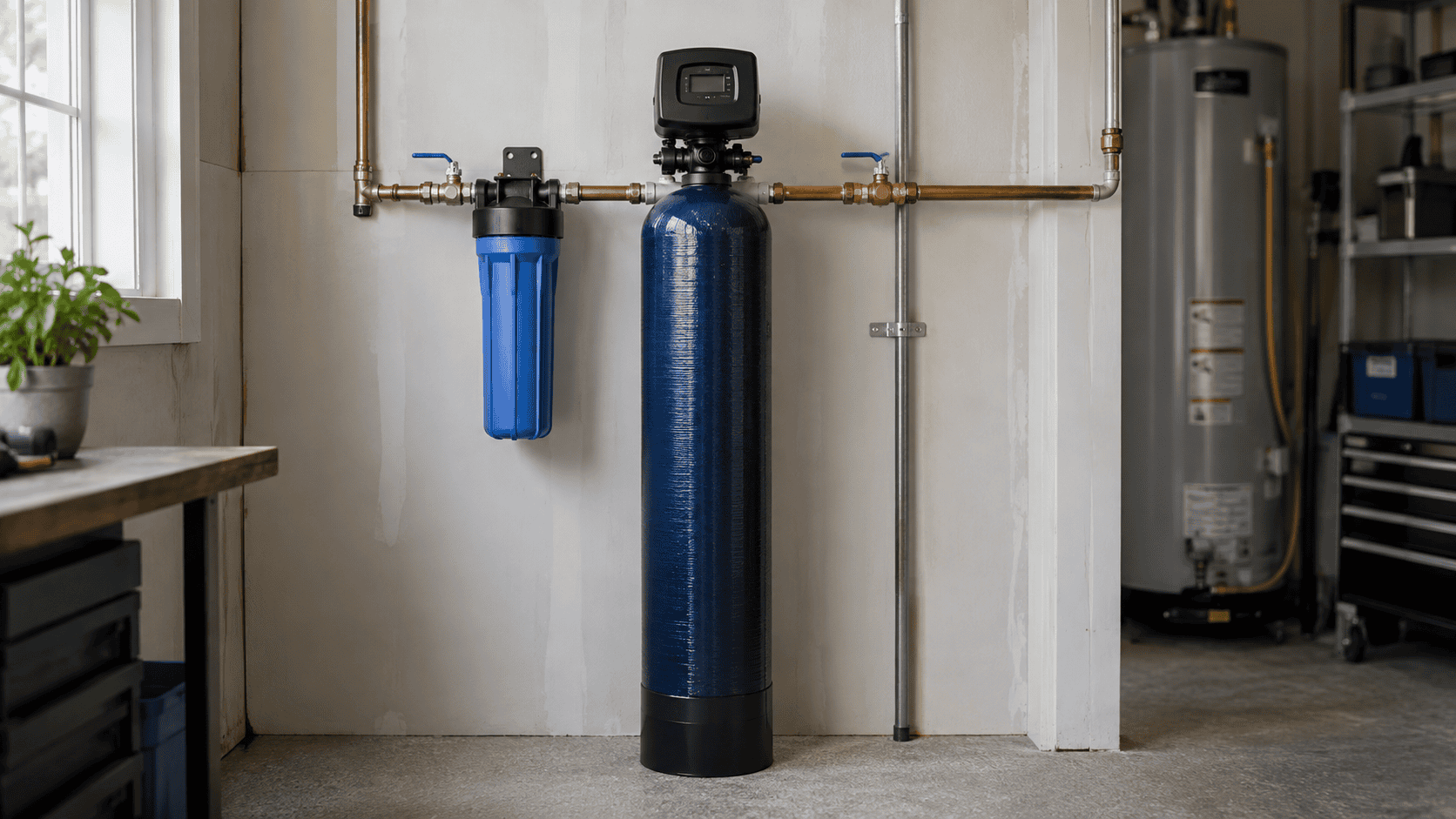
SpringWell CF1
SpringWell WS
Common questions
Does FutureSoft soften water?
No. It’s a conditioner. It changes how hardness minerals behave so they don’t form scale, but it doesn’t remove them, so your water still tests hard and won’t feel soft. For softened water you need an ion-exchange softener. See our hard water guide.
Is it certified?
Not by any certifier we checked: NSF International, WQA and IAPMO R&T don’t list it, and SpringWell doesn’t say where its “up to 95%” figure comes from.
Can I use it on well water?
Only if your water has no iron, manganese or hydrogen sulfide, which SpringWell says it can’t handle. Test your well first; many wells need iron or sulfur treatment before a conditioner. See our well water guide.
Does it remove chlorine or contaminants?
No. It only addresses scale. For chlorine taste at every tap, SpringWell sells the CF1; for certified lead or PFAS reduction, use a certified drinking-water filter.
The bottom line
FutureSoft is a no-salt, no-drain way to try to cut scale on city water. Buy it knowing that it conditions rather than softens, and that its scale claim is SpringWell’s, not a certifier’s. If you want truly soft water, buy an ion-exchange softener instead. Compare options in our hard water guide.
- Certifier directories: NSF International, WQA and IAPMO R&T, searched under SpringWell, FutureSoft and its parent companies. No listings.
- Maker documents: SpringWell's FutureSoft product page. It doesn't give a source for its "up to 95%" scale figure or name its media.
- Independent lab tests: None published by SpringWell.