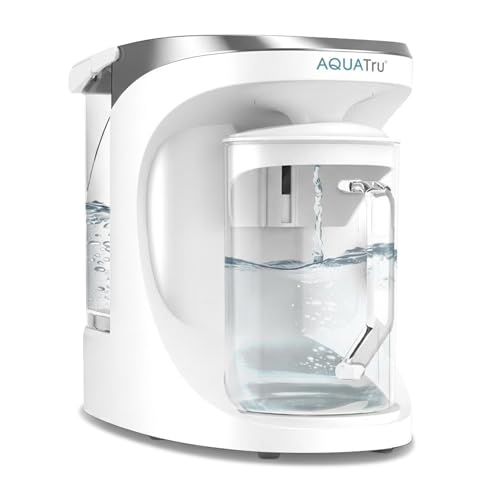
Hard water is two problems with two fixes. For scale on fixtures, appliances and the water heater, you need a whole-house ion-exchange softener, ideally certified to NSF/ANSI 44. For drinking water, the best water filter for hard water is the AquaTru Carafe: countertop reverse osmosis certified by IAPMO R&T to NSF/ANSI 58 for TDS (total dissolved solids), with no plumbing. It reduces hardness in the water it treats, at that one tap.
The catch: AquaTru doesn’t recommend it for water harder than 10 grains per gallon (171 mg/L), so water above that limit needs softening ahead of it.
Health information, not medical advice. Guidance differs for infants, pregnancy, and existing conditions. Test your own water and speak to a doctor or your local health authority. We may earn a commission when you buy through our links; it never affects our scores.
What is the best water filter for hard water?
For scale throughout the house, it’s not a filter at all but an ion-exchange water softener, and the certification to look for is NSF/ANSI 44. For drinking water, it’s a certified reverse osmosis system, and our top pick is the AquaTru Carafe, certified by IAPMO R&T to NSF/ANSI 58. Salt-free conditioners are designed to reduce scale, not to soften: the calcium and magnesium stay in the water.
Pick by the problem you can see:

Aquasana SimplySoft
AquaTru Carafe
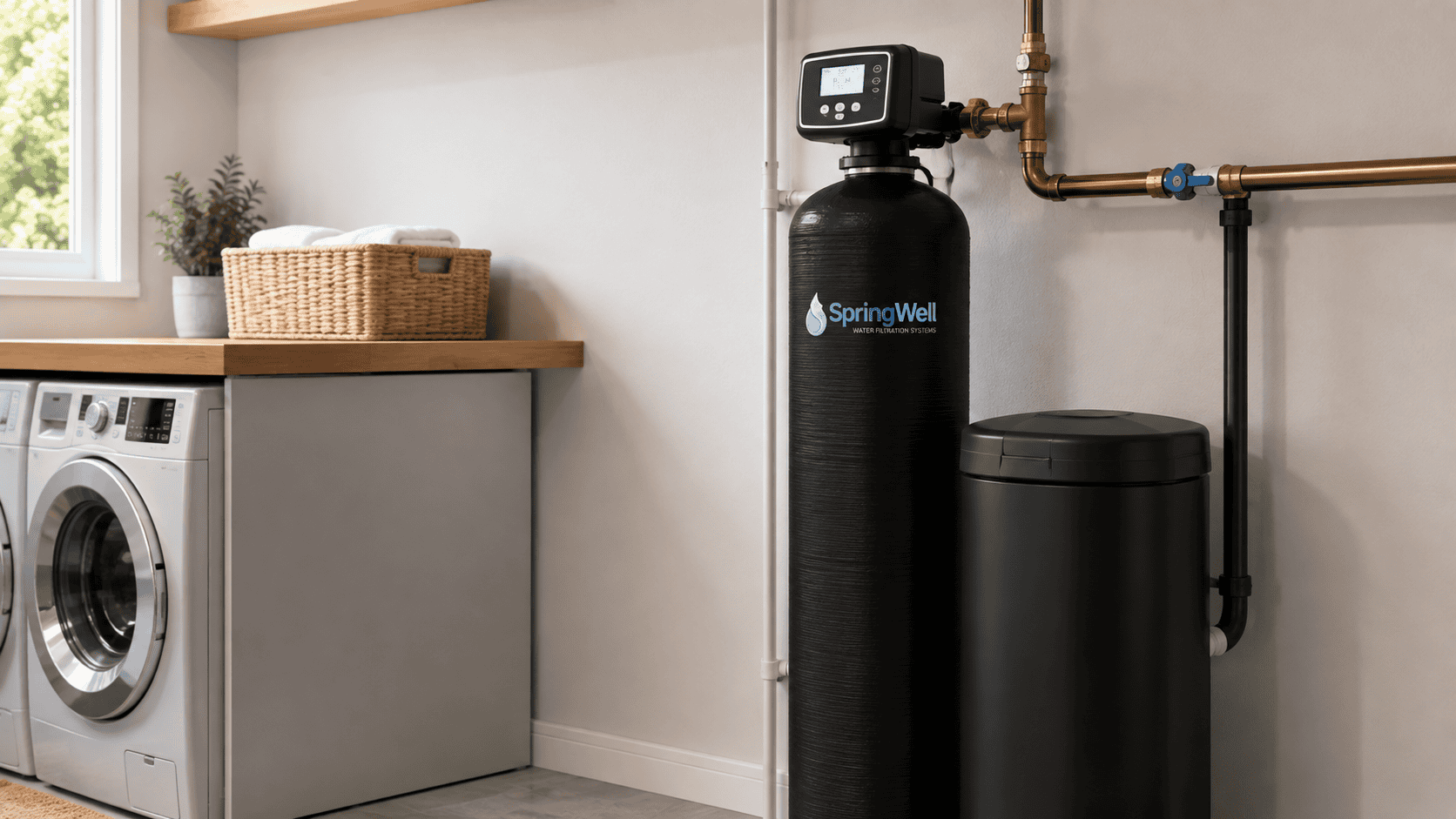
SpringWell FutureSoft
Both problems? Soften the whole house first, then add reverse osmosis at the kitchen sink for drinking water. Not sure how hard your water is? Check it first.
How do our picks compare?
Three whole-house systems and three drinking-water systems, by what they treat and how they’re certified.
| System | Treats | Reduces hardness? | Certification | Hardness limit |
|---|---|---|---|---|
| Aquasana SimplySoftSalt softener, 40,000 grains | Whole house | Yes, removes it | IAPMO R&TNSF/ANSI 44, hardness | Up to 200 gpg; 1 ppm iron (Aquasana) |
| Kenmore 350Salt softener, 32,100 grains | Whole house | Yes, removes it | NSF InternationalNSF/ANSI 44, hardness | Up to 90 gpg; 8 ppm iron (Kenmore) |
| SpringWell FutureSoftSalt-free conditioner (TAC) | Whole house | No; aims to reduce scale | None found | Up to 81 gpg; no iron or manganese (SpringWell) |
| AquaTru CarafeCountertop RO | One tap | Yes, in the water it treats | IAPMO R&TNSF/ANSI 58, TDS | 10 gpg (AquaTru) |
| Waterdrop G3P800Under-sink RO, tankless | One tap | Yes, in the water it treats | IAPMO R&TNSF/ANSI 58, TDS | None on the product page |
| APEC RO-90Under-sink RO, tank | One tap | Yes, in the water it treats | WQANSF/ANSI 58, TDS | Softener helps on extremely hard water (APEC manual) |
IAPMO R&T file WP-16886 (NSF/ANSI 44) lists the Aquasana SimplySoft WH-SF40 and WH-SF60 for hardness, efficiency rated, and NSF International lists the Kenmore 350 (625.383500, Water Channel Partners) under NSF/ANSI 44 for hardness, efficiency rated; checked 13 October 2026. IAPMO R&T file W-10194 (NSF/ANSI 58) lists the AquaTru Carafe (AT100 to AT140); file WC-13976 (NSF/ANSI 58) lists the Waterdrop WD-G3P800 under Qingdao Ecopure Filter Co.; WQA’s NSF/ANSI 58 listing covers the APEC RO-90; checked 11 October 2026. None of the RO listings includes a hardness-reduction claim; TDS reduction isn’t the same as a certified hardness claim. Hardness limits are from each maker’s own documents.
Which systems do we recommend?
Start with the group that matches your problem. Within each group, picks are in order of our score.
For the whole house
Aquasana SimplySoft
Removes hardness from every tap, the water heater included, and regenerates by gallons used. The Amazon listing is the softener only; the installation kit with the pre-filter costs extra.

Kenmore 350
Very salt-efficient, with the bypass valve and install kit in the box, at a lower price than most certified softeners. Its 7.2 gpm flow suits smaller homes, and some owners report early control failures.
SpringWell FutureSoft
Template-assisted crystallization with no salt, power or drain, rated for hardness up to 81 grains per gallon. It conditions rather than softens.
For drinking water
AquaTru Carafe
One of the broadest certified claim lists we've seen, including fluoride and arsenic, with no plumbing. It needs an outlet and makes half a gallon at a time, and its filters work out to about $0.33 a gallon at AquaTru's prices.
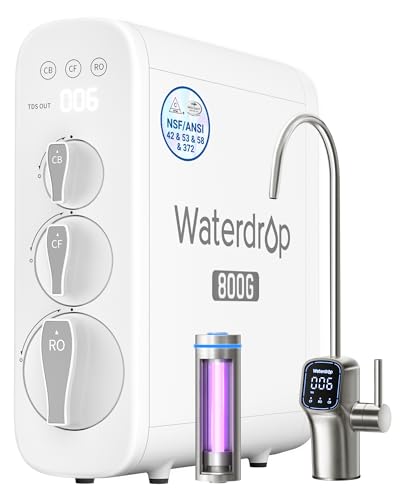
Waterdrop G3P800
Tankless reverse osmosis with certified lead, fluoride and PFOA/PFOS reduction from its own faucet. It needs a power outlet under the sink, and filters cost about $160 a year.

APEC RO-90
One of the broadest certified claim lists in under-sink RO, including lead, fluoride and arsenic V, and filters cost about $60 to $75 a year. No PFAS claim and no mineral stage.
Also certified by IAPMO R&T or WQA to NSF/ANSI 58: the AquaTru Classic for bigger countertop batches, and the Aquasana SmartFlow RO if you want minerals added back.
How hard is your water?
Check your number against the classes below before you buy anything. The classes measure hardness in mg/L (milligrams per liter) as calcium carbonate. Softener and filter makers often use gpg (grains per gallon) instead; AquaTru’s data sheet, for example, equates 10 gpg with 171 mg/L.
| Class | mg/L as calcium carbonate | Grains per gallon |
|---|---|---|
| Soft | 0 to 60 | 0 to 3.5 |
| Moderately hard | 61 to 120 | 3.6 to 7.0 |
| Hard | 121 to 180 | 7.1 to 10.5 |
| Very hard | More than 180 | More than 10.5 |
Classes from the U.S. Geological Survey (USGS). Grains per gallon are mg/L divided by 17.1, rounded.
Hardness below 7.0 gpg (120 mg/L) generally doesn’t need treatment. Above that, decide what bothers you: scale, spots, soap, or taste.
Is hard water a health problem?
Hardness itself, which comes mainly from calcium and magnesium, isn’t a health concern but can be a nuisance, according to the U.S. Geological Survey. That covers hardness only; other things in well water, such as nitrate or arsenic, need their own test. The nuisance is real, though. When hard water is heated, calcium carbonate deposits form, and that scale can shorten the life of equipment and lowers the efficiency of electric water heaters. Calcium also reacts with soap to form soap scum, so you need more soap and detergent. For the white crust that’s already there, see how to remove hard water stains.
Does a water softener remove hardness?
Yes. Ion-exchange softening is the most common way to treat hard water: the softener’s resin replaces calcium and magnesium ions with sodium or, less often, potassium. NSF/ANSI 44 is the standard for these residential softeners. NSF International describes it as covering cation exchange resins regenerated with sodium chloride or potassium chloride salt, including reduction of hardness from a known quality source.
Our pick is the Aquasana SimplySoft, certified by IAPMO R&T to NSF/ANSI 44 for hardness reduction and salt efficiency. If you shop for another model, look it up on NSF International, IAPMO R&T, or WQA and check that the listing shows NSF/ANSI 44. A box that says “softener” or “conditioner” isn’t a certification. See our guide to NSF certification for how to read a listing.
Softening has one trade-off for drinking water. A sodium-based softener raises the sodium content of the water, and water for drinking or cooking doesn’t necessarily need to be softened, according to Virginia Tech’s household water quality program. One way around that is to soften the house and put reverse osmosis at the kitchen sink.
Do salt-free water softeners work?
They don’t soften water. Salt-free systems are scale-control devices, also called conditioners: they aim to reduce the scale that hardness causes rather than remove the hardness. TAC (template-assisted crystallization) is designed to encourage calcium carbonate to form crystals on its treatment media, so it’s less likely to deposit on pipes and fixtures downstream. The calcium and magnesium stay in the water, so a hardness test will still show hard water.
The evidence varies by technology and by product. Few conclusive studies confirm how well these devices work in homes. There is a test standard for them now: IAPMO/ANSI Z601, first published in 2018, sets performance testing for scale-reduction devices used in residential water heating, while NSF/ANSI 44 covers ion-exchange softeners. Judge a product by its own certification, not by claims for the technology; IAPMO R&T’s directory lists four products certified to Z601. TAC also needs relatively clean water, and salt-free systems generally aren’t designed to remove iron and manganese, so water that contains them needs pretreatment or a suitable ion-exchange softener.
The SpringWell FutureSoft is the salt-free system we review. It’s a TAC conditioner, and SpringWell says it prevents up to 95% of scale buildup, without giving test conditions. That’s a maker’s claim, not a certified one: we found no certification for the FutureSoft system at NSF International, WQA, or IAPMO R&T, either as a softener under NSF/ANSI 44 or as a scale-reduction device under IAPMO/ANSI Z601 (checked 13 October 2026). SpringWell rates it for up to 81 grains per gallon, at pH 7.0 to 9.5, with no iron, manganese, or hydrogen sulfide in the water, and says it won’t stop spotting the way salt does.
Does reverse osmosis remove hardness?
Yes, at the one tap it serves. RO membranes reduce dissolved calcium and magnesium, so they reduce hardness in the water they treat, but RO units are point-of-use devices: they don’t soften the rest of the house. None of our picks carries a hardness-reduction claim. NSF/ANSI 58 certification confirms TDS reduction and the individual contaminant claims listed for each model, which isn’t the same as a certified hardness claim. See how reverse osmosis works.
Very hard water is hard on the membrane, and softening relatively hard water before an RO system can increase the life of the membrane. AquaTru doesn’t recommend the Carafe above 10 gpg, Culligan strongly recommends a softener above 10 gpg for its Aquasential RO and Smart RO systems, and APEC’s RO-90 manual says a softener “will help greatly” when the water source is extremely hard. Check your RO system’s feed-water hardness limit: if your water is above it, plan on a softener first and RO second. Limits differ by model, and not every maker publishes one.
What else do people ask about hard water?
Short answers on softeners, sodium, membranes, renting and maintenance.
Do I need a water softener or a filter for hard water?
A softener if hardness is causing scale and spots around the house, and a filter if you only care about drinking water. An ion-exchange softener certified to NSF/ANSI 44, such as the Aquasana SimplySoft, treats every tap. Reverse osmosis, like the AquaTru Carafe certified by IAPMO R&T to NSF/ANSI 58, treats one tap.
Is softened water OK to drink?
A sodium-based softener raises the sodium in your water, and drinking and cooking water doesn’t necessarily need to be softened, according to Virginia Tech’s household water quality program. One option is reverse osmosis at the kitchen sink for drinking water. Ask your doctor if you’re on a low-sodium diet.
Will hard water damage a reverse osmosis system?
Very hard water shortens membrane life, and softening first helps the membrane last. AquaTru doesn’t recommend the Carafe above 10 grains per gallon, Culligan strongly recommends a softener above 10 gpg, and APEC says a softener helps greatly with extremely hard water.
Can renters treat hard water?
Yes, for drinking water. The AquaTru Carafe and AquaTru Classic need no installation or plumbing, just a 120-volt outlet, and both are certified by IAPMO R&T to NSF/ANSI 58 for TDS. A whole-house softener or conditioner treats all the water entering the home, so ask your landlord first.
Does a salt-free conditioner need maintenance?
Very little, according to SpringWell: the FutureSoft uses no salt, no electricity, and no drain, and SpringWell rates its media for more than five years. The bigger issue is your water. SpringWell’s limits allow no iron, manganese, or hydrogen sulfide, so treat those first. See our FutureSoft review.
Sources
- USGS Water Science School: Hardness of water
- NSF International: NSF/ANSI 44, residential water softeners
- University of Nebraska-Lincoln Extension, G2275: Salt-free water “softener” options (2016)
- Virginia Tech, Virginia Household Water Quality Program: Hardness in household water (442-664)
- University of Nebraska-Lincoln Extension, G1490: Reverse osmosis
- Connecticut Department of Public Health: Reverse osmosis treatment of private drinking water systems
- AquaTru Carafe performance data sheet
- APEC RO-90 owner’s manual
- Culligan Aquasential RO and Smart RO owner’s guide
- Aquasana SimplySoft WH-SF40 and WH-SF60 performance data sheet
- SpringWell FutureSoft product page
- IAPMO R&T product listing directory (Aquasana WP-16886; AquaTru W-10194; Qingdao Ecopure WC-13976; IAPMO/ANSI Z601 scale reduction devices)
- WQA certified product listings (APEC Water Systems, Aquasana)
Prices as of October 14, 2026. Product prices and availability are accurate as of the date/time indicated and are subject to change. As an Amazon Associate we earn from qualifying purchases.