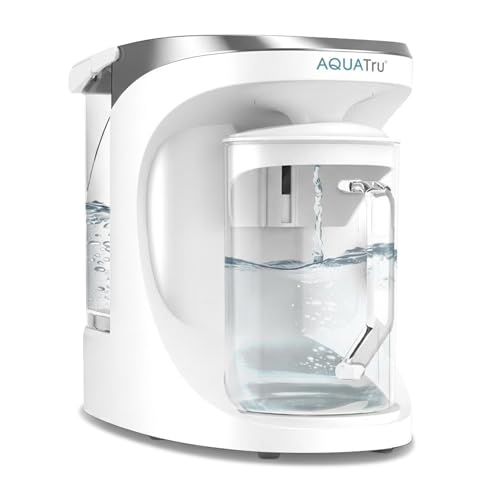
Countertop reverse osmosis certified by IAPMO R&T to NSF/ANSI 58 for nitrate, with a 98.3% average reduction in testing, plus lead, fluoride, arsenic and PFOA/PFOS. It needs no plumbing, which suits renters and anyone who only needs nitrate-safe water for drinking and formula.
The catch: It makes half a gallon at a time and needs a power outlet, so a household that drinks and cooks with a lot of water will run several batches a day.
Health information, not medical advice. Guidance differs for infants, pregnancy and existing conditions. Test your own water and speak to a doctor or your local health authority. We may earn a commission when you buy through our links; it never affects our scores.
The short answer
A water filter only reduces nitrate if it uses reverse osmosis, ion exchange or distillation, and the only way to know a specific model works is a certification that names nitrate. Of the filters we’ve reviewed, five carry that certification: the AquaTru Carafe and Classic and the Aquasana SmartFlow under NSF/ANSI 58, the Culligan Aquasential RO through a dealer, and the Culligan ZeroWater pitcher under NSF/ANSI 53. The EPA limit is 10 mg/L of nitrate measured as nitrogen, and the people most at risk above it are infants under six months.
Boiling doesn’t help. It concentrates nitrate as the water evaporates. Carbon pitchers and most under-sink carbon filters aren’t certified for nitrate at all.
How the nitrate filters compare
The five filters we recommend for nitrate, ranked by our overall score. Every one is certified for nitrate reduction by IAPMO R&T or WQA, and every one is also certified for lead. Two sit on the counter, two go under the sink, and one is a pitcher. How we score
| # | Filter | Score | Certified by | Lead | PFAS | Fluoride | Filter life | Cost per gallon | Price |
|---|---|---|---|---|---|---|---|---|---|
| 01 | AquaTru CarafeBest overall, no plumbing | 4.6 | IAPMO R&T | Certified | Certified | Certified | 300 to 600 gal | $0.33 | $356.25on Amazon › |
| 02 | AquaTru ClassicBest countertop for families | 4.5 | IAPMO R&T | Certified | Certified | Certified | 600 gal (carbon filters) | $0.17 | $451.25on Amazon › |
| 03 | Culligan ZeroWaterBest pitcher for nitrate | 4.2 | IAPMO R&T | Certified | Certified | Certified | 20 gal | See priceat Culligan › | |
| 04 | Aquasana SmartFlow ROBest under-sink | 4.1 | WQA | Certified | Certified | Certified | 250 gal (carbon blocks) | $0.49+ | $239.99on Amazon › |
| 05 | Culligan Aquasential ROBest professionally installed | 3.9 | WQA | Certified | Certified | Certified | 1 to 2 yr per cartridge | Dealer-priced | Get a quoteat Culligan › |
Certified: Certified by an independent body (named in each pick). Lab test: Tested by a named independent lab, not certified. Claim: The maker's claim, not certified. No: No claim. PFAS means PFOA/PFOS, or Total PFAS where the pick says so.
Our five picks in detail
What each filter is certified to reduce, who certifies it, and who it suits. The nitrate figures are the average reductions from each certifier’s test results.
AquaTru Carafe
One of the broadest certified claim lists we've seen, including fluoride and arsenic, with no plumbing. It needs an outlet and makes half a gallon at a time, and its filters work out to about $0.33 a gallon at AquaTru's prices.

AquaTru Classic
The same certified reverse osmosis claim list as the Carafe in a bigger countertop unit, about a gallon per batch. It needs a power outlet, and filters cost about $130 a year.
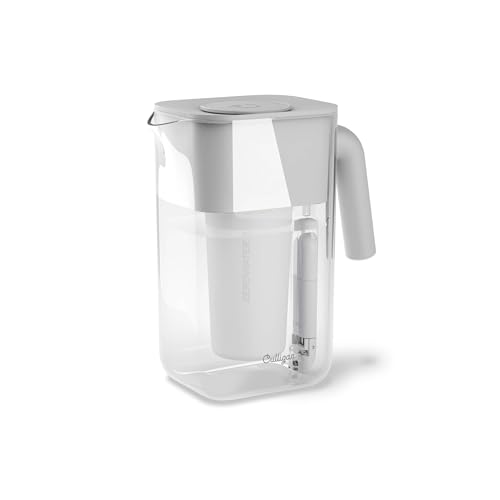
Culligan ZeroWater
One of few pitchers with certified fluoride reduction, plus Total PFAS. Filters cost $0.68 to $0.93 a gallon and run out faster on hard water.
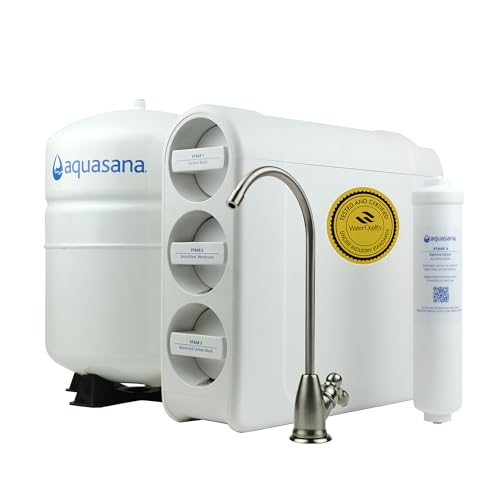
Aquasana SmartFlow RO
One of the most broadly certified under-sink RO systems we've checked, with minerals added back. The cost is the carbon blocks: $91.99 every 6 months or 250 gallons, plus the remineralizer and a yearly membrane.
Culligan Aquasential RO
One of the broadest certified claim lists we've seen, installed and serviced by a local dealer. There's no public price, and the claims depend on the configuration, so ask for the tank model with the Total Defense cartridge.
Nitrate results by filter
Certification is the minimum. The reduction figures show how much margin each filter has, which matters if your water tests well above the limit.
| Filter | Nitrate reduction | Certified to | Certifier |
|---|---|---|---|
| AquaTru Carafe | 98.3% | NSF/ANSI 58 | IAPMO R&T |
| Culligan ZeroWater | 99.1% at pH 6.5, 90.2% at pH 8.5 | NSF/ANSI 53 | IAPMO R&T |
| AquaTru Classic | 89.9% (nitrate and nitrite) | NSF/ANSI 58 | IAPMO R&T |
| Aquasana SmartFlow | 78% (nitrate and nitrite) | NSF/ANSI 58 | WQA |
| Culligan Aquasential RO | Certified; WQA lists claims, not percentages | NSF/ANSI 58 | WQA |
Two details change which model you should buy. The Culligan ZeroWater’s nitrate claim appears on its certificate revised in June 2026, so check that the filter you buy is the current Culligan line, not the older ZeroWater filter. And Culligan’s nitrate certification covers the tank-style Aquasential RO and the Smart RO Nitrate, but not the plain Smart RO or the Tankless models.
What nitrate is and who it affects
Nitrate reaches water mainly from fertilizer runoff, leaking septic systems and sewage, and natural deposits, according to the EPA. The EPA’s legal limit for public water systems is 10 mg/L of nitrate measured as nitrogen, and 1 mg/L for nitrite. Some labs report nitrate itself rather than nitrogen; on that scale the same limit is about 45 mg/L, so check which unit your lab report uses before comparing.
Infants under six months are the group most at risk. The EPA says infants who drink water above the nitrate limit can become seriously ill and may die if untreated, with symptoms that include shortness of breath and blue-baby syndrome. Penn State Extension notes the risk is highest in the first four months and falls after about six months, and both Penn State and the Virginia Department of Health also name pregnant women as more vulnerable. For healthy adults, the same source says studies suggest nitrate in drinking water is not a significant risk.
Most people with a nitrate problem are on a private well. City utilities must test for nitrate and stay under the limit, and their annual water quality report lists the result. In California, Texas, Florida and New York, our tap water checker shows any nitrate violations on your utility’s record. Private wells aren’t regulated, so the owner is responsible for testing. Shallow wells, dug wells and wells near farmland or septic fields are the most vulnerable, and a well can change after flooding. Our well water guide covers what to test for and where.
What removes nitrate, and what doesn’t
Nitrate dissolves completely in water, so a filter has to separate the dissolved ions themselves. Three methods do that, and the rest of the common options don’t.
| Method | Reduces nitrate? | What to know |
|---|---|---|
| Reverse osmosis | Yes | The usual choice for drinking water at one tap. Penn State puts typical removal at about 83% to 92%, so very high levels can still exceed the limit afterward. |
| Ion exchange (nitrate-selective) | Yes | Works like a softener but swaps chloride for nitrate. Can treat the whole house, but high sulfate interferes and the brine needs disposal. |
| Distillation | Yes | Effective but slow, with home units making about a gallon every four to five hours. |
| Boiling | No | Concentrates nitrate as water evaporates. |
| Carbon and sediment filters | No | Not designed for dissolved nitrate. No carbon pitcher we’ve reviewed is certified for it. |
| Chlorination | No | It disinfects; it doesn’t remove nitrate. |
The Culligan ZeroWater is the exception among pitchers because it uses ion exchange resin rather than carbon alone, which is how it earned a nitrate claim. Its filter is certified for only 20 gallons, though, so it suits a household that needs a small amount of nitrate-safe water, such as for an infant’s formula, rather than all drinking and cooking.
Others we considered
These are well-known filters that people often assume handle nitrate, but none is certified for it.
- APEC RO-90. WQA certifies it for 12 claims, including lead, fluoride and arsenic V, but nitrate isn’t one of them. Our APEC RO-90 review.
- Waterdrop G3P800. Waterdrop’s data sheet lists nitrate, but its IAPMO R&T certificates don’t. Our Waterdrop G3P800 review.
- iSpring RCC7AK-BN. NSF International certifies it for lead, fluoride and dissolved solids, with no nitrate claim. Our iSpring review.
- Brita Elite and PUR PLUS pitchers. Both are certified for lead, and the PUR PLUS for Total PFAS, but neither for nitrate.
- Whole-house nitrate systems. Nitrate-selective ion exchange can treat every tap, but we haven’t found one certified for nitrate that we can recommend yet. For drinking water, a certified system at the kitchen tap is the proven route.
How to choose a nitrate filter
Four checks decide almost every case, and the first one comes before you spend anything.
Test before you buy
On a private well, test for nitrate at least once a year and after flooding. On city water, read your utility’s annual water quality report. Note whether the result is reported as nitrogen or as nitrate. Our well water guide covers how to test well water.
Match the certification
Look for nitrate or nitrate/nitrite on the certifier’s listing for the exact model, usually under NSF/ANSI 58. A maker’s own claim, or nitrate listed only on a data sheet, isn’t the same thing. Our NSF certification guide explains how to read a listing.
Pick a format
Countertop RO like the AquaTru needs no plumbing. Under-sink RO like the SmartFlow gives filtered water on tap. The Culligan ZeroWater pitcher costs least up front but needs frequent filter changes.
Retest after installing
Reverse osmosis doesn’t remove every bit of nitrate. If your water tests far above the limit, test the filtered water too, and change filters on schedule.
Common questions
The questions we hear most about nitrate and water filters.
What’s the best water filter for nitrates?
Our top pick is the AquaTru Carafe, certified by IAPMO R&T to NSF/ANSI 58 for nitrate with a 98.3% average reduction, and no plumbing needed. For filtered water on tap, the Aquasana SmartFlow is certified by WQA for nitrate and nitrite under the sink.
Does boiling water remove nitrates?
No. Boiling concentrates nitrate, because water evaporates and the nitrate stays behind. Use a certified filter, or bottled water for an infant until you have one.
Do Brita filters remove nitrates?
No. The Brita Elite is certified for lead, chlorine, mercury and cadmium, but not nitrate. Among pitchers we’ve reviewed, only the Culligan ZeroWater is certified for nitrate.
Is nitrate in well water safe for baby formula?
Not above the EPA limit of 10 mg/L as nitrogen. The EPA says infants under six months who drink water above it can become seriously ill. Test your well, and use a filter certified for nitrate or bottled water for formula. See our baby formula water guide.
Do all reverse osmosis systems remove nitrate?
Reverse osmosis generally reduces nitrate, but certification varies by model. The APEC RO-90, Waterdrop G3P800 and iSpring RCC7AK-BN aren’t certified for it. See our reverse osmosis guide for every system we’ve checked.
Sources
- EPA: National Primary Drinking Water Regulations (nitrate and nitrite)
- Penn State Extension: Nitrates in drinking water
- Virginia Department of Health: Nitrate in private wells
- IAPMO R&T product listing directory: AquaTru (Carafe AT100 to AT140, Classic AT2000 to AT2050); Culligan ZeroWater
- WQA certified product listings: Aquasana (AQ-SFRO2), Culligan International (Aquasential), APEC Water Systems
- NSF International listing, iSpring Water Systems
Prices as of October 14, 2026. Product prices and availability are accurate as of the date/time indicated and are subject to change. As an Amazon Associate we earn from qualifying purchases.