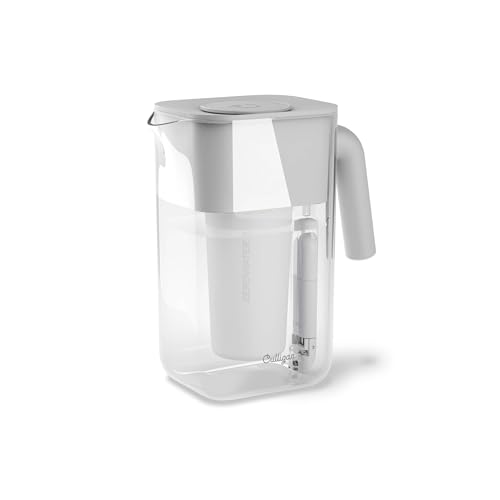
Certified by IAPMO R&T for fluoride, Total PFAS, lead, chromium-6, mercury and nitrate, plus pharmaceuticals under NSF/ANSI 401. No other pitcher here covers fluoride and Total PFAS with certified claims.
The catch: Each filter is certified for 20 gallons, and fewer on hard water, so filters cost $0.68 to $0.93 a gallon.
Health information, not medical advice. Guidance differs for infants, pregnancy and existing conditions. Test your own water and speak to a doctor or your local health authority. We may earn a commission when you buy through our links; it never affects our scores.
How the pitchers compare
The seven pitchers we’ve reviewed, ranked by our overall score. Certification is the biggest divide: some are certified for lead, PFAS or fluoride, and some only for chlorine and taste. How we score
| # | Pitcher | Score | Lead | PFAS | Fluoride | Filter life | Cost per gallon | Price |
|---|---|---|---|---|---|---|---|---|
| 01 | Culligan ZeroWaterBest overall | 4.2 | Certified | Certified | Certified | 20 gal | See priceat Culligan › | |
| 02 | Brita EliteBest value for certified lead | 4.1 | Certified | Claim | No | 120 gal | $0.14 | $47.99on Amazon › |
| 03 | PUR PLUS PitcherBest budget for lead and PFAS | 4.0 | Certified | Certified | No | 40 gal | $28.12on Amazon › | |
| 04 | ZeroWater 10-CupBest for near-zero TDS | 3.9 | Certified | Certified | No | 15 gal | $37.99on Amazon › | |
| 05 | Clearly Filtered PitcherBroad lab-tested reduction | 3.8 | Lab test | Lab test | Lab test | 100 gal | $0.50 to $0.65 | $109.99on Amazon › |
| 06 | Waterdrop ChubbyLongest filter life | 3.5 | No | No | Claim | 200 gal | $24.99on Amazon › | |
| 07 | Epic Nano XPBroad claims, little certification | 2.7 | Claim | Claim | No | 100 gal | $84.00on Amazon › |
Certified: Certified by an independent body (named in each pick). Lab test: Tested by a named independent lab, not certified. Claim: The maker's claim, not certified. No: No claim. PFAS means PFOA/PFOS, or Total PFAS where the pick says so.
Our seven picks in detail
What each pitcher is certified for, who certifies it, and who it suits. Tap a name for the full review.
Culligan ZeroWater
One of few pitchers with certified fluoride reduction, plus Total PFAS. Filters cost $0.68 to $0.93 a gallon and run out faster on hard water.
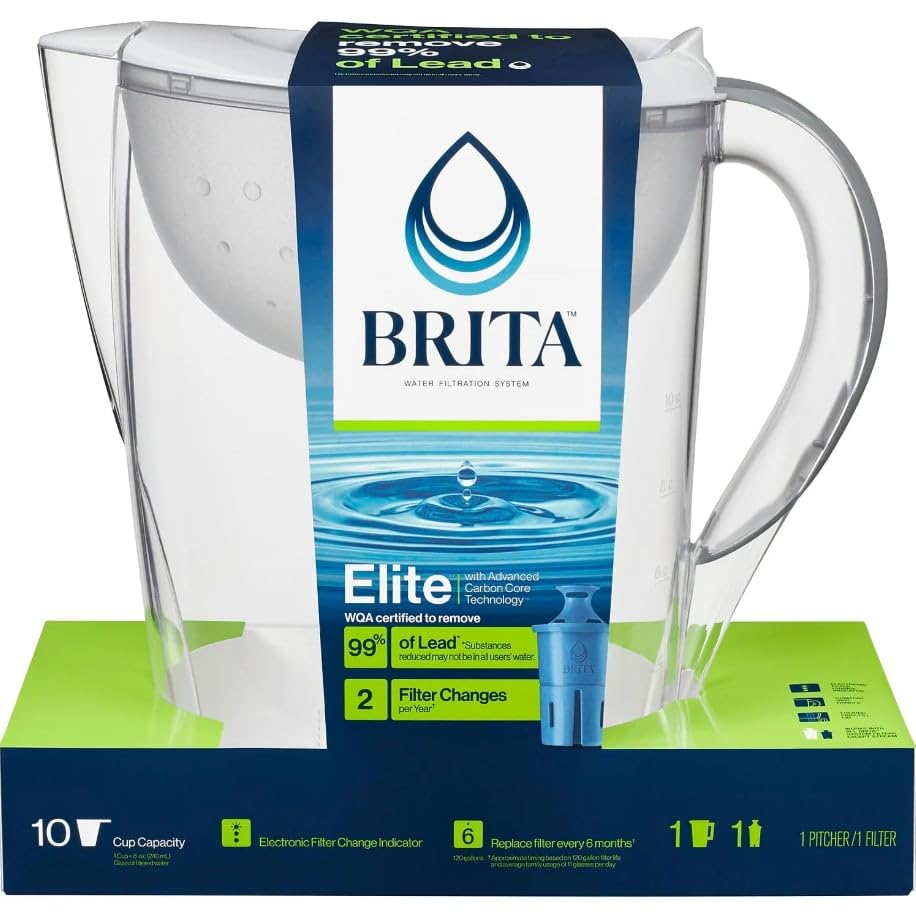
Brita Elite
Certified lead reduction in most Brita pitchers and a 120-gallon filter, at about $0.14 a gallon. No fluoride, TDS or certified PFAS claim.

PUR PLUS Pitcher
Certified lead and Total PFAS reduction for about $0.25 a gallon with a 3-pack of filters. You change it every 40 gallons, and owners say it slows as it fills.
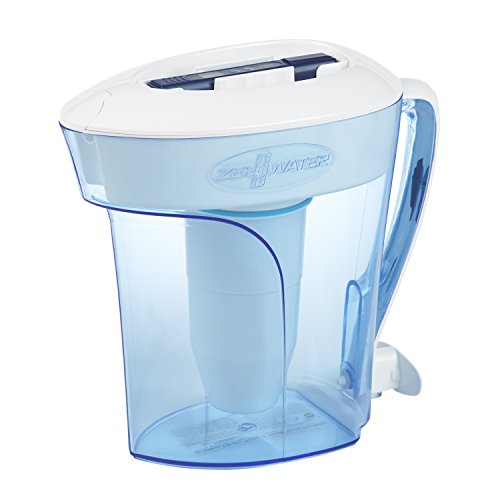
ZeroWater 10-Cup
Takes dissolved solids to near zero, and the included meter shows when the filter is spent. Filters run out fast, so it's one of the more expensive pitchers to run.
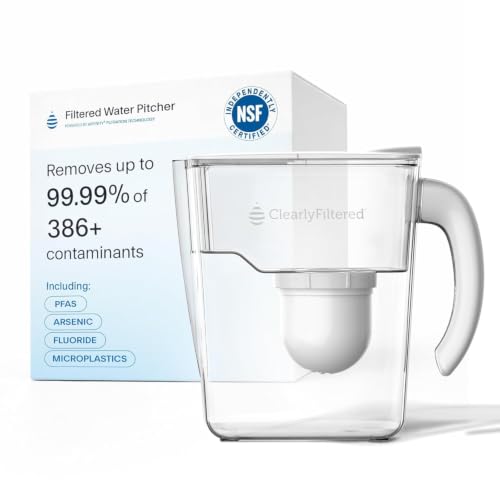
Clearly Filtered Pitcher
A long list of published lab results, including fluoride and arsenic, but only chlorine is certified. Slow to fill, and filters cost $0.50 to $0.65 a gallon.
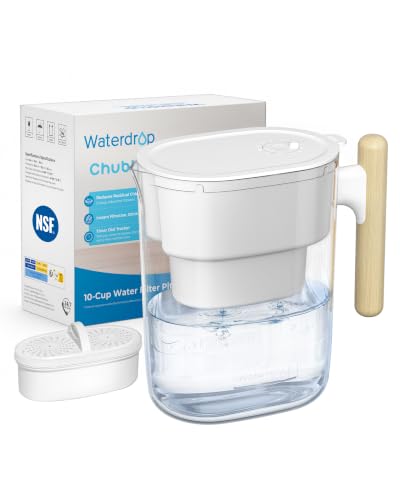
Waterdrop Chubby
A chlorine and taste pitcher with the longest filter life here, 200 gallons, at about $0.07 a gallon in filters. Waterdrop's fluoride and heavy-metal claims aren't certified.
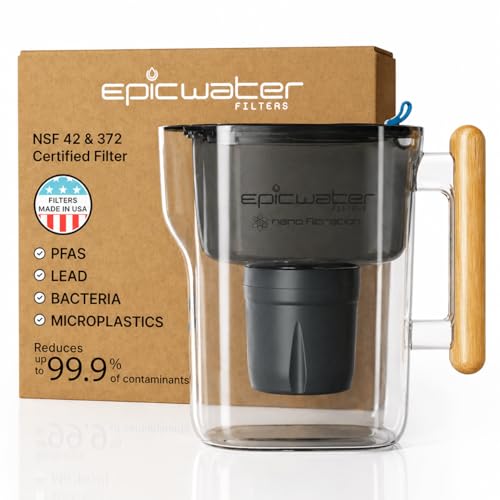
Epic Nano XP
A long list of claims, including bacteria and viruses, but none are certified, and its virus result is below purifier level. Not for water that may be unsafe to drink.
How to choose a water filter pitcher
Match it to your water
Most pitchers are certified only for chlorine and taste. For lead, PFAS or fluoride, pick one certified for exactly that, and check the pitcher too: the Brita Elite’s lead certification, for example, covers most Brita pitchers but not the Everyday (OB46).
Check the certifier, not the box
“Reduces lead” means little on its own. Look for the certifier’s name (NSF International, IAPMO R&T or WQA) and find the product on its public listing. Lab results are useful, but they aren’t certification. How certification works
Count the running cost
Filter life here ranges from 15 gallons (ZeroWater) to 200 (Waterdrop Chubby), and filter cost from about $0.07 to more than $0.90 a gallon. Over a year, that often matters more than the pitcher’s price.
Know a pitcher’s limits
Pitchers pour slowly and filter small batches. For fluoride, arsenic or high dissolved solids, or water for a big household, look at countertop or under-sink reverse osmosis.
Common questions
What’s the best water filter pitcher?
Our top pick is the Culligan ZeroWater, certified by IAPMO R&T for fluoride, Total PFAS, lead and more. For certified lead and Total PFAS reduction on a budget, the PUR PLUS. For the lowest running cost with certified lead reduction, the Brita Elite.
Do pitcher filters remove fluoride?
Most don’t. Of the pitchers here, only the Culligan ZeroWater is certified for fluoride, by IAPMO R&T. The Clearly Filtered is lab-tested for it, not certified. For dependable fluoride reduction, reverse osmosis is the surer route. See our fluoride guide.
Do pitchers remove lead and PFAS?
Only the certified ones. For lead: the ZeroWater, Culligan ZeroWater and PUR PLUS (all certified by IAPMO R&T), and the Brita Elite in most Brita pitchers (IAPMO R&T, WQA and NSF International). For PFAS: the Culligan ZeroWater and PUR PLUS are certified for Total PFAS, and the ZeroWater for PFOA and PFOS. See our PFAS guide and lead guide.
How often do I change a pitcher filter?
It depends on the pitcher. Rated filter life is 15 gallons for the ZeroWater, 20 for the Culligan ZeroWater, 40 for the PUR PLUS (about two months), 100 for the Clearly Filtered and Epic Nano XP (about three to four months), 120 for the Brita Elite (about six months) and 200 for the Waterdrop Chubby. Hard water shortens ion-exchange filters like ZeroWater’s.
Are water filter pitchers worth it?
For chlorine and taste, and for lead or PFAS when certified, they’re the cheapest way to improve tap water, with nothing to install. They aren’t a fix for fluoride, arsenic or dissolved solids in most cases, and they shouldn’t be used to treat water that may be unsafe to drink.
Sources
- IAPMO R&T product listing directory (Brita LP W-13905; Kaz USA W-29904; Culligan International (ZeroWater) W-17155; Zero Technologies W-14820)
- ZeroWater performance data sheet (IAPMO R&T)
- IAPMO R&T certificate W-17155, Culligan ZeroWater (NSF/ANSI 53)
- PUR PLUS pitcher filter performance data sheet (IAPMO R&T)
- NSF International listing, Brita Elite filter (OB06)
- NSF International listing, Clearly Filtered
- NSF International listing, Epic Water Filters (NSF/ANSI 42)
- NSF International listing, Waterdrop
- Clearly Filtered pitcher lab results
Prices as of October 14, 2026. Product prices and availability are accurate as of the date/time indicated and are subject to change. As an Amazon Associate we earn from qualifying purchases.