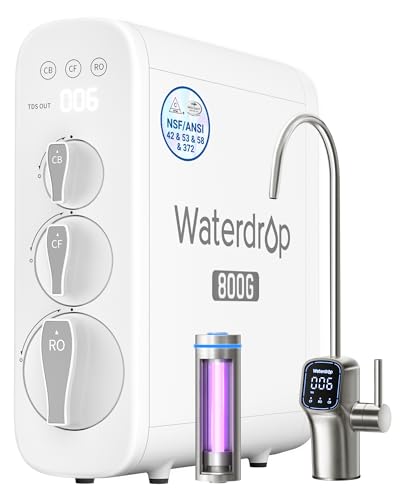
Aquasana vs Waterdrop: The Waterdrop G3P800 is certified by IAPMO R&T to NSF/ANSI 58 for lead and fluoride and to NSF/ANSI 53 for PFOA/PFOS, filters on demand with no tank, and costs less a year in filters at both makers’ prices. The Aquasana SmartFlow RO is certified by WQA for a longer list, including arsenic V, nitrate and microplastics, and adds minerals back.
The catch: The G3P800 needs a power outlet under the sink and has no remineralizer. Pick the SmartFlow if arsenic or nitrate is on your water report.
Health information, not medical advice. Guidance differs for infants, pregnancy, and existing conditions. Test your own water and speak to a doctor or your local health authority. We may earn a commission when you buy through our links; it never affects our scores.
How do Aquasana and Waterdrop compare?
Both are under-sink reverse osmosis systems certified for lead, fluoride and PFOA/PFOS, but they’re built differently. The Waterdrop G3P800 is tankless and electric. The Aquasana SmartFlow (models AQ-SFRO2 and AQ-SFRO) is a four-stage system with a storage tank and a remineralizer, and its manual lists no power requirement. Waterdrop is certified by IAPMO R&T, Aquasana by WQA. If you’re also weighing a countertop unit, see AquaTru vs Waterdrop. How we score
| # | System | Score | Certified by | Lead | PFAS | Fluoride | Running cost | Price |
|---|---|---|---|---|---|---|---|---|
| 01 | Waterdrop G3P800Best of the twoUnder-sink RO | 4.3 | IAPMO R&T | Certified | Certified | Certified | About $160/yr | $849.00on Amazon › |
| 02 | Aquasana SmartFlow ROLongest certified listUnder-sink RO | 4.1 | WQA | Certified | Certified | Certified | $0.49+/gal | $239.99on Amazon › |
Certified: Certified by an independent body (named in each pick). Lab test: Tested by a named independent lab, not certified. Claim: The maker's claim, not certified. No: No claim. PFAS means PFOA/PFOS, or Total PFAS where the pick says so.
What is each one certified to remove?
The Aquasana SmartFlow’s certified list is longer. Both are certified for lead, fluoride, PFOA/PFOS, cadmium, barium, radium, dissolved solids and chlorine; only the SmartFlow adds arsenic V, nitrate, chromium, copper, mercury, chloramine and microplastics.
| Contaminant | Waterdrop G3P800 | Aquasana SmartFlow RO |
|---|---|---|
| Lead | Certified (NSF/ANSI 58) | Certified (NSF/ANSI 53) |
| Fluoride | Certified (NSF/ANSI 58) | Certified (NSF/ANSI 58) |
| PFOA/PFOS | Certified (NSF/ANSI 53) | Certified (NSF/ANSI 53) |
| Arsenic V | No claim | Certified (NSF/ANSI 58) |
| Nitrate, nitrite | No claim | Certified (NSF/ANSI 58) |
| Chromium-6, chromium-3 | No claim | Certified (NSF/ANSI 58) |
| Cadmium, barium, radium 226/228 | Certified (NSF/ANSI 58) | Certified (NSF/ANSI 58) |
| Copper, selenium | No claim | Certified (NSF/ANSI 58) |
| Mercury | No claim | Certified (NSF/ANSI 53) |
| Total dissolved solids | Certified (NSF/ANSI 58) | Certified (NSF/ANSI 58) |
| Chlorine | Certified (NSF/ANSI 42) | Certified, plus chloramine (NSF/ANSI 42) |
| Microplastics | No claim | Certified (NSF/ANSI 401) |
| VOCs, cysts, asbestos, MTBE | No claim | Certified (NSF/ANSI 53) |
Waterdrop: IAPMO R&T files WC-13976 (NSF/ANSI 58), WC-14805 (NSF/ANSI 53) and WC-14301 (NSF/ANSI 42), model WD-G3P800, listee Qingdao Ecopure Filter Co. Aquasana: WQA listings for the AQ-SFRO and AQ-SFRO2 under NSF/ANSI 42, 53, 58 and 401; the arsenic V claim is at a 50 ppb challenge. Neither system is certified for Total PFAS, and Aquasana says to add a UV filter if your water may contain bacteria or viruses.
Which is better for PFAS?
They’re level. Both carry a PFOA/PFOS claim under NSF/ANSI 53: The Waterdrop from IAPMO R&T (file WC-14805) and the Aquasana from WQA. Aquasana’s performance data sheet reports 99.7% PFOA/PFOS reduction. Neither is certified for Total PFAS. See our PFAS filter guide and does reverse osmosis remove PFAS?
Is either one tankless?
Only the Waterdrop. Waterdrop’s product page describes the G3P800’s “sleek, tankless design” and says it saves 70% of the space under the sink. Aquasana’s SmartFlow comes with a storage tank, and Aquasana says the amount of filtered water in it at any given time varies with your water pressure. A tank holds filtered water ready to pour but takes cabinet space; a tankless system makes water as you pour.
Which makes more water?
The Waterdrop, on the makers’ own figures. Waterdrop rates the G3P800 at 800 gallons a day with a 3:1 pure-to-drain ratio, which it describes as one cup of wastewater for every three cups of filtered water (maker’s claim). Aquasana rates the SmartFlow at 25.7 gallons a day and 0.7 gallons a minute at the faucet when the tank is full (maker’s figures); its product page gives no drain ratio. Neither figure is part of the certifications above.
Does either need electricity?
The Waterdrop does. Waterdrop lists “Electricity Required: Yes” and ships a power adapter, so you need an outlet in the sink cabinet. The power also runs the faucet display, which shows TDS and filter life, and a UV LED that Waterdrop says switches on when water flows. Aquasana’s manual lists no power requirement for the SmartFlow; it says inlet pressure must be at least 40 psi and suggests a booster pump if yours is lower.
Which one adds minerals back?
The Aquasana. Its fourth stage is a remineralizer that, in Aquasana’s words, adds back “beneficial amounts of minerals that are lost in the reverse osmosis process.” Waterdrop’s comparison table marks alkaline mineralization as not included on the G3P800, and its page lists no mineral filter for it. Reverse osmosis strips minerals along with contaminants, so some people find straight RO water tastes flat. See is reverse osmosis water good for you?
Which is cheaper to run?
The Waterdrop. At Waterdrop’s prices, its CF filter ($29.99) is changed every 6 months, the CB carbon filter ($29.99) every 12 months, and the RO membrane ($139.99) every 24 months. Replacing each on that time schedule costs $159.97 a year, the figure Waterdrop publishes. Aquasana sells its two carbon blocks (stages 1 and 3) as a set for $91.99, changed every 6 months or 250 gallons, and the remineralizer costs $31.49 every 6 months. Replacing both twice a year comes to $246.96 at Aquasana’s current prices before the membrane, which Aquasana says to replace every 12 months; its site didn’t show a membrane price when we checked. Aquasana’s Water for Life plan takes 15% off replacements. Our filter change guide covers the schedules.
Which is easier to install?
The Waterdrop, if you have an outlet. Waterdrop says the G3P800 is a 30-minute DIY install and includes a 1/4-inch drain saddle and Teflon tape in the box. Aquasana recommends hiring a professional to install the SmartFlow. Its manual calls for an existing faucet hole of at least 1/2 inch (and strongly recommends a professional if you need to drill one), a drain saddle mounted above the trap and not on the garbage disposal line, and notes that local codes may require an air gap or backflow preventer. Aquasana’s product page lists a 2-year limited warranty and a 90-day satisfaction guarantee for the SmartFlow; Waterdrop gives the G3P800 a 1-year warranty.
How do the two score in detail?
The Waterdrop G3P800 scores higher on our rubric: It covers lead, fluoride and PFOA/PFOS with certification, needs no tank and costs less a year in filters. The Aquasana SmartFlow scores on its longer WQA list and its remineralizer.
Waterdrop G3P800
Tankless reverse osmosis with certified lead, fluoride and PFOA/PFOS reduction from its own faucet. It needs a power outlet under the sink, and filters cost about $160 a year.
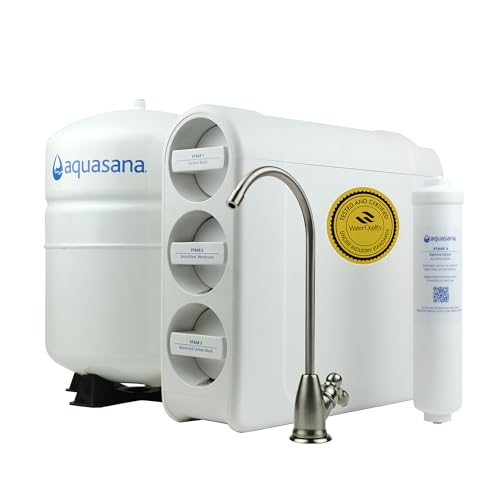
Aquasana SmartFlow RO
One of the most broadly certified under-sink RO systems we've checked, with minerals added back. The cost is the carbon blocks: $91.99 every 6 months or 250 gallons, plus the remineralizer and a yearly membrane.
Aquasana or Waterdrop: Which should you buy?
Buy the Waterdrop G3P800 if lead, fluoride or PFOA/PFOS is your concern and you have an outlet under the sink; buy the Aquasana SmartFlow if arsenic or nitrate is on your water report.
Pick the Waterdrop G3P800 if
Lead, fluoride and PFOA/PFOS are your concerns, you want unlimited water with no tank and lower filter costs, and you have an outlet under the sink.
Pick the Aquasana SmartFlow if
Your water report shows arsenic or nitrate, you want minerals added back, or you’d rather not run power under the sink.
Want no drain line at all?
The Aquasana AQ-6300M is a carbon system, not RO, certified by WQA for lead and PFOA/PFOS, with no fluoride claim.
Compare more RO systems
See our reverse osmosis roundup and under-sink roundup.
What do people ask about Aquasana and Waterdrop?
Answers to the questions that come up once you’ve narrowed it to these two.
Is Aquasana or Waterdrop better?
The Waterdrop G3P800 scores higher: IAPMO R&T certifies it for lead, fluoride and PFOA/PFOS, it has no tank, and its filters cost about $160 a year. The Aquasana SmartFlow, certified by WQA, has the longer list, adding arsenic V, nitrate and microplastics, plus a remineralizer, but costs more to run.
Does the Aquasana SmartFlow have a tank?
Yes. The SmartFlow stores filtered water in a holding tank under the sink, and Aquasana says how much is ready at any given time varies with your water pressure, which must be at least 40 psi. The Waterdrop G3P800 is tankless and makes water as you pour, which saves cabinet space but needs an outlet.
Does the Waterdrop G3P800 remove arsenic?
It isn’t certified for arsenic. IAPMO R&T’s NSF/ANSI 58 listing for the WD-G3P800 covers lead, fluoride, cadmium, barium, radium and dissolved solids. For certified arsenic reduction, the Aquasana SmartFlow is certified by WQA for arsenic V under NSF/ANSI 58. See our well water guide.
How often do the filters need changing?
Waterdrop: The CF filter every 6 months, the CB carbon filter every 12 months and the RO membrane every 24 months. Aquasana: Both carbon blocks and the remineralizer every 6 months (the carbon blocks sooner at 250 gallons), and the membrane every 12 months. Waterdrop’s faucet display tracks filter life for you.
Which is better for renters?
Neither suits most renters, because both need a faucet, a drain connection and room under the sink, and the Waterdrop also needs an outlet there. If you can’t change the plumbing, a countertop reverse osmosis system such as the AquaTru Carafe needs no install. See our apartment filter guide.
Sources
- IAPMO R&T product listing directory (Qingdao Ecopure Filter Co.: WC-13976, WC-14805, WC-14301)
- WQA certified product listings (search “Aquasana”)
- Waterdrop G3P800 product page
- Aquasana SmartFlow Reverse Osmosis product page
- Aquasana AQ-SFRO2 performance data sheet
- Aquasana AQ-SFRO2 installation manual
- Aquasana SmartFlow carbon block replacements
- Aquasana SmartFlow remineralizer replacement
Prices as of October 14, 2026. Product prices and availability are accurate as of the date/time indicated and are subject to change. As an Amazon Associate we earn from qualifying purchases.