Health information, not medical advice. Guidance differs for infants, pregnancy, and existing conditions. Test your own water and speak to a doctor or your local health authority. We may earn a commission when you buy through our links; it never affects our scores.
The short answer
Arsenic gets into water from natural deposits in rock and sediment and from human activities, and private well owners are responsible for testing and treating their own water. The EPA’s enforceable limit for public water is 10 µg/L (0.010 mg/L), and its health goal is zero. Long-term exposure is linked to skin changes and to cancers of the skin, bladder, and lungs (WHO). Arsenic has no taste or smell, so only a lab test will tell you if it’s there. Reverse osmosis, adsorptive media, anion exchange, and distillation can reduce it, but the form of arsenic matters, and boiling does not remove it.
Where does arsenic in water come from?
Arsenic occurs naturally as a trace part of many rocks and sediments, and it is also released by mining, industry, wood preservatives, and pesticides. Other sources include erosion of natural deposits, orchard runoff, and glass and electronics production wastes. The WHO considers contaminated groundwater the greatest public health threat from arsenic.
About 44 million people in the lower 48 states use water from domestic wells, and a USGS study of more than 20,000 wells estimated that 2.1 million of them may be drinking water with arsenic above 10 micrograms per liter. The study’s 95 percent confidence range was 1.5 to 2.9 million people. In a national study of aquifers used for drinking water, about 7 percent of wells sampled exceeded 10 µg/L, and a separate study of the Southwest found about 16 percent of drinking-water wells sampled above that level. States in the West, the Northeast and Midwest, and the Atlantic Southeast are among those with the most people potentially affected. See our well water guide.
What’s the difference between arsenic III and arsenic V?
Arsenic in drinking water can be in either of two forms: Trivalent arsenic (arsenic III) or pentavalent arsenic (arsenic V). Both are potentially harmful, but ATSDR ranks the trivalent form as more toxic, and it is the hardest to reduce.
This matters for treatment. Massachusetts says arsenic III must be oxidized to arsenic V before it can be removed, and lists chlorine, hydrogen peroxide, and ozone as oxidants. New Hampshire adds permanganate and manganese dioxide media as options, and says a pre-oxidation step can improve overall treatment. The arsenic fact sheet that comes with NSF/ANSI 58 reverse osmosis systems notes that chlorine converts arsenic III to arsenic V, but chloramine may not convert all of it (example data sheet, California Water Boards).
Is arsenic in water harmful?
Above the EPA limit, the EPA says, arsenic can cause skin damage or circulatory problems and may increase cancer risk. The WHO calls skin lesions and skin cancer the most characteristic effects of long-term exposure, and also links it to bladder and lung cancer, developmental effects, diabetes, pulmonary disease, and cardiovascular disease.
According to ATSDR, long-term, low-level ingestion can darken the skin and cause small corns or warts on the palms, soles, and torso, and ingestion has been linked to cancers of the skin, liver, bladder, and lungs. The EPA and the Department of Health and Human Services consider inorganic arsenic a known human carcinogen, and IARC classifies it as carcinogenic to humans. Effects may take many years to appear.
What are the limits for arsenic in drinking water?
The EPA and the WHO use the same number. The current US standard was set in a final rule published January 22, 2001, lowering the limit from 50 ppb, and public water systems had to comply by January 23, 2006.
| Agency | Value | What it’s for |
|---|---|---|
| EPA | 0.010 mg/L (10 µg/L, or 10 ppb) | Enforceable MCL for public water systems |
| EPA | Zero | MCLG (health goal); not enforceable |
| WHO | 10 µg/L | Provisional guideline, because arsenic is hard to remove in practice; keep levels as low as reasonably possible |
The EPA limit applies to public water systems. Private well owners are responsible for their own testing and treatment.
How do you test for arsenic in water?
Arsenic has no taste or odor, so it can only be detected by a lab test. Minnesota recommends testing every well for arsenic at least once. If a new well had arsenic, it suggests retesting about six months after construction. Our water test kit guide compares mail-in lab kits that include arsenic.
On city water? Look up your utility in our tap water checker to see whether it has broken the federal arsenic limit (10 ppb) since 2016.
Before you buy treatment, ask the lab about speciation. Labs can measure arsenic III and arsenic V separately at extra cost, and New Hampshire, which sets its own public water limit at 5 ppb, advises a follow-up arsenic III test when arsenic is above 5 ppb. After installing a system, test the treated water for total arsenic.

Tap Score Advanced Home Water Test
How do you remove arsenic from water?
- Reverse osmosis is generally used at a single faucet because of the water it sends to drain. Massachusetts says it is not effective at removing arsenic III, so pre-oxidation may be needed, while New Hampshire puts RO removal at about 60 percent for arsenic III and 95 percent for arsenic V. See how reverse osmosis works.
- Adsorptive media, including iron-based and titanium-based media, are available for whole-house and point-of-use systems, and New Hampshire estimates a new filter every one to three years. Massachusetts says point-of-use cartridges may need replacing about every six months. Activated alumina and most other adsorptive media remove arsenic III poorly or not at all, and performance depends on pH.
- Anion exchange works like a water softener and is generally used for the whole house. It removes arsenic V only.
- Distillation is another treatment option, typically at one faucet.
- Iron and manganese can interfere with arsenic removal and may need to be treated first. See our manganese page.
- Boiling does not remove arsenic and can concentrate it as water evaporates, Minnesota says. Chlorine disinfection alone does not remove it either.
Check the certification claim, not just the technology. NSF/ANSI 58 (reverse osmosis) lists arsenic and pentavalent arsenic reduction as optional claims. NSF’s listings show the claims “Arsenic (Pentavalent)<=50 ppb Reduction” and “Arsenic (Pentavalent)<=300 ppb Reduction” under NSF/ANSI 58 and “Arsenic (Pentavalent)<=50 ppb Reduction” under NSF/ANSI 53. Each listing says the product is only for water shown to be at or below the stated arsenic concentration and valency. Most certified systems are certified only for arsenic V, so if your water has arsenic III, it may need to be oxidized first. See our NSF certification guide.
Which filters are certified for arsenic?
Each filter below is certified for arsenic reduction, with the certifier, standard and test level on each card. Most claims cover arsenic V, so check which form your water has (see above).
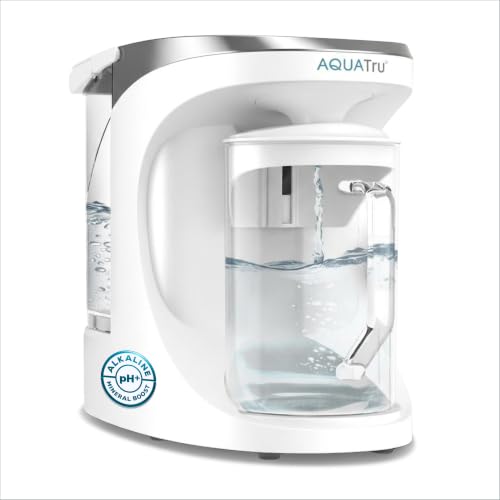
AquaTru Carafe

AquaTru Classic

APEC RO-90
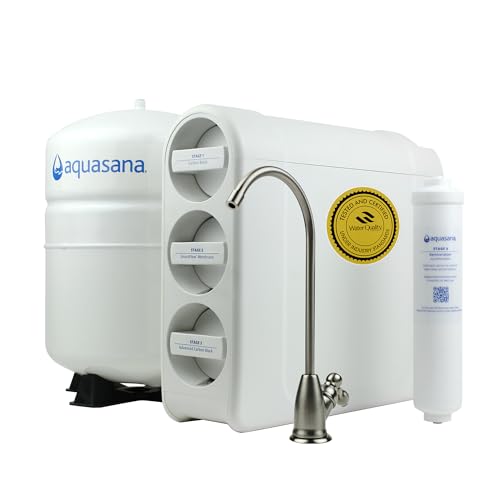
Aquasana SmartFlow RO
Culligan Aquasential RO
Common questions
Does boiling water remove arsenic?
No. Boiling does not remove arsenic, and it can concentrate arsenic as water evaporates.
What is the EPA limit for arsenic in drinking water?
The enforceable limit is 0.010 mg/L, or 10 ppb, and the health goal is zero. It was set in 2001 and took effect for public water systems on January 23, 2006.
Can you taste or smell arsenic in water?
No. Arsenic gives water no taste or odor, so it can only be found with a lab test.
Does reverse osmosis remove arsenic?
NSF/ANSI 58 includes arsenic and pentavalent arsenic reduction claims. Reverse osmosis is not effective at removing arsenic III, and New Hampshire recommends a follow-up arsenic III test before choosing a treatment system when arsenic is above 5 ppb.
How many private wells have high arsenic?
The USGS estimates about 2.1 million people in the lower 48 states may be drinking domestic well water with more than 10 micrograms per liter of arsenic, out of about 44 million domestic well users.
Sources
Prices as of November 1, 2026. Product prices and availability are accurate as of the date/time indicated and are subject to change. As an Amazon Associate we earn from qualifying purchases.