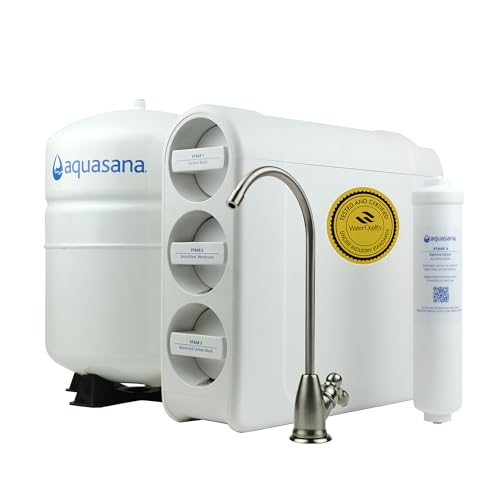
WQA certifies the SmartFlow for lead, PFOA/PFOS, fluoride, arsenic V, nitrate, chromium-6 and dissolved solids, and Aquasana adds microplastics and pharmaceuticals under NSF/ANSI 401. A remineralizer puts calcium and magnesium back.
The catch: Its carbon blocks are certified for 250 gallons and cost $91.99 every 6 months, so it’s expensive to run.
Health information, not medical advice. Guidance differs for infants, pregnancy and existing conditions. Test your own water and speak to a doctor or your local health authority. We may earn a commission when you buy through our links; it never affects our scores.
Our verdict
The SmartFlow is Aquasana’s current under-sink reverse osmosis system, replacing the OptimH2O. It has four stages: a carbon block, the SmartFlow membrane, Aquasana’s Claryum carbon block and a remineralizer, feeding a 3.2-gallon tank and its own faucet. Aquasana rates it at 25.7 gallons a day and 0.7 gallons a minute at the tap.
Its certified list is one of the broadest we’ve checked. WQA certifies it to NSF/ANSI 58 for fluoride, arsenic V, nitrate and nitrite, chromium-6, cadmium, copper, barium, selenium, radium and dissolved solids, and to NSF/ANSI 53 for lead, mercury and PFOA/PFOS. Aquasana’s data sheet also lists NSF/ANSI 42 for chlorine and chloramine and NSF/ANSI 401 for microplastics and 15 pharmaceuticals and chemicals. The remineralizer adds minerals back, so it avoids the flat taste of plain RO. Our NSF certification guide explains how to check a certifier’s listing yourself.
The cost is in the filters. WQA certifies the two carbon blocks for 250 gallons, and Aquasana says to change them every 6 months or 250 gallons. They cost $91.99 a pair, the remineralizer $31.49 every 6 months, and the membrane is replaced yearly. That’s at least $0.49 a gallon at the certified capacity, before the membrane, which is more than most under-sink RO systems.
You want certified PFOA/PFOS, lead and fluoride reduction in one under-sink system, with minerals added back, and you’ll pay more for filters.
Running cost matters most. The APEC RO-90 is certified for lead, fluoride and arsenic V with filters at about $60 to $75 a year, though not for PFAS.
How it scored
Contaminant reduction carries the most weight in the overall score. How we score filters
What it removes
Figures are from Aquasana’s performance data sheet. The certified-to column shows the standard each claim falls under.
| Contaminant | Reduction | Certified to |
|---|---|---|
| Lead | 99.8% / 99% | NSF/ANSI 53 |
| PFOA and PFOS | 99.7% | NSF/ANSI 53 |
| Fluoride | 90% | NSF/ANSI 58 |
| Arsenic V | 96% | NSF/ANSI 58 |
| Chromium-6 | 98% | NSF/ANSI 58 |
| Nitrate / nitrite | 78% | NSF/ANSI 58 |
| Total dissolved solids (TDS) | 96.4% | NSF/ANSI 58 |
| Mercury, cysts, VOCs, asbestos | Certified | NSF/ANSI 53 |
| Chlorine, chloramine | 96.8% | NSF/ANSI 42 |
| Microplastics | 99.3% | NSF/ANSI 401 |
| Pharmaceuticals and chemicals15 compounds, incl. BPA and ibuprofen | 91.7–97% | NSF/ANSI 401 |
| Bacteria, viruses | – | No claim |
Lead figures are at pH 6.5 and 8.5. The nitrate claim applies to water with no more than 27 mg/L nitrate and 3 mg/L nitrite, at 40 psi or more. We saw WQA’s model rows for NSF/ANSI 58 (AQ-SFRO2 and AQ-SFRO, every faucet finish) and NSF/ANSI 53 (AQ-SFRO2) on 7 October 2026. WQA’s NSF/ANSI 42 and 401 listings for Aquasana include its storage-tank systems; the 42 and 401 percentages come from Aquasana’s data sheet. Aquasana says to add a UV filter if your water may contain bacteria or viruses.
What it costs to run
Aquasana’s schedule is 6 months or 250 gallons for the two carbon blocks ($91.99), 6 months for the remineralizer ($31.49) and 12 months for the membrane. That’s about $247 a year before the membrane, and at least $0.49 a gallon if you use the full 250 gallons every 6 months. Aquasana’s Water for Life plan takes 15% off replacements. For comparison, the AquaTru Carafe works out to about $0.33 a gallon.
Pros and cons
Strengths
- Certified by WQA for lead, PFOA/PFOS and fluoride in one system
- Also certified for arsenic V, nitrate, chromium-6 and TDS
- Remineralizer adds minerals back for taste
- 2-year warranty and 90-day satisfaction guarantee (Aquasana)
What to know
- Carbon blocks certified for 250 gallons, changed every 6 months
- About $247 a year in filters before the membrane
- Usable tank volume drops to 1.4 gallons at low pressure
- Under-sink install; professional install recommended
What owners say
Owners like the taste and the compact design. The common complaints are filter prices and installation.
Often praised
- Clean, non-flat taste from the remineralizer
- Compact unit that fits under most sinks
- Confidence in the certified claims
Common complaints
- Expensive replacement filters
- Installation takes time; some hire a plumber
- Slower tank refill when water pressure is low
Recurring themes across verified buyer reviews.
Specifications
- Model
- AQ-SFRO2 (faucet finishes -NF, -CHR, -BN, -ORB, -MB)
- Type
- Under-sink reverse osmosis, 4 stages
- Certifier
- WQA
- Certified to
- NSF/ANSI 42, 53, 58, 401; CSA B483.1
- Daily production
- 25.7 gal (WQA)
- Flow
- 0.7 gpm
- Tank
- 3.2 gal; 1.4 to 3.2 usable, by pressure
- Filter life
- Carbon 6 months or 250 gal; remineralizer 6 months; membrane 12 months
- Warranty
- 2 years (Aquasana)
Alternatives worth considering

APEC RO-90
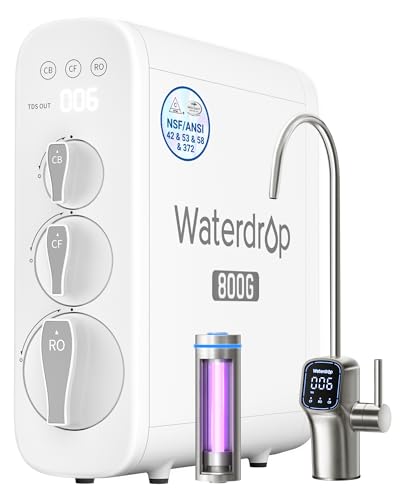
Waterdrop G3P800
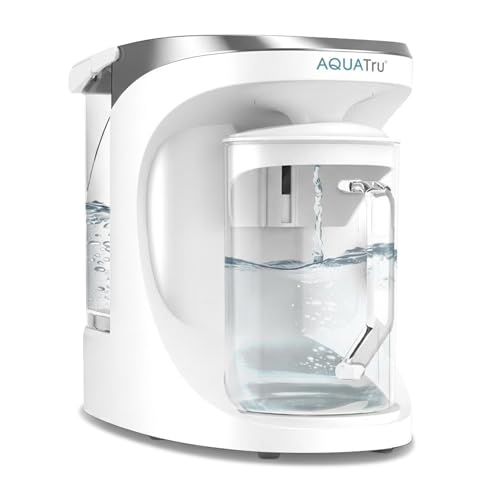
AquaTru Carafe
Common questions
Is the Aquasana SmartFlow certified?
Yes, by WQA. We saw its NSF/ANSI 58 listing (fluoride, arsenic V, nitrate, chromium-6, metals, TDS) and NSF/ANSI 53 listing (lead, mercury, PFOA/PFOS). Aquasana’s data sheet adds NSF/ANSI 42 and 401 and CSA B483.1.
Does it remove PFAS?
It’s certified for PFOA and PFOS under NSF/ANSI 53, at 99.7% on Aquasana’s data sheet. It isn’t certified for total PFAS. See our PFAS guide.
Does it remove fluoride?
Yes, certified under NSF/ANSI 58 at 90%. See our fluoride guide.
Is it the same as the Aquasana OptimH2O?
No. The SmartFlow replaces the OptimH2O, which Aquasana no longer sells. The SmartFlow makes about twice as much water a day under test (25.7 vs 13.32 gallons) and costs less than the OptimH2O did. Both are certified for lead and PFOA/PFOS. If you own an OptimH2O, see our OptimH2O page for its filters.
AQ-SFRO or AQ-SFRO2?
WQA lists both with the same NSF/ANSI 58 claims and the same replacement filters. The AQ-SFRO2 is the model Aquasana sells now.
How often do the filters need changing?
Carbon blocks every 6 months or 250 gallons, the remineralizer every 6 months and the membrane every 12 months, per Aquasana.
The bottom line
Buy the Aquasana SmartFlow if you want certified lead, PFOA/PFOS and fluoride reduction in one under-sink system, with minerals added back, and you’re ready for filter costs of around $250 a year. If running cost matters more and PFAS isn’t your concern, the APEC RO-90 is certified for lead, fluoride and arsenic V for a fraction of the filter cost. Compare them all in our reverse osmosis guide.
- Certifier listings: WQA, Aquasana Inc.: NSF/ANSI 58, AQ-SFRO2 and AQ-SFRO (all faucet variants), 25.7 gpd, element AQ-SFRO-S2, claims arsenic V (50 ppb), barium, cadmium, copper, fluoride, chromium-6, nitrate, nitrite, radium 226/228, selenium, TDS, trivalent chromium, turbidity. NSF/ANSI 53, AQ-SFRO2, element AQ-SFRO-S1S3, 250 gal, 0.7 gpm: asbestos, cyst, lead, mercury, MTBE, PFOA, PFOS, VOC. WQA lists Aquasana storage-tank systems under NSF/ANSI 42 and 401; model rows not seen.
- Also searched: NSF International (Aquasana): UV systems only.
- Maker documents: Aquasana AQ-SFRO2 performance data sheet and product page; carbon block and remineralizer replacement pages.
- Independent lab tests: None used.
Sources
Prices as of October 14, 2026. Product prices and availability are accurate as of the date/time indicated and are subject to change. As an Amazon Associate we earn from qualifying purchases.