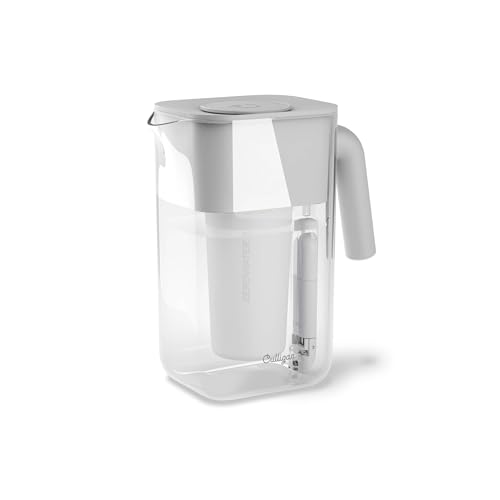
The most heavily certified pitcher filter we have reviewed, covering Total PFAS, fluoride, nitrate and a dozen pharmaceutical compounds under three separate standards. The catch is printed in its own performance data sheet: the certified filter capacity is 20 gallons, well short of what the marketing suggests.
We may earn a commission if you buy through our links, at no extra cost to you. It never affects our scores.
The Most Certified Pitcher You Can Buy, With a 20-Gallon Catch
Culligan bought ZeroWater and, in the new Culligan with ZeroWater Technology line, has done something the pitcher category rarely bothers with: taken the whole product through certification rather than certifying a handful of headline contaminants. The filter is certified by IAPMO R&T against NSF/ANSI 42, 53 and 401, plus NSF/ANSI/CAN 372 for lead-free materials and CSA B483.1 for Canada. That 401 listing is the unusual one, and it covers twelve pharmaceutical and incidental compounds along with bisphenol A.
The figures behind it are specific rather than rounded-up marketing. Total PFAS, defined as seven named compounds, reduces by 99.7%. Fluoride, which most pitchers cannot touch at all, reduces by 99.7% from an 8 mg/L challenge. Lead comes in at 98.9% at pH 6.5 and 98.8% at pH 8.5, hexavalent chromium above 99%, nitrate 99.1%.
Then you read the rest of the data sheet. Filter capacity is 20 gallons. Culligan’s support site separately publishes a table suggesting 25 to 40 gallons on typical municipal water, and as little as 8 gallons above 400 ppm. Twenty is the figure the certification was granted against, and it is the smaller one.
At roughly $14.50 a cartridge, certified water from this pitcher costs about $0.72 a gallon. That is four times what a Brita Elite costs to run and roughly five times an AquaTru, and it is the price of having the broadest certified contaminant list in the category.
Best for: households on municipal water with a known contaminant problem, particularly PFAS, fluoride or nitrate, who want the broadest certified reduction available without plumbing anything in, and who will budget honestly for cartridges rather than stretching them past the meter.
How It Scored, Category by Category
Each category is weighted into the overall score. Contaminant reduction is the best result any pitcher has posted for us and carries the most weight. Filter life and cost per gallon is what pulls the total back toward the middle of the field.
What It Removes
Every figure below comes from Culligan’s published performance data sheet and is backed by an IAPMO R&T certification, not by manufacturer testing alone. Metals are tested at two pH values and we show both where they differ.
| Contaminant | Average reduction | Certified? |
|---|---|---|
| Total PFAS (7 compounds) | 99.7% | NSF/ANSI 53 |
| Fluoride | 99.7% | NSF/ANSI 53 |
| Lead (pH 6.5 / 8.5) | 98.9% / 98.8% | NSF/ANSI 53 |
| Chromium-6 (pH 6.5 / 8.5) | 99.4% / 99.5% | NSF/ANSI 53 |
| Copper | 99.6% | NSF/ANSI 53 |
| Nitrate / nitrite | 99.1% / 90.2% | NSF/ANSI 53 |
| Mercury (pH 6.5 / 8.5) | 96.6% / 94.2% | NSF/ANSI 53 |
| Chlorine & zinc | 99.4% / 99.9% | NSF/ANSI 42 |
| Pharmaceuticals & BPA (13 compounds) | 96.1 to 99.4% | NSF/ANSI 401 |
| Total dissolved solids | Marketed at 99.9% | Not certified |
| Arsenic, microplastics | Not claimed | Not certified |
| Bacteria, viruses, cysts | Not claimed | Not certified |
Source: Culligan’s ZeroWater Technology performance data sheet and certifications. Systems are certified by IAPMO R&T, not by NSF International, against the NSF/ANSI standards named above. The near-zero TDS reading is the product’s headline claim and sits outside all of these certifications, because no standard tests TDS reduction on a gravity pitcher. The 401 compounds are atenolol, carbamazepine, DEET, estrone, ibuprofen, linuron, meprobamate, metolachlor, naproxen, nonylphenol, phenytoin and trimethoprim, plus bisphenol A. For what it covers, see our PFAS guide, fluoride guide and lead guide.
A zero reading is not a safety reading. The built-in meter measures dissolved solids, and this filter holds no microbiological certification. Culligan’s data sheet states the device is for potable water only and should not be used on water that is microbiologically unsafe or of unknown quality without disinfection. A reading of 000 from untested well or surface water tells you nothing about bacteria, viruses or cysts.
Why the 20-Gallon Figure Matters More Than the Price Tag
Pitchers are sold on the pitcher and paid for on the cartridges, and this one has the widest gap between those two numbers in the category. The certification was granted against a capacity of 20 gallons. Work out your cost per gallon on that figure, not on the 25 to 40 gallons the support table suggests for average water.
That table is worth reading anyway, because it makes explicit what most brands leave vague: filter life scales with what is in your water. Culligan’s own published ranges run from 40 gallons or more below 50 ppm down to 8 gallons or fewer above 400 ppm. On hard, high-TDS supply your running cost is not slightly higher than the brochure figure, it is several times higher, and the ion-exchange resin is doing exactly what it was designed to do while that happens.
| Filter | Rated life | Cost per gallon |
|---|---|---|
| Culligan ZeroWater | 20 gal | ~$0.72 |
| Legacy ZeroWater | 25 to 40 gal | ~$0.70 |
| Clearly Filtered pitcher | 100 gal | ~$0.55 |
| Brita Elite pitcher | 120 gal | ~$0.17 |
| AquaTru Classic | Varies by stage | ~$0.15 |
ZeroWater figure calculated at approximately $14.50 per replacement cartridge across the 20-gallon certified service life. Per-cartridge pricing is consistent across pack sizes on Amazon at the time of writing. Comparison figures are from our own reviews of each product. If you stretch a cartridge past 20 gallons because the meter still reads low, your cost per gallon falls, but you are running past the point the certification covers, which is the reason to buy this filter in the first place.
The upside is that you are never guessing. The meter reads zero while the resin is working and its indicator turns orange once it reads 6 or higher, which is Culligan’s stated replacement point. That is a more honest wear signal than the calendar timers on most pitchers, and it is why the cost is at least predictable even when it is high.
The New Filters Do Not Fit the Old Pitchers
This is the trap worth knowing before you order anything. Culligan redesigned the cartridge to install from the top down rather than twisting in from below, so Culligan with ZeroWater Technology cartridges are not compatible with legacy ZeroWater pitchers, and legacy cartridges will not fit the new ones. Culligan sells both lines side by side and labels the older one as legacy.
The two are also certified differently. The legacy line covers chlorine, lead, chromium-6 and PFOA/PFOS. The new line adds Total PFAS as a group, fluoride, nitrate, nitrite, mercury, cadmium, zinc and the NSF/ANSI 401 pharmaceutical list. If you own a legacy pitcher and the contaminant you care about is on the second list, you need the new hardware, not just new cartridges. Our review of the legacy ZeroWater pitcher covers the older system on its own terms.
One inconsistency we noticed. Culligan’s support page describes the filter media two different ways in two different answers, once as coal-based activated carbon with KDF and ion exchange resin, and once as activated carbon derived from coconut shell. Both appear on the same page. It does not change the certified performance, which is what we score on, but if the carbon source matters to you, ask before buying rather than trusting the page.
Pros and Cons
What we liked
- Certified against NSF/ANSI 42, 53 and 401, which is rare on a pitcher
- Total PFAS at 99.7% and fluoride at 99.7%, both certified
- TDS meter built in, with a defined replacement threshold
- No install, no priming, seven sizes from 7-cup to 40-cup
Worth considering
- 20-gallon certified capacity, the lowest of any pitcher we cover
- Running cost multiplies on high-TDS water, by the brand’s own figures
- Strips minerals too, so the water tastes flat and reads slightly acidic
- Not compatible with legacy cartridges, and only a 90-day warranty
What Independent Testing and Owners Report
Our score reflects certified performance. This line is new enough that the retail review pool needs reading carefully: a visible share of early reviews on major listings are labelled as collected through promotions or supplied by sampling programs in exchange for product, which is disclosed and legal but is not unprompted buyer sentiment. We have weighted independent lab testing more heavily than star counts as a result.
Independent testers who bought the product and ran their own lab work reach the same split we do: exceptional removal, punishing upkeep. One outlet recorded complete reduction of metals, minerals and inorganics with no leaching from the filter materials, while also rating it the highest-maintenance filter in its comparison. Another ranked it mid-pack across thirteen pitchers, near the top for lead and metals and near the bottom for daily use and upkeep cost.
Owners consistently praise
- A genuine 000 reading on the built-in meter from typical tap water
- Certified performance on contaminants other pitchers do not claim
- The redesigned lid, spout and handle over the legacy pitcher
Common complaints
- Slow gravity flow, rated at 2 gallons per day
- Cartridges exhausting quickly, especially on high-TDS supply
- Flat taste, and a sour note if a filter is pushed past the orange light
Qualitative summary of published independent lab testing and recurring themes across verified buyer reviews, current as of September 2026. We are not a testing lab. We report the patterns we see, positive and negative, and never cherry-pick.
The Details
Common Questions
Is Culligan ZeroWater NSF certified?
It is certified to NSF/ANSI standards, but by IAPMO R&T rather than by NSF International. That is a real, independent, ANSI-accredited certification and it counts. The standards are NSF/ANSI 42 for chlorine and zinc, NSF/ANSI 53 for Total PFAS, fluoride, lead, chromium-6 and nitrate, and NSF/ANSI 401 for pharmaceuticals and BPA, plus NSF/ANSI/CAN 372 for lead-free materials.
Is this the same as the old ZeroWater pitcher?
No. Culligan owns ZeroWater and now sells two separate lines. The newer Culligan with ZeroWater Technology pitchers use a redesigned top-loading cartridge that is not interchangeable with legacy ZeroWater filters in either direction, and it carries a broader certification covering Total PFAS, fluoride, nitrate and pharmaceutical compounds that the legacy line does not.
Does it really remove PFAS?
Yes, and the claim is specific rather than vague. It is certified under NSF/ANSI 53 for Total PFAS at 99.7% average reduction, where Total PFAS is defined as PFOA, PFOS, PFHxS, PFNA, PFHpA, PFBS and PFDA. That is a group claim rather than the PFOA and PFOS pair most certified filters stop at. See our PFAS guide for how the alternatives compare.
How long does a cartridge actually last?
The certified capacity is 20 gallons. Culligan separately publishes expected durations by feed water TDS, from 40 gallons or more below 50 ppm down to 8 gallons or fewer above 400 ppm. Use 20 gallons for budgeting and let the built-in meter tell you the truth for your own water. Replace once it reads 6 or higher.
Does it remove fluoride?
Yes, at 99.7% from an 8 mg/L challenge, certified under NSF/ANSI 53. That is genuinely unusual for a pitcher, since most carbon pitchers make no fluoride claim at all. See our fluoride guide for the alternatives.
Why does the water taste flat?
Because ion exchange strips dissolved minerals along with contaminants, the same reason reverse osmosis water tastes flat. If it bothers you, our guide to remineralizing low mineral water covers the fixes and which ones actually work.
Should You Buy It?
Buy it if you have a specific contaminant problem and want it dealt with by a certified product that needs no plumbing. Nothing else in the pitcher category carries Total PFAS, fluoride, nitrate and an NSF/ANSI 401 pharmaceutical listing at once, and if that list matches your water report, the running cost is worth paying. Go in knowing the cartridge is certified for 20 gallons and budget on that number rather than the marketing one.
Do not buy it as a general-purpose pitcher because it makes the meter read zero. At roughly $0.72 a gallon it is four times the running cost of a Brita Elite, which tastes better and costs a fraction to own, and the TDS figure that sells this product is the one claim on it that nobody has certified.
If the contaminant list is what you are after and you would rather not buy cartridges every few weeks, step up to the no-install AquaTru Carafe, certified under NSF/ANSI 58 and far cheaper per gallon. Compare the field in our best water filter pitchers roundup.
Check price on Amazon ›