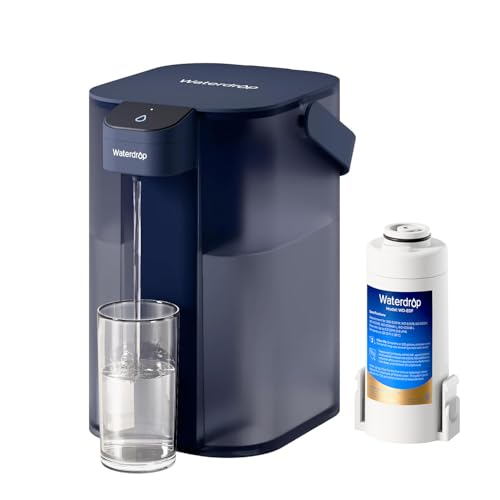
The best gravity water filter we’ve scored is the Waterdrop ED01. It’s certified by IAPMO R&T for lead, mercury, chlorine, and microplastics, and each WD-EDF filter is certified for 200 gallons, so its filters cost far less per gallon than the MaxClear’s.
The catch: It holds 15 cups, and its PFOA/PFOS figure is Waterdrop’s own claim. For certified lead and Total PFAS, the Culligan MaxClear is the only gravity system we found.
Health information, not medical advice. Guidance differs for infants, pregnancy, and existing conditions. Test your own water and speak to a doctor or your local health authority. We may earn a commission when you buy through our links; it never affects our scores.
How do the gravity filters compare?
The five gravity filters we recommend, ranked by our overall score. Certification splits them clearly: Two are certified for lead, one for Total PFAS, and the rest for chlorine or microplastics only. How we score
| # | Filter | Score | Certified by | Lead | PFAS | Fluoride | Filter life | Cost per gallon | Price |
|---|---|---|---|---|---|---|---|---|---|
| 01 | Waterdrop ED01Best overall | 4.1 | IAPMO R&T | Certified | Claim | No | 200 gal | $0.08 | $49.99on Amazon › |
| 02 | Culligan MaxClear VentureBest for lead and PFAS | 3.6 | IAPMO R&T | Certified | Certified | No | 50 gal | $1.58 | See priceat Culligan › |
| 03 | Big Berkey with Phoenix elementsBest off-grid system | 3.4 | NSF (Phoenix elements) | Lab test | Lab test | No | 1,050 gal certified | $0.02 to $0.11 | $267.00on Amazon › |
| 04 | Travel Berkey with Phoenix elementsMost portable | 3.3 | NSF (Phoenix elements) | Lab test | Lab test | No | 1,050 gal certified | $0.02 to $0.11 | $120.00on Amazon › |
| 05 | Boroux LegacyMicroplastics only | 2.2 | WQA | No | No | No | Not rated | Not rated | $399.00on Amazon › |
Certified: Certified by an independent body (named in each pick). Lab test: Tested by a named independent lab, not certified. Claim: The maker's claim, not certified. No: No claim. PFAS means PFOA/PFOS, or Total PFAS where the pick says so.
Our five picks in detail
What each filter is certified for, who certifies it, and who it suits.
Waterdrop ED01
Our highest score here: certified lead reduction for about $40, with filters at roughly $0.08 a gallon in a 3-pack. It's small, though: 15 cups at a time, pumped out by a rechargeable battery. Buy the ED01, not the ED01A, which uses a different filter certified for chlorine only.
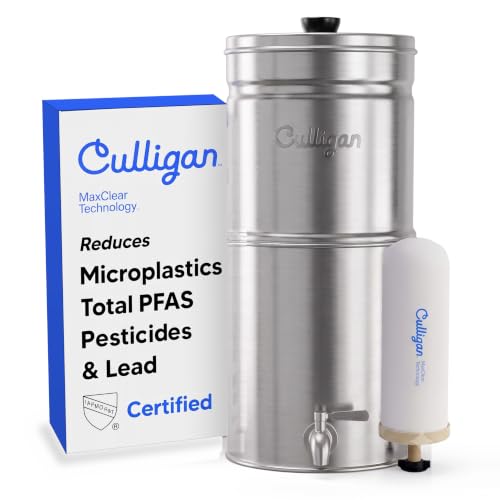
Culligan MaxClear Venture
The only gravity system we found with certified lead and Total PFAS reduction. The cost is the filter: about $79 each on Amazon for 50 certified gallons, roughly $1.58 a gallon. No fluoride claim.

Big Berkey with Phoenix elements
Works with no power or plumbing, which suits off-grid homes and emergencies. Only chlorine, taste and odor are certified; the Black Berkey elements it used to ship with aren't certified at all.
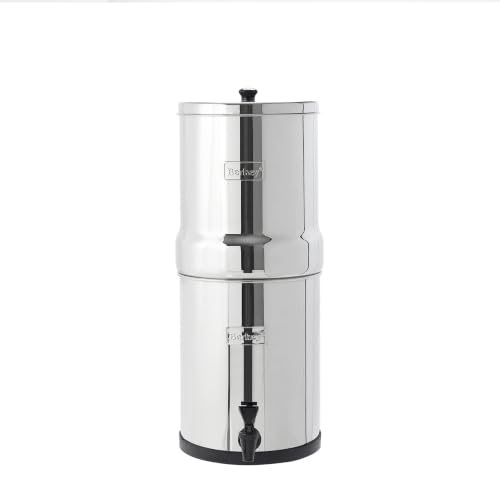
Travel Berkey with Phoenix elements
The portable Berkey. Buy the Phoenix elements to get the certified version; the system on Amazon ships with Black Berkey elements, which aren't certified.

Boroux Legacy
Built well and sized like a Royal Berkey, but its only certified health-related claim is microplastics, and it filters slowly: Boroux says about a gallon an hour with two filters. Boroux says the filters last up to 12 months but gives no gallon rating.
Which gravity filters didn’t make the list?
- British Berkefeld (Doulton). NSF International certifies its 2.25-gallon system for cysts, turbidity, and microplastics, but only with Ultra Sterasyl candles, and not for lead or PFAS. The common Amazon bundle ships with Super Sterasyl candles, which aren’t covered.
- ProOne. Culligan is replacing it with the MaxClear. Its lead and PFAS figures are lab results, not certification.
- Black Berkey elements. Not certified by NSF International, IAPMO R&T, or WQA, and under an EPA stop-sale order. Only the Phoenix elements are certified. Our Big Berkey review covers the details.
- Alexapure Pro, LifeStraw Home dispenser, Waterdrop King Tank. Each advertises lab results or standards, but we found no listing for them on NSF International’s directory.
How do you choose a gravity water filter?
Check the exact filter
Gravity certifications apply to one filter in one housing. Berkey is certified only with Phoenix elements, the ED01 only with the WD-EDF filter (not the ED01A’s), and the MaxClear filter only in Culligan’s Venture and Scout, even though Culligan says it fits a Berkey.
Count the cost per gallon
Filter costs range from about $0.02 a gallon (Berkey Phoenix, at Berkey’s rating) to about $1.58 (MaxClear, at its certified 50 gallons). At a gallon a day, that’s the difference between a few dollars and several hundred a year.
Know what they don’t do
None of these is certified to make untreated water safe from bacteria or viruses, and none is certified for fluoride. For fluoride or arsenic, look at countertop reverse osmosis.
Match the size to your household
The ED01 holds 15 cups, the Travel Berkey 1.5 gallons, and the Big Berkey, Scout, Venture, and Boroux 2.25 to 3 gallons. Gravity filters are slow: Boroux says about a gallon an hour with two filters.
Common questions
What’s the best gravity water filter?
The Waterdrop ED01 has our highest score. It’s certified by IAPMO R&T for lead and microplastics, with filters certified for 200 gallons. If you want certified lead and Total PFAS reduction in a full-size stainless unit, the Culligan MaxClear is the one, though its filters cost far more per gallon. For off-grid use with low running costs, the Big Berkey with Phoenix elements.
Which gravity filters remove lead?
Two are certified for it: The Waterdrop ED01 and the Culligan MaxClear, both by IAPMO R&T under NSF/ANSI 53. The Berkey Phoenix elements are lab-tested for lead by a named lab, but not certified. See our lead guide.
Do gravity filters remove PFAS?
The Culligan MaxClear is certified for Total PFAS by IAPMO R&T. The Berkey Phoenix elements are lab-tested for PFOA and PFOS, and the Waterdrop ED01’s PFOA/PFOS figure is Waterdrop’s own claim. See our PFAS guide.
Do gravity filters remove fluoride?
None of the filters here is certified for fluoride. Berkey’s Phoenix lab report shows 75.5%, below the level a certification requires. For fluoride, reverse osmosis is the dependable route. See our fluoride guide.
Can I use a gravity filter for camping or well water?
For taste and the certified contaminants, yes. None is certified to remove bacteria or viruses, so treat water from a lake, stream, or untested well first. See our well water guide.
Will MaxClear filters fit my Berkey?
Culligan says they fit Berkey and other gravity housings, but the IAPMO R&T certification covers them only in Culligan’s Venture and Scout. In a Berkey, the certified claims don’t apply.
Sources
- IAPMO R&T product listing directory: Culligan International (MaxClear) W-17176, W-17177, W-17178; Qingdao Ecopure (Waterdrop) W-14269, W-14270, W-14513
- NSF International listing, New Millennium Concepts (Berkey with Phoenix elements)
- NSF International listing, British Berkefeld (Doulton)
- WQA certified product listings (search “Boroux”: James Enterprise Inc)
- Culligan MaxClear Venture product page
- Waterdrop ED01 product page
- Boroux Legacy performance data sheet
Prices as of October 14, 2026. Product prices and availability are accurate as of the date/time indicated and are subject to change. As an Amazon Associate we earn from qualifying purchases.