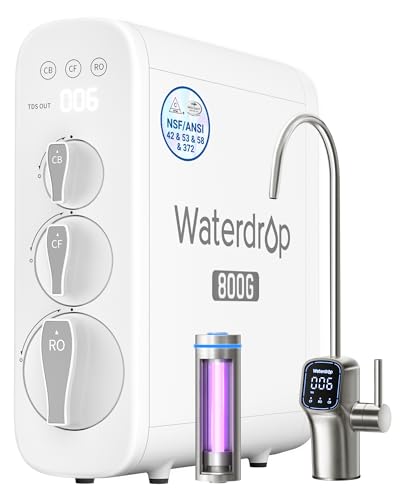
Certified by IAPMO R&T for lead, fluoride, PFOA/PFOS, cadmium and chlorine, with filtered water from its own faucet and no storage tank under the sink.
The catch: It needs a power outlet under the sink, and it costs more than tank RO systems.
Health information, not medical advice. Guidance differs for infants, pregnancy and existing conditions. Test your own water and speak to a doctor or your local health authority. We may earn a commission when you buy through our links; it never affects our scores.
Our verdict
The Waterdrop G3P800 is a tankless reverse osmosis system. Instead of filling a storage tank under the sink, it filters on demand into its own faucet, so it takes less cabinet space and doesn’t run dry after a big pour. Waterdrop rates it at 800 gallons a day with a 3:1 ratio of filtered water to drain water, which is efficient for reverse osmosis.
Its certifications are broad and current. IAPMO R&T certifies the WD-G3P800 to NSF/ANSI 58 for lead, fluoride, cadmium, barium, radium and dissolved solids; to NSF/ANSI 53 for PFOA and PFOS; and to NSF/ANSI 42 for chlorine, taste and odor. Our NSF certification guide explains how to check a certifier’s listing yourself.
The trade-offs are practical. It needs electricity, so you need an outlet under the sink, which many kitchens don’t have. It costs more than a tank system, and like all reverse osmosis it removes minerals, so some people find the water tastes flat.
You own your home, want certified lead, fluoride and PFAS reduction from a dedicated faucet, and have (or can add) an outlet under the sink.
You rent, have no outlet under the sink, or only need chlorine taste removed.
How it scored
Contaminant reduction carries the most weight in the overall score. How we score filters
What it removes
Every row below is certified by IAPMO R&T for the WD-G3P800.
| Contaminant | G3P800 | Certified to |
|---|---|---|
| Lead | Reduced | NSF/ANSI 58 |
| Fluoride | Reduced | NSF/ANSI 58 |
| PFOA / PFOS | Reduced | NSF/ANSI 53 |
| Cadmium, barium, radium 226/228 | Reduced | NSF/ANSI 58 |
| Total dissolved solids | Reduced | NSF/ANSI 58 |
| Chlorine, taste and odor | Reduced | NSF/ANSI 42 |
IAPMO R&T files WC-13976 (NSF/ANSI 58, with the WD-G3P800-RO membrane), WC-14805 (NSF/ANSI 53, with the WD-G3-CB filter, 1,100 gallons) and WC-14301 (NSF/ANSI 42, WD-G3-CB, 1,100 gallons), all issued to Qingdao Ecopure Filter Co. and active on 7 October 2026. Waterdrop also lists arsenic, nitrate and other reductions on its data sheet, and a UV light; those aren’t on the certificates. Reverse osmosis isn’t meant to make unsafe water safe to drink.
What it costs to run
The G3P800 uses three filters on different schedules. At Waterdrop’s prices, the sediment filter (CF) is $29.99 every 6 months or 550 gallons, the carbon filter (CB) is $29.99 every 12 months or 1,100 gallons, and the RO membrane is $139.99 every 24 months or 2,200 gallons. That works out to about $160 a year. The smart faucet shows filter life, so you don’t have to track the dates.
Pros and cons
Strengths
- Certified by IAPMO R&T for lead, fluoride and PFOA/PFOS
- Tankless: compact, with no wait for a tank to refill
- 3:1 filtered-to-drain ratio, efficient for RO
- Faucet display shows TDS and filter life
What to know
- Needs a power outlet under the sink
- Costs more than tank RO systems
- Removes minerals, so the water can taste flat
- Three filters on three replacement schedules
What owners say
Owners like the speed and the space it saves. Most complaints come from not planning for the outlet, or from the taste of mineral-free water.
Often praised
- Fast filtered water with no tank to wait on
- Compact under the sink
- The TDS display on the faucet
Common complaints
- Finding out at install that it needs an outlet
- Flat taste without a remineralizing filter
- Occasional filter errors after a change
Recurring themes across verified buyer reviews.
Specifications
- Model
- Waterdrop G3P800 (WD-G3P800)
- Type
- Tankless reverse osmosis, under-sink
- Certifier
- IAPMO R&T
- Certified to
- NSF/ANSI 42, 53 and 58
- Rated output
- 800 gallons a day
- Drain ratio
- 3:1 (Waterdrop)
- Filters
- CF 6 mo, CB 12 mo, RO 24 mo
- Power
- Needs an outlet (adapter included)
- Size
- 18.1 x 5.7 x 17.7 in
- Warranty
- 1 year
Alternatives worth considering
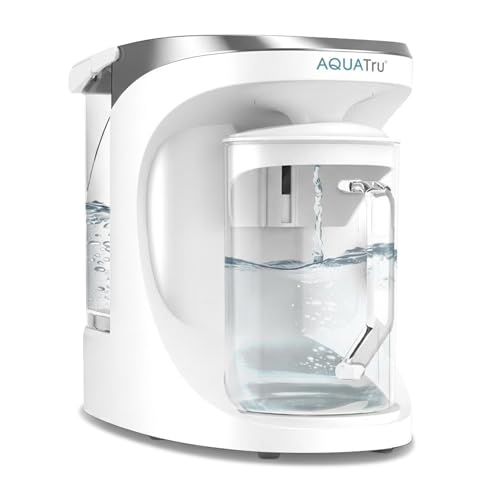
AquaTru Carafe

Epic Smart Shield
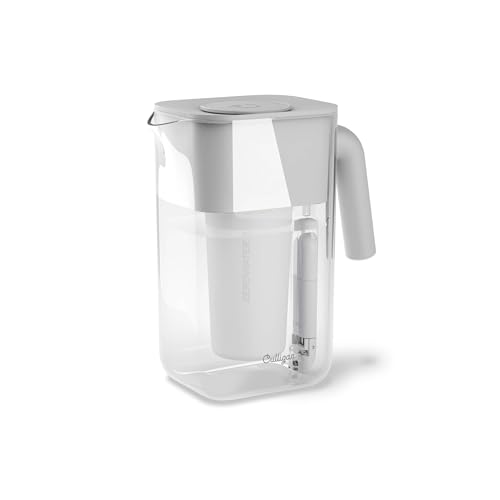
Culligan ZeroWater
Common questions
Is the Waterdrop G3P800 certified?
Yes, by IAPMO R&T: NSF/ANSI 58 for lead, fluoride, cadmium, barium, radium and dissolved solids; NSF/ANSI 53 for PFOA/PFOS; and NSF/ANSI 42 for chlorine, taste and odor. All three listings were active on 7 October 2026. NSF International doesn’t list it; IAPMO R&T is the certifier.
Does it need electricity?
Yes. It has a pump and a smart faucet, so it needs a standard outlet under the sink. Check before you buy, because many kitchens don’t have one there.
Does it remove lead and fluoride?
Yes. Both are certified under NSF/ANSI 58. See our lead guide and fluoride guide.
Does it remove PFAS?
It’s certified under NSF/ANSI 53 for PFOA and PFOS, the two most-studied PFAS. It isn’t certified for Total PFAS. See our PFAS guide.
How much water does it waste?
Waterdrop rates it at 3:1, three parts filtered water for every one part sent down the drain. That’s efficient for reverse osmosis.
How does it compare with the AquaTru Carafe?
Both are certified for lead, fluoride and PFOA/PFOS. The G3P800 gives you unlimited water from its own faucet but needs plumbing and an outlet. The AquaTru Carafe sits on the counter with no install, but makes half a gallon at a time.
The bottom line
Buy the G3P800 if you want certified lead, fluoride and PFAS reduction from a dedicated faucet, with no tank, and you have an outlet under the sink. If you rent or can’t add an outlet, the AquaTru Carafe covers the same three contaminants without any plumbing. Compare everything in our under-sink guide.
- Certifier listings: IAPMO R&T files WC-13976 (NSF/ANSI 58), WC-14805 (NSF/ANSI 53) and WC-14301 (NSF/ANSI 42), all active, for model WD-G3P800, issued to Qingdao Ecopure Filter Co.
- Also searched: NSF International. Waterdrop's NSF listings don't include the G3P800.
- Maker documents: Waterdrop's G3P800 product page and performance data sheet.
- Independent lab tests: None found.
Sources
Prices as of October 14, 2026. Product prices and availability are accurate as of the date/time indicated and are subject to change. As an Amazon Associate we earn from qualifying purchases.