
The Aquasana SimplySoft WH-SF40 is the best water softener we’ve reviewed because IAPMO R&T certifies it to NSF/ANSI 44 for hardness reduction and salt efficiency (file WP-16886), and its 11.02 gallons a minute is the highest flow of our three picks.
The catch: It goes on your main water line, and Aquasana recommends a licensed plumber or certified installer.
Health information, not medical advice. Guidance differs for infants, pregnancy and existing conditions. Test your own water and speak to a doctor or your local health authority. We may earn a commission when you buy through our links; it never affects our scores.
How do the best water softeners compare?
All three are salt-based softeners listed to NSF/ANSI 44 for hardness reduction and as efficiency rated, ranked by our overall score. We only rank softeners a certifier lists, because the listing is what backs the capacity and efficiency claims. How we score
| # | Softener | Score | Lead | PFAS | Fluoride | Filter life | Price |
|---|---|---|---|---|---|---|---|
| 01 | Aquasana SimplySoftBest overall | 4.1 | No | No | No | Resin lasts years; salt is the main cost | $749.00on Amazon › |
| 02 | Kenmore 350Best for smaller homes | 4.1 | No | No | No | Resin lasts years; salt is the main cost | $625.90on Amazon › |
| 03 | EcoPure EP42Best salt efficiency | 4.0 | No | No | No | Resin lasts years; salt is the main cost | $1,155.09on Amazon › |
Certified: Certified by an independent body (named in each pick). Lab test: Tested by a named independent lab, not certified. Claim: The maker's claim, not certified. No: No claim. The PFAS column means PFOA/PFOS, or Total PFAS where the pick says so.
The specifications below decide which one fits your house. Efficiency figures are each maker’s rating at the salt dose shown, and each is valid only at that dose.
| Softener | Certifier | Rated flow | Grains per lb of salt | Iron limit | Hardness limit |
|---|---|---|---|---|---|
| Aquasana SimplySoftWH-SF40 | IAPMO R&TWP-16886 | 11.02 gpm | 4,423 at 3 lb | 1 ppm | 200 gpg |
| Kenmore 350625.383500 | NSF International | 7.2 gpm | 5,040 at 2.5 lb | 8 ppm clear-water | 90 gpg |
| EcoPure EP42EP42 | NSF International | 8.2 gpm | 5,090 at 3.3 lb | 11 ppm clear-water | 110 gpg |
Listings checked 4 November 2026: IAPMO R&T file WP-16886 and NSF International’s NSF/ANSI 44 listing under Water Channel Partners. Flow rates are from the listings. The listings show each softener as efficiency rated, which means at least 3,350 grains per pound of salt. The grains-per-pound figures and the iron and hardness limits come from maker documents.
Which water softener should you buy?
Choose by how much water your house uses at once, then by your water. Each pick suits a different home.
Aquasana SimplySoft
Removes hardness throughout the house, the water heater included, and regenerates by gallons used. The Amazon listing is the softener only; the installation kit with the pre-filter costs extra.

Kenmore 350
Very salt-efficient, with the bypass valve and install kit in the box. Its 7.2 gpm flow suits smaller homes, and some owners report early control failures.

EcoPure EP42
More capacity than a 32,000-grain softener and very salt-efficient, with the bypass valve in the box. Its 8.2 gpm flow is below high-flow models, and its 11 ppm iron rating is EcoPure's own.
What size water softener do you need?
Size a softener by flow first, then by how much hardness you remove each day. Flow decides whether the softener keeps up when two showers and a washer run together. The Aquasana SimplySoft’s 11.02 gallons a minute suits bigger homes, and Aquasana sizes it for up to 5 people and 4 bathrooms. The Kenmore 350 has the lowest flow of the three at 7.2 gallons a minute, so it suits smaller homes. EcoPure pitches the EP42 at households of 1 to 5 or more people, and its 8.2 gallons a minute sits between them.
Capacity comes next. Multiply the gallons you soften per day by your hardness in grains per gallon (gpg). A home softening 165 gallons a day at 15 gpg removes about 2,475 grains a day, so a softener rated for 13,269 grains at a 3 lb salt dose, as the SimplySoft is, recharges about every 5 days. Lower salt settings save salt but give less capacity between regenerations.
How hard does your water need to be to need a softener?
Water above 120 mg/L, about 7 gpg, is generally classed as hard, and above 180 mg/L, about 10.5 gpg, as very hard. The harder the water, the more scaling in equipment and the more soap you need. To convert mg/L to gpg, divide by 17.1. If you don’t know your number, ask your water utility or test your water.
| Classification | mg/L as calcium carbonate | About gpg |
|---|---|---|
| Soft | 0 to 60 | 0 to 3.5 |
| Moderately hard | 61 to 120 | 3.6 to 7 |
| Hard | 121 to 180 | 7.1 to 10.5 |
| Very hard | More than 180 | More than 10.5 |
Classification from the US Geological Survey. The gpg column is our conversion. See our hard water guide.
How much salt will a water softener use?
About 180 to 200 pounds a year for a home softening 60,000 gallons of 15 gpg water, if the softener runs at its rated setting. That’s roughly 4.5 to 5 bags of 40 lb salt. The EcoPure EP42 and Kenmore 350 use the least, and the difference between all three is small.
| Softener | Grains per lb | Salt per year at 15 gpg | 40 lb bags a year |
|---|---|---|---|
| EcoPure EP42 | 5,090 | About 177 lb | About 4.4 |
| Kenmore 350 | 5,040 | About 179 lb | About 4.5 |
| Aquasana SimplySoft | 4,423 | About 204 lb | About 5.1 |
Our calculation: 60,000 gallons x 15 gpg = 900,000 grains a year, divided by each maker’s rated grains per pound. Real use can be higher, because the ratings apply only at the salt dose each maker states.
Salt isn’t the only upkeep. Aquasana recommends a softener cleaner every 3 months for indoor installations and cleaning the brine tank every 2 to 3 years.
Is a salt-free water softener a real softener?
No. A salt-free conditioner doesn’t remove calcium or magnesium, so the water stays hard. It aims to reduce scale instead, and that’s why we don’t rank one here. NSF/ANSI 44 covers cation exchange softeners, the type that removes hardness. If your area restricts salt-discharge softeners, or you only want less scale and accept that the water stays hard, the conditioner below is the one we’ve reviewed. It scores lower because we found no certifier listing for its scale claim.
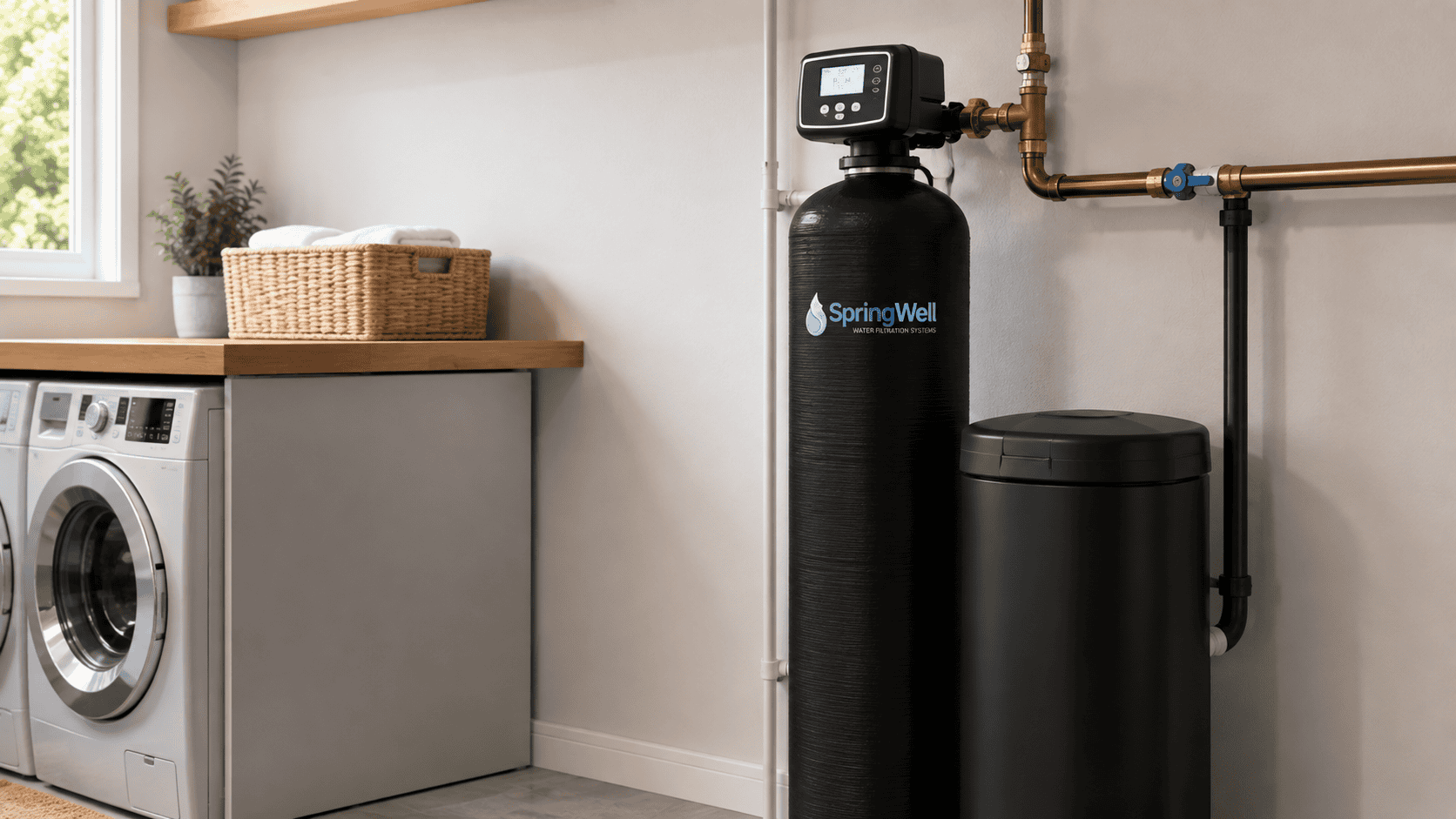
SpringWell FutureSoft
Which other softeners are certified?
NSF International’s NSF/ANSI 44 listing covers many more softeners than we’ve reviewed. These are listed, but we haven’t scored them yet, so they aren’t ranked.
- Higher flow. NSF International lists the Kenmore 625.384600 at 12.5 gallons a minute, the Whirlpool WHEC46 at 12.5 and the Whirlpool WHES48 at 12.
- Barium and radium. The Rheem RHS32 and RHS42 and the Morton MHY are listed for barium and radium 226/228 reduction as well as hardness. None of our three picks carries those claims.
- More capacity from the same brands. Aquasana’s SimplySoft WH-SF60 is on the same IAPMO R&T file as the WH-SF40, at 11.1 gallons a minute.
Common questions
Can I install a water softener myself?
Yes, if you’re comfortable cutting into your main water line. All three need a drain for regeneration water and a standard outlet. The Kenmore 350 and EcoPure EP42 include a bypass valve; check what comes with the SimplySoft listing you buy, because Aquasana’s installation steps use a pre-filter. Aquasana recommends a licensed plumber or certified installer, and some areas require one, so check your local plumbing code.
Does a water softener add sodium to drinking water?
Yes. Aquasana says softening adds about 7.5 mg of sodium per quart for each gpg of hardness removed, so 15 gpg water gains about 112 mg per quart. If you’re watching sodium, drink from a reverse osmosis tap. See our sodium guide.
Which water softener is best for well water?
The EcoPure EP42 has the highest iron rating of our picks, up to 11 ppm of clear-water iron, followed by the Kenmore 350 at 8 ppm. Those are the makers’ figures. Softeners are meant for water that’s microbiologically safe, so test the well first. See our well water guide.
Are salt-based water softeners banned anywhere?
They can be. California law lets local agencies in certain regions prohibit new residential self-regenerating softeners after a regional water board finds that controlling salinity will contribute to water quality objectives. Check with your city or sewer agency before you buy.
Does a water softener remove chlorine, lead or PFAS?
Our three picks aren’t certified for those; their listings cover hardness reduction only. For drinking water, add a filter certified for each contaminant you need to reduce, because reduction claims vary by model. See our best reverse osmosis system guide.
Sources
- NSF International NSF/ANSI 44 listings: Water Channel Partners (checked 4 Nov 2026)
- IAPMO R&T listing WP-16886, Aquasana, Inc., NSF/ANSI 44 (checked 4 Nov 2026)
- Aquasana WH-SF40 and WH-SF60 performance data sheet
- Kenmore 625.383500 owner’s manual
- EcoPure EP31 and EP42 installation and operation manual
Featured image: Water preparing bottles by Muselsom, cropped, CC BY-SA 4.0.
Prices as of November 12, 2026. Product prices and availability are accurate as of the date/time indicated and are subject to change. As an Amazon Associate we earn from qualifying purchases.