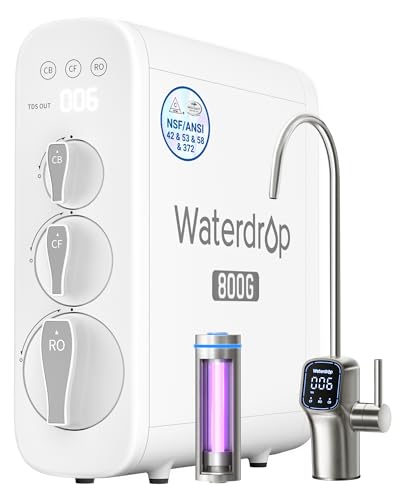
Waterdrop vs iSpring: The Waterdrop G3P800 is certified by IAPMO R&T to NSF/ANSI 58 for lead and fluoride and to NSF/ANSI 53 for PFOA/PFOS, and it filters on demand with no storage tank. The iSpring RCC7AK-BN is certified by NSF International to NSF/ANSI 58 for lead, fluoride and seven more contaminants, but not for PFAS.
The catch: The G3P800 needs a power outlet under the sink, and the standard model has no remineralization stage. If you buy the iSpring, buy the -BN or -BLK: The plain RCC7AK is certified for dissolved solids only.
Health information, not medical advice. Guidance differs for infants, pregnancy, and existing conditions. Test your own water and speak to a doctor or your local health authority. We may earn a commission when you buy through our links; it never affects our scores.
How do Waterdrop and iSpring compare?
Both are under-sink reverse osmosis systems with their own faucet, but they’re built differently. The Waterdrop G3P800 is tankless: Waterdrop describes a “sleek, tankless design” that filters as you pour and needs electricity. The iSpring RCC7AK-BN is a six-stage system that fills a storage tank and finishes with an alkaline stage after the membrane. They also answer to different certifiers, IAPMO R&T for Waterdrop and NSF International for iSpring. How we score
| # | System | Score | Certified by | Lead | PFAS | Fluoride | Running cost | Price |
|---|---|---|---|---|---|---|---|---|
| 01 | Waterdrop G3P800Best of the twoUnder-sink RO | 4.3 | IAPMO R&T | Certified | Certified | Certified | About $160/yr | $759.00on Amazon › |
| 02 | iSpring RCC7AK-BNTank RO with an alkaline stageUnder-sink RO | 3.9 | NSF International | Certified | Claim | Certified | $90 to $100/yr | $199.99on Amazon › |
Certified: Certified by an independent body (named in each pick). Lab test: Tested by a named independent lab, not certified. Claim: The maker's claim, not certified. No: No claim. PFAS means PFOA/PFOS, or Total PFAS where the pick says so.
What is each one certified to remove?
Both are certified for lead, fluoride and dissolved solids under NSF/ANSI 58, but only the Waterdrop is certified for PFOA/PFOS and chlorine. The iSpring’s NSF International listing adds copper, selenium, trivalent chromium and asbestos, and the Waterdrop’s IAPMO R&T listing adds radium 226/228.
| Contaminant | Waterdrop G3P800 | iSpring RCC7AK-BN / -BLK | Plain iSpring RCC7AK |
|---|---|---|---|
| Lead | Certified (NSF/ANSI 58) | Certified (NSF/ANSI 58) | No claim |
| Fluoride | Certified (NSF/ANSI 58) | Certified (NSF/ANSI 58) | No claim |
| PFOA/PFOS | Certified (NSF/ANSI 53) | No claim | No claim |
| Total dissolved solids | Certified (NSF/ANSI 58) | Certified (NSF/ANSI 58) | Certified (NSF/ANSI 58) |
| Cadmium, barium | Certified (NSF/ANSI 58) | Certified (NSF/ANSI 58) | No claim |
| Radium 226/228 | Certified (NSF/ANSI 58) | No claim | No claim |
| Copper, selenium, trivalent chromium | No claim | Certified (NSF/ANSI 58) | No claim |
| Asbestos | No claim | Certified (NSF/ANSI 58) | No claim |
| Chlorine | Certified (NSF/ANSI 42) | No claim | No claim |
| Arsenic, nitrate | No claim | No claim | No claim |
Waterdrop: IAPMO R&T files WC-13976 (NSF/ANSI 58), WC-14805 (NSF/ANSI 53) and WC-14301 (NSF/ANSI 42), model WD-G3P800, listee Qingdao Ecopure Filter Co. iSpring: NSF International listing for iSpring Water Systems LLC under NSF/ANSI 58, current as of 12 October 2026. The RCC7AK-BN and RCC7AK-BLK (Nanjing plant, filters FP15, FC15, FG15, MC7, FT15 and FA15) carry nine claims; the plain RCC7AK (Taichung plant) carries TDS reduction only. Certifications apply to the exact model, so check the suffix before you buy.
Why does the iSpring model suffix matter?
Because NSF International certifies the plain RCC7AK for TDS reduction only, while the RCC7AK-BN and RCC7AK-BLK are certified for lead, fluoride, TDS, asbestos, barium, cadmium, trivalent chromium, copper and selenium. The listings are split by factory: The -BN and -BLK come from iSpring’s Nanjing, China plant, and the plain RCC7AK from its Taichung City, Taiwan plant. The same split applies to the UV versions: The RCC7AK-UVBN and RCC7AK-UVBLK carry all nine claims, the RCC7AK-UV only TDS. If a listing or box says only “RCC7AK”, don’t assume lead or fluoride reduction is certified.
Is Waterdrop or iSpring better for PFAS?
The Waterdrop G3P800. IAPMO R&T certifies it under NSF/ANSI 53 for PFOA and PFOS (file WC-14805). It isn’t certified for Total PFAS. NSF International’s listing for the iSpring covers NSF/ANSI 58 only, with no PFAS claim on any RCC7AK model. See our PFAS filter guide and does reverse osmosis remove PFAS?
Which makes more water?
The Waterdrop, on the makers’ own figures. Waterdrop rates the G3P800 at 800 gallons a day and says it fills a 6-ounce cup in 5 seconds, with no tank to run dry. iSpring rates the RCC7AK at 75 gallons a day on its product page. NSF International’s listing puts the RCC7AK-BN’s daily production rate at 25.41 gallons under its test conditions. The tank on the iSpring stores filtered water so a pour comes out fast, but once the tank is empty you wait for it to refill.
Which wastes less water?
The Waterdrop, by the makers’ own numbers, though the two are measured differently. Waterdrop’s figure is a 3:1 pure-to-drain ratio, which it describes as one cup of wastewater for every three cups of filtered water (maker’s claim). iSpring’s 2014 user manual for the RCC7AK lists an efficiency rating of 15.82% and a recovery rating of 26.76% (maker’s figures). The EPA’s WaterSense specification defines the efficiency rating as the percentage of the water going into the system that is available to the user as RO treated water, so on iSpring’s number about 5.3 gallons go to the drain for every gallon you get. That’s a whole-system rating for a system with a storage tank, not a pure-to-drain ratio for the membrane alone, so it can’t be set directly against Waterdrop’s 3:1. Neither figure is part of the certifications on this page.
Does either need electricity?
The Waterdrop does. Waterdrop lists “Electricity Required: Yes” and includes a power adapter, so you need an outlet in the sink cabinet. iSpring’s manual lists six filter stages and a feed pressure of 40 to 80 psi, and neither the manual nor iSpring’s RCC7AK product pages mention a pump or power supply; iSpring sells pumped versions under the RCC7P-AK name. In exchange for the outlet, the Waterdrop saves space: Waterdrop says the tankless design frees about 70% of the space under the sink. The iSpring needs room for its filter rack and a tank.
Which one adds minerals back?
The iSpring, as standard. Its sixth stage, the FA15 alkaline filter, sits after the membrane; iSpring’s manual lists it as the alkaline stage, and NSF International’s listing names the FA15 among the RCC7AK-BN’s replacement elements. The standard G3P800 has no mineral stage: Waterdrop’s comparison table marks alkaline mineralization as not included, and the base system lists no mineral filter. Waterdrop does sell a G3P800 bundle with its MNR35 remineralization filter, an add-on it lists for G3 series systems. Reverse osmosis removes minerals along with contaminants, so some people find straight RO water tastes flat. See is reverse osmosis water good for you?
How often do the filters need changing?
The Waterdrop has three filter cartridges and the iSpring six, so the iSpring needs more changes. At Waterdrop’s prices, the G3P800’s CF filter ($29.99) is changed every 6 months or 550 gallons, the CB carbon filter ($29.99) every 12 months or 1,100 gallons, and the RO membrane ($139.99) about every 24 months. Waterdrop’s own pages disagree on the membrane’s gallon rating, listing 2,200 gallons in one place and 2,900 in another, so we go by the 24-month interval. That works out to $159.97 a year, the same figure Waterdrop publishes, and Waterdrop says the filters change with a twist and no tools. iSpring’s manual says to change stages 1, 2, 3 and 6 every 6 months, stage 5 every 12 months and the membrane every 2 to 3 years. That’s nine cartridges a year plus a membrane every few years. iSpring sells those nine as a one-year set (F9K, $80.99, no membrane) and a two-year set with a membrane (F19K75, $178.99), so at iSpring’s prices the filters work out to about $90 to $100 a year, depending on the set you buy and when the membrane is due.
How do the two score in detail?
The Waterdrop scores higher because its certifications cover PFOA/PFOS as well as lead and fluoride; the iSpring is the pick if you want a tank system with an alkaline stage.
Waterdrop G3P800
Tankless reverse osmosis with certified lead, fluoride and PFOA/PFOS reduction from its own faucet. It needs a power outlet under the sink, and filters cost about $160 a year.
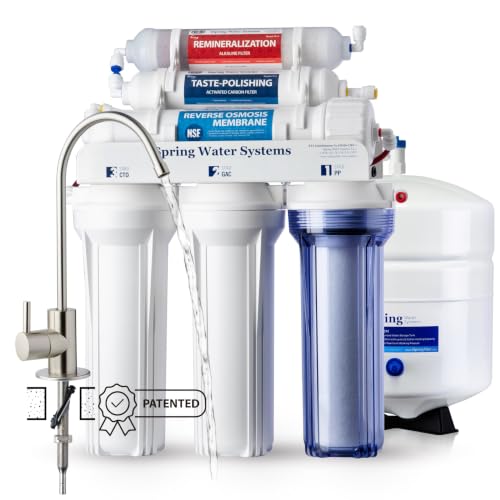
iSpring RCC7AK-BN
One of the least expensive under-sink reverse osmosis systems we found with certified lead and fluoride reduction, plus an alkaline stage that adds minerals back. Check the model: only the -BN and -BLK versions are certified for lead and fluoride. Filters run about $90 to $100 a year at iSpring's prices.
Waterdrop or iSpring: Which should you buy?
Buy the Waterdrop for certified PFOA/PFOS reduction and on-demand water; buy the iSpring RCC7AK-BN or -BLK if you want no power under the sink and an alkaline stage.
Pick the Waterdrop G3P800 if
You want certified PFOA/PFOS reduction along with lead and fluoride, fast water with no tank, and you have (or can add) an outlet under the sink.
Pick the iSpring RCC7AK-BN if
Lead and fluoride are your main concerns, you’d rather not run power under the sink, and you want an alkaline stage after the membrane. Make sure the model ends in -BN or -BLK.
Can’t install under the sink?
See AquaTru vs Waterdrop, which pits the G3P800 against a countertop RO system.
Compare more RO systems
See our reverse osmosis roundup and iSpring vs APEC ROES-50.
What do people ask about Waterdrop and iSpring?
Answers to the questions that come up after choosing between them.
Is Waterdrop or iSpring better?
The Waterdrop G3P800 scores higher. IAPMO R&T certifies it to NSF/ANSI 58 for lead and fluoride, NSF/ANSI 53 for PFOA/PFOS and NSF/ANSI 42 for chlorine, and it delivers water on demand with no tank. The iSpring RCC7AK-BN is NSF certified for lead and fluoride, with no certified PFAS claim.
Is the iSpring RCC7AK NSF certified for lead?
Only the RCC7AK-BN and RCC7AK-BLK. NSF International lists those two for lead, fluoride and seven other contaminants under NSF/ANSI 58. The plain RCC7AK, made in a different factory, is listed for TDS reduction only. Check the suffix on the box or listing before you buy. See our lead guide.
How much water does a reverse osmosis system waste?
The tankless Waterdrop sends less to the drain on the makers’ own figures. Waterdrop claims a 3:1 pure-to-drain ratio for the tankless G3P800. iSpring’s manual gives the tank-based RCC7AK an efficiency rating of 15.82%, so most of the water entering it goes to the drain. Neither figure is certified, and they’re measured differently.
Can I install either one myself?
Waterdrop pitches the G3P800 as a DIY job: It says installation takes about 30 minutes and includes a drain saddle in the box, but you need an outlet under the sink. The iSpring needs no outlet but has more parts to fit: Six stages, a tank and a faucet. Both connect to a drain line. See how reverse osmosis works.
Which is better for renters?
Neither is ideal, since both need a faucet, a drain connection and space under the sink, and the Waterdrop also needs an outlet there. If you can’t change the plumbing, a countertop reverse osmosis system such as the AquaTru Carafe, which AquaTru says needs no installation or plumbing, is the simpler choice. See our apartment filter guide.
Sources
- NSF International listing, iSpring Water Systems LLC (NSF/ANSI 58)
- IAPMO R&T product listing directory (Qingdao Ecopure Filter Co.: WC-13976, WC-14805, WC-14301)
- Waterdrop G3P800 product page
- Waterdrop MNR35 remineralization filter
- EPA WaterSense Specification for Point-of-Use Reverse Osmosis Systems, Version 1.0 (November 2024)
Prices as of November 1, 2026. Product prices and availability are accurate as of the date/time indicated and are subject to change. As an Amazon Associate we earn from qualifying purchases.