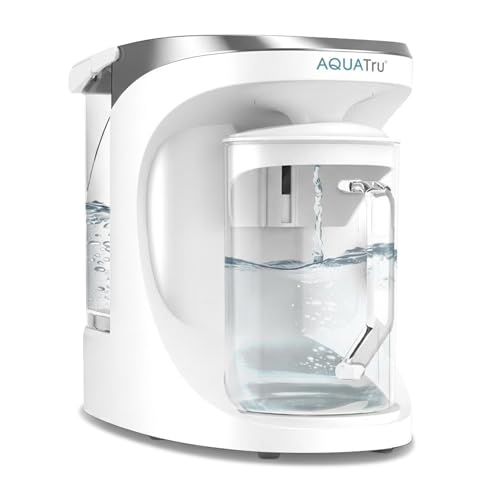
AquaTru Carafe vs Classic: both are certified by IAPMO R&T to the same four standards for lead, fluoride, arsenic, nitrate, PFOA/PFOS, and microplastics. The Carafe is smaller and fills a glass carafe that goes straight in the fridge, while the Classic makes more water per batch and costs about half as much per gallon to run.
The catch: At about $0.33 a gallon, the Carafe costs roughly twice as much to run as the Classic.
Health information, not medical advice. Guidance differs for infants, pregnancy, and existing conditions. Test your own water and speak to a doctor or your local health authority. We may earn a commission when you buy through our links; it never affects our scores.
How do the AquaTru Carafe and Classic compare?
Two countertop reverse osmosis systems from the same maker, with no plumbing. You fill a tap water tank, plug it in, and filtered water collects in a separate container. The differences are size, running cost, and a few certified claims. How we score
| # | Filter | Score | Certified by | Lead | PFAS | Fluoride | Running cost | Price |
|---|---|---|---|---|---|---|---|---|
| 01 | AquaTru CarafeBest of the twoCountertop RO | 4.6 | IAPMO R&T | Certified | Certified | Certified | $0.33/gal | $356.25on Amazon › |
| 02 | AquaTru ClassicMore water, lower running costCountertop RO | 4.5 | IAPMO R&T | Certified | Certified | Certified | $0.17/gal | $451.25on Amazon › |
Certified: Certified by an independent body (named in each pick). Lab test: Tested by a named independent lab, not certified. Claim: The maker's claim, not certified. No: No claim. PFAS means PFOA/PFOS, or Total PFAS where the pick says so.
What is each one certified to remove?
Both are certified by IAPMO R&T to NSF/ANSI 42, 53, 58, and 401, under separate model listings. Most of the claims match. The Carafe adds chromium-6; the Classic adds VOCs and 15 compounds such as pharmaceuticals and pesticides.
| Contaminant | AquaTru Carafe | AquaTru Classic |
|---|---|---|
| Lead | Certified (NSF/ANSI 58) | Certified (NSF/ANSI 58) |
| Fluoride | Certified (NSF/ANSI 58) | Certified (NSF/ANSI 58) |
| PFAS | PFOA/PFOS (NSF/ANSI 53) | PFOA/PFOS (NSF/ANSI 53) |
| Arsenic, nitrate | Certified (NSF/ANSI 58) | Certified (NSF/ANSI 58) |
| Chromium-6 | Certified (NSF/ANSI 58) | No claim |
| VOCs | No claim | Certified (NSF/ANSI 53) |
| Microplastics | Certified (NSF/ANSI 401) | Certified, plus 15 compounds (NSF/ANSI 401) |
| Chlorine, chloramine | Certified (NSF/ANSI 42) | Certified (NSF/ANSI 42) |
| Efficiency rating | 63% | 75% |
IAPMO R&T listings for models AT100 to AT140 (Carafe) and AT2000 to AT2050 (Classic, files W-10188, W-10193, W-10194, and W-10195). Neither is certified for Total PFAS.
Which holds more water?
The Classic. It has a 1-gallon tap water tank and a clean water tank of about 3 quarts, and holds about 3 quarts of filtered water at a time, about 50% more than the Carafe. The Carafe has a 0.66-gallon tap water tank and fills a half-gallon glass carafe in 12 to 15 minutes. For one or two people the Carafe keeps up; for a family that drinks and cooks with filtered water, the Classic means fewer refills.
Which takes less counter space?
The Carafe, at 13 × 14 × 7.5 inches and about 9 pounds, against 14 × 14 × 12 inches for the Classic. The Carafe’s glass container also lifts out and fits in the fridge, so you get cold water without a second jug. Both need a 120 V outlet.
Which is cheaper to run?
The Classic, at about $0.17 a gallon against about $0.33 for the Carafe, based on AquaTru’s filter prices and rated filter lives. That works out to about $130 a year in filters for the Classic. The Classic also wastes less water, with a 75% efficiency rating against 63%. The two use different filters, so you can’t swap them between units.
The two in detail
AquaTru Carafe
One of the broadest certified claim lists we've seen, including fluoride and arsenic, with no plumbing. It needs an outlet and makes half a gallon at a time, and its filters work out to about $0.33 a gallon at AquaTru's prices.

AquaTru Classic
The same certified reverse osmosis claim list as the Carafe in a bigger countertop unit, about a gallon per batch. It needs a power outlet, and filters cost about $130 a year.
AquaTru Carafe or Classic: which should you buy?
Pick the AquaTru Carafe if
You’re one or two people, counter space is tight, or you want chilled water in a glass carafe. It also carries the chromium-6 claim.
Pick the AquaTru Classic if
You drink and cook with a lot of filtered water, you want the lower cost per gallon, or VOCs are on your water report.
Consider a pitcher if
You don’t want to plug anything in. The Culligan ZeroWater is certified for fluoride and Total PFAS. See AquaTru vs ZeroWater.
Compare more countertop filters
See our countertop roundup and reverse osmosis roundup.
Common questions
Is the AquaTru Carafe or Classic better?
For most small households, the Carafe: it’s smaller, fills a glass carafe for the fridge, and is certified by IAPMO R&T for the same core contaminants. The Classic is the better pick if you use a lot of filtered water, since it makes more per batch and costs about half as much per gallon.
Do they filter water the same way?
Yes. Both use four stages: a pre-filter and carbon, a reverse osmosis membrane, and a final carbon filter. Both are certified to the same four NSF/ANSI standards, with small differences in the claims listed above.
Are AquaTru Carafe and Classic filters interchangeable?
No. Each unit uses its own filter set. Buy replacements for the model you own.
Do both remove fluoride?
Yes. Both are certified by IAPMO R&T for fluoride under NSF/ANSI 58. See our fluoride guide.
Do both remove PFAS?
Both are certified for PFOA and PFOS under NSF/ANSI 53, not for Total PFAS. See our PFAS guide.
Sources
- IAPMO R&T product listing directory (AquaTru, models AT100 to AT140 and AT2000 to AT2050)
- AquaTru performance data sheets and filter prices (aquatru.com)
Prices as of October 14, 2026. Product prices and availability are accurate as of the date/time indicated and are subject to change. As an Amazon Associate we earn from qualifying purchases.