The short version
There is no single substitute for distilled water, because distilled water does two unrelated things at once: it contains almost no dissolved minerals, and it contains nothing living. Work out which of those you actually need. If you need mineral free water for an appliance, reverse osmosis or deionized water will do, and boiling will not, because boiling concentrates minerals rather than removing them. If you need germ free water for a nasal rinse, boiled and cooled tap water will do, and an ordinary filter pitcher will not. Get that distinction the wrong way round and the substitute is either useless or, in the case of nasal rinsing, dangerous.
Skip to what we recommend ›Health information notice. This page is general information, not medical advice. Guidance differs for infants, during pregnancy, and for anyone with a lung condition or a weakened immune system. Test your own water, follow the instructions that came with your device, and speak to a doctor or your local health authority about your own situation.
Distilled Water Does Two Different Jobs
Distillation boils water, captures the steam, and condenses it back into a separate container. Everything that cannot travel as vapor stays behind: calcium, magnesium, sodium, iron, most metals, and anything alive. What arrives in the second container is water with almost no dissolved solids and no bacteria, protozoa, or amoebas in it.
Those are two separate properties, and almost every recipe that calls for distilled water only needs one of them. A humidifier needs the mineral free half, because minerals are what become white dust and scale. A neti pot needs the germ free half, because the mineral content of tap water is harmless in your nose and the organisms in it are not. Once you know which half your job depends on, the list of workable substitutes gets much shorter and much clearer.
- If you need mineral free water, you are protecting a machine or avoiding residue. Reverse osmosis, deionized, and demineralized water all get you most of the way there. Boiling gets you the opposite of where you want to be.
- If you need germ free water, you are protecting yourself. Boiling works, sterile water works, and a filter works only if it carries a specific certification. Low mineral content is irrelevant.
The trap is that both types get sold under vague labels. Bottled water marked purified may have been distilled, treated by reverse osmosis, or processed some other way entirely, and the bottle often does not say which. If the label does not name the process, treat it as unknown.
What Each Substitute Actually Replaces
Ranked by how close each one gets to real distilled water, with the reason it falls short:
| Substitute | Minerals removed | Free of organisms | Use it for |
|---|---|---|---|
| Deionized or demineralized | Yes | No | Batteries, cooling systems, appliances |
| Reverse osmosis | Mostly | Not by default | CPAP, humidifiers, aquariums, general appliance use |
| Sterile water, pharmacy | Usually | Yes | Nasal rinsing, anything the packaging specifies |
| Boiled and cooled tap | No, it concentrates them | Yes | Nasal rinsing only |
| Bottled purified water | Depends on the process | Usually | Only when the label names distillation or reverse osmosis |
| Filter pitcher water | No | No | Drinking. It is not a distilled water substitute |
| Spring or mineral water | No | No | Nothing on this page |
| Condensate or rainwater | Low, but variable | No | Nothing. It collects on dirty surfaces |
Water from a dehumidifier, an air conditioner drip tray, or a tumble dryer is low in minerals for the same reason distilled water is, which is why it keeps getting suggested online. It has also condensed onto coils and sat in a tray, so it carries whatever was growing there. Appliance manufacturers routinely name it as a water type to avoid, and it should never go anywhere near a person.
What to Use for What
The same question has a different answer depending on what you are filling. These are the cases people actually search for:
| What you are filling | Workable substitute | Do not use |
|---|---|---|
| CPAP humidifier chamber | Reverse osmosis water, if your chamber allows anything other than distilled | Tap, spring, or bottled water that is not distilled or RO |
| Ultrasonic or cool mist humidifier | Reverse osmosis or deionized water, second to distilled | Tap water, which becomes white dust and airborne minerals |
| Evaporative wick humidifier | Tap water is fine, the wick holds the minerals back | Nothing in particular, but change the wick on schedule |
| Neti pot or sinus rinse | Sterile water, boiled and cooled tap, or a certified filter | Tap water, pitcher-filtered water, well water |
| Contact lenses | Nothing. Commercial sterile saline only | Distilled, boiled, or homemade saline of any kind |
| Lead-acid car battery | Deionized or demineralized water | Tap water, which leaves deposits on the plates |
| Steam iron or garment steamer | Whatever the manual specifies, often untreated tap water | Assuming distilled is the safer choice, see below |
| Freshwater or reef aquarium | RO or RO/DI water, remineralized before it goes in the tank | Straight distilled water with nothing added back |
| Baby formula | Safe tap or filtered water. Distilled is not required | Untested well water, and high-fluoride water for formula-fed infants |
Two of those deserve more than a table row. On CPAP machines, the water instruction belongs to the chamber rather than to the machine, and the two are not interchangeable. ResMed’s standard HumidAir 11 chamber is labelled for distilled water only, while the cleanable, dishwasher-safe chamber for the same device is labelled as accepting drinking quality water. Read the label on the part you are filling before you decide what to fill it with, and if it says distilled only, that is a warranty condition as much as a maintenance tip.
On baby formula, distilled water is a common recommendation that mostly is not necessary. What matters more is that the water is microbiologically safe and, for a formula-fed infant, low in fluoride, since formula reconstituted with fluoridated water is a recognized route to dental fluorosis. Our guide to water filters for baby formula covers which certifications actually address that.
Never use distilled or homemade water with contact lenses. Distilled water is mineral free, not sterile in the way lens care requires, and rinsing or storing lenses in it has been linked to Acanthamoeba keratitis, a rare corneal infection that is extremely difficult to treat. Contact lenses take commercial sterile saline and lens solution, and nothing else.
Where Filtered Water Counts, and Where It Does Not
This is the part most articles on the subject get wrong, because filtered water qualifies as a substitute in one of the two jobs and not the other, and the deciding factor is a specific certification rather than the price of the filter.
For mineral removal, reverse osmosis is the practical home substitute, and the standard tells you how far it goes. Every system certified to NSF/ANSI 58 has passed the standard’s TDS reduction test, which challenges the system with water at 750 mg/L of dissolved solids and requires an average reduction of at least 75 percent, leaving no more than 187 mg/L in the product water. Read that carefully: 75 percent is the floor, not the typical result. Good systems do far better, often above 90 percent, but the certification alone does not promise you near-zero water the way distillation does. If your appliance genuinely needs low mineral water, measure your own output with a TDS meter rather than assuming.
It is also worth knowing that TDS reduction is frequently the only claim a certified system holds. The base iSpring RCC7AK, for instance, is listed by NSF International under Standard 58 for TDS reduction and nothing else, which is a weak listing if you are shopping for lead removal and exactly the right listing if you are here for mineral free water. Our explainer on what NSF certification actually means covers how to read a listing rather than a marketing claim.
For nasal rinsing, a filter counts only if it carries one of a short list of labels. The CDC accepts a filter labelled NSF 53 or NSF 58, or one stating an absolute pore size of 1 micron or smaller, or one describing cyst removal or cyst reduction. Those ratings exist because the risk is Naegleria fowleri and Acanthamoeba, organisms that are harmless when swallowed and can cause a nearly always fatal brain infection when they reach the nasal passages. A standard carbon pitcher or refrigerator filter is a taste filter and does not qualify, whatever else it removes.
Boiling is not a substitute for distillation. Boiling water kills organisms and evaporates some of the water, which leaves the dissolved minerals behind in a slightly more concentrated solution. Boiled tap water is therefore safe for a nasal rinse and worse than useless in a humidifier or a CPAP chamber. Distillation works because it captures the steam. A pan with the lid off does not.
The One Appliance Where Distilled Can Be Wrong
Steam irons are the case where reaching for distilled water may damage the thing you were trying to protect, and where manufacturers openly disagree with each other.
Rowenta states that its irons and steam generators are designed for untreated tap water, that pure distilled and pure demineralized water should not be used because they can affect steam behaviour and produce sediment in the steam chamber, and that a 50/50 mix of tap and distilled water is the answer only where water is very hard. Philips takes close to the opposite position, saying its irons are designed for tap water but recommending distilled or demineralized water in hard water areas to slow scale buildup.
Both are describing real failure modes: scale in one direction, spitting and premature wear in the other. The honest answer is that the manual for your specific iron outranks any general rule, including this page. If you have hard water and no manual, a 50/50 mix is the compromise both manufacturers accept. If your iron already spits or leaves brown marks, the usual cause is scale, and our guide to removing hard water deposits covers descaling it.
Making Distilled Water at Home
You can distil water on a stovetop, and it is worth knowing how, but the yield tells you why nobody does it twice. Half fill a large pot, float a smaller heatproof bowl on the water or rest it on a rack above the waterline, invert the pot lid over the top, and pile ice on the inverted lid. Simmer rather than boil hard. Steam rises, condenses on the cold underside of the lid, runs to the handle at the low point, and drips into the bowl. Everything left in the pot is what you were trying to remove.
Expect roughly a cup of water per hour, plus the energy to boil a pot for that hour. It is a genuine answer to an emergency, and a bad answer to a recurring need. If you are going through gallons a week, as anyone running a CPAP nightly or a humidifier through the winter will be, a countertop distiller or a reverse osmosis system stops the trips to the store and pays for itself against the price of bottled distilled water.
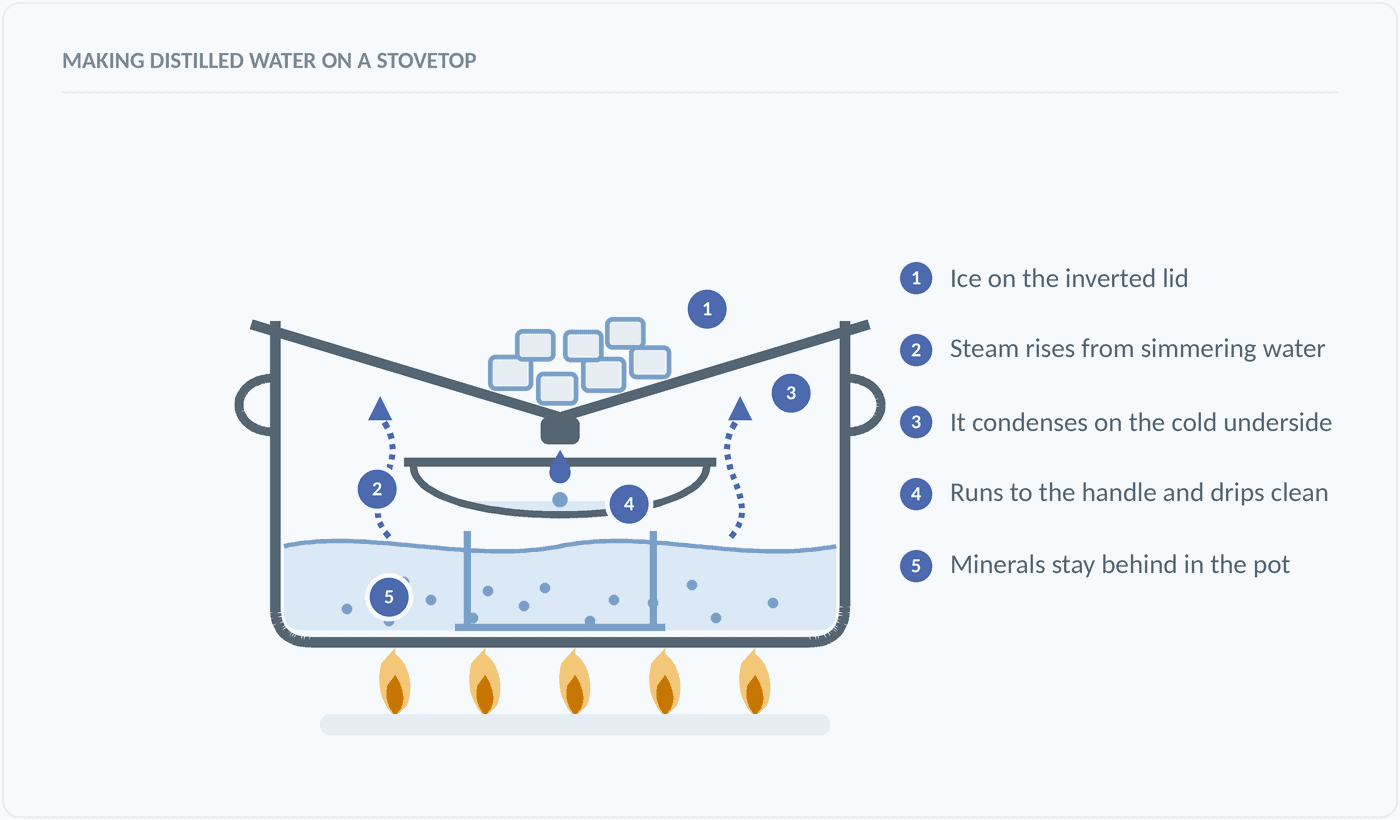
The bowl has to sit above the waterline and directly under the lid handle, which is the lowest point of the inverted lid and where every drop runs to.
The EPA has a position on this. Its guidance on home humidifiers names distillation as the most effective way to remove minerals from water, and notes that deionization and reverse osmosis remove most minerals but are generally less effective, so demineralized water will on average carry more mineral content than distilled. That is a fair summary of the whole page: reverse osmosis is close, and close is enough for nearly everything except a manufacturer instruction that says distilled only.
What We Recommend
If you are buying distilled water repeatedly, one of these three ends the problem. Which one depends on whether close is good enough for your use.
When you buy through the links below we may earn a commission, at no extra cost to you.
AquaTru Carafe
Countertop distiller
Digital TDS meter
Start with the meter, because it costs very little and answers the only question that matters. Measure your tap water, then measure whatever you were planning to substitute. If your reverse osmosis output reads in the low tens of parts per million against tap water in the hundreds, it is a workable stand-in for every appliance use on this page. If it reads high, the membrane is due for replacement or the system is underperforming, and you have found a problem worth knowing about anyway. Any of the systems in our reverse osmosis roundup will get you there, and the no-install AquaTru Carafe is the one to reach for if you rent or have no space under the sink. A countertop distiller is the only one of the three that produces genuinely distilled water, which matters when a device manual specifies it and nothing else will satisfy the warranty.
Frequently Asked Questions
Can I use boiled water instead of distilled water?
Only when the reason you needed distilled water was to avoid organisms, as with a nasal rinse. Boiling kills the things that matter there. It does not remove minerals, and because some water evaporates, what is left is marginally more concentrated than what you started with. For a humidifier, a CPAP chamber, or a car battery, boiled tap water is no better than tap water.
Is filtered water the same as distilled water?
No. A carbon pitcher or faucet filter improves taste and reduces specific contaminants while leaving the dissolved minerals in place, which is exactly the thing distilled water does not have. Reverse osmosis is the exception, since it removes most dissolved solids, though a system certified to NSF/ANSI 58 is only required to average 75 percent TDS reduction rather than to reach zero.
Can I use purified or spring water in my CPAP?
Spring water, no, it is not treated to remove minerals at all. Purified water depends entirely on how it was purified, and the bottle often does not say. Reverse osmosis water is a reasonable stand-in if your humidifier chamber permits anything other than distilled. Check the label on the chamber itself, since manufacturers label different chambers for the same machine differently.
What is the difference between distilled and deionized water?
Distillation removes minerals, most other dissolved solids, and anything living. Deionization strips out dissolved ions using resin, so the mineral content drops just as far, but organic matter and microorganisms can pass straight through. That makes deionized water a fine substitute in a battery or a machine, and an unacceptable one for anything that goes near a person.
Can I use tap water for a neti pot if I filter it?
Only with a filter carrying the right label. The CDC accepts a filter labelled NSF 53 or NSF 58, one with an absolute pore size of 1 micron or smaller, or one describing cyst removal or cyst reduction. An ordinary pitcher or fridge filter does not qualify. Otherwise use distilled water, sterile water, or tap water boiled for one minute and cooled, three minutes if you are above 6,500 feet.
Is drinking distilled water bad for you?
Drinking it occasionally is not harmful, it just tastes flat, because the minerals that give water flavour have been removed. It is not a health product either. If you drink reverse osmosis or distilled water as your main supply, your minerals come from food rather than from water, which is where most of them come from in any case. If you want the taste back, our guide to remineralizing distilled water covers the methods that work and the health claim that does not hold up.
Sources
- CDC, How to Safely Rinse Sinuses
- FDA, Is Rinsing Your Sinuses With Neti Pots Safe?
- US EPA, Use and Care of Home Humidifiers
- NSF International, NSF/ANSI 58: Reverse Osmosis Drinking Water Treatment Systems
- Water Conditioning and Purification, TDS Reduction Testing Under NSF/ANSI 42 and NSF/ANSI 58
- Rowenta, Care and Use Guides
- Philips, What Type of Water Can I Use in My Steam Iron or Steamer?