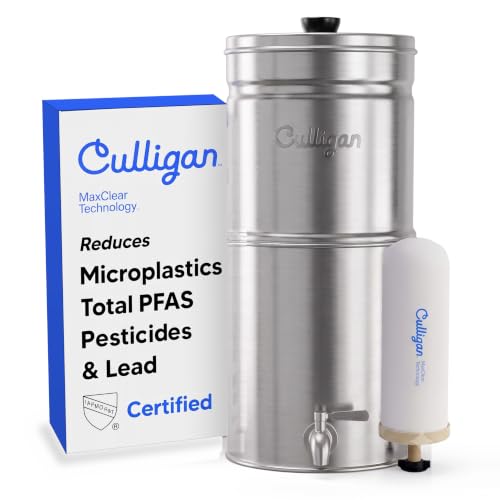
Culligan MaxClear vs Berkey: The Culligan MaxClear is certified by IAPMO R&T under NSF/ANSI 53 for lead and Total PFAS, under NSF/ANSI 401 for microplastics, and under NSF/ANSI 42 for chlorine and chloramine. The Big Berkey’s only contaminant-reduction certification is NSF/ANSI 42 from NSF International, for chlorine, taste, and odor, and only with Phoenix elements.
The catch: Each MaxClear filter is certified for just 50 gallons, so it costs far more per gallon to run than a Berkey.
Health information, not medical advice. Guidance differs for infants, pregnancy, and existing conditions. Test your own water and speak to a doctor or your local health authority. We may earn a commission when you buy through our links; it never affects our scores.
How do the Culligan MaxClear and Berkey compare?
They work the same way but carry very different certifications. Both are stainless steel gravity filters: You pour tap water into the top chamber and it drips through the filters into the bottom one, with no power or plumbing. The MaxClear is certified for lead, Total PFAS, microplastics, chlorine, and chloramine. The Berkey, with Phoenix elements, is certified for chlorine, taste, and odor, and its PFAS results come from a lab Berkey hired. How we score
| # | Filter | Score | Certified by | Lead | PFAS | Fluoride | Running cost | Price |
|---|---|---|---|---|---|---|---|---|
| 01 | Culligan MaxClear VentureBest of the twoGravity | 3.6 | IAPMO R&T | Certified | Certified | No | $1.58/gal | See priceat Culligan › |
| 02 | Big Berkey with Phoenix elementsLowest filter cost | 3.4 | NSF (Phoenix elements) | Lab test | Lab test | No | $267.00on Amazon › |
Certified: Certified by an independent body (named in each pick). Lab test: Tested by a named independent lab, not certified. Claim: The maker's claim, not certified. No: No claim. PFAS means PFOA/PFOS, or Total PFAS where the pick says so.
What is each one certified to remove?
The MaxClear is certified by IAPMO R&T to three reduction standards; the Berkey is certified by NSF International to one. The table compares the MaxClear Venture and Scout with the MCF701 filter against the Big Berkey with Phoenix Gravity New Millennium Edition elements (PGF9-2).
| Contaminant | Culligan MaxClear | Big Berkey (Phoenix) |
|---|---|---|
| Lead | Certified (NSF/ANSI 53) | Not certified |
| PFAS | Certified for Total PFAS (NSF/ANSI 53) | Not certified; PFOA and PFOS lab-tested by RaYnu Lab |
| Microplastics | Certified (NSF/ANSI 401) | Not certified |
| Chlorine | Certified (NSF/ANSI 42) | Certified (NSF/ANSI 42) |
| Chloramine | Certified (NSF/ANSI 42) | Not certified; maker’s claim |
| Taste and odor | Not on the data sheet | Certified (NSF/ANSI 42) |
| Fluoride | No claim | Not certified; maker’s claim of up to 75.5% at first |
| Bacteria, viruses | No claim | No claim |
| Certified capacity | 50 gal per filter | 1,050 gal service cycle |
Culligan MaxClear: IAPMO R&T files W-17176 (NSF/ANSI 42), W-17177 (NSF/ANSI 53), and W-17178 (NSF/ANSI 401), models MCVB, MCVP, MCSB, and MCSP with the MCF701 filter; reduction figures from Culligan’s performance data sheet. Big Berkey: NSF International lists New Millennium Concepts Ltd under NSF/ANSI 42 for the Big, Royal, and Travel Berkey with Phoenix PGF9-2 elements, for chlorine reduction and taste and odor reduction, at a 1,050-gallon service cycle (listing current as of 12 October 2026). NSF International showed no New Millennium Concepts products under NSF/ANSI 53 on 12 October 2026. NSF International lists no Black Berkey elements.
Which is better for lead and PFAS?
The MaxClear, because it’s the one certified for them. Culligan’s data sheet shows 99.2% average lead reduction at pH 6.5 and 99.1% at pH 8.5, and 99.6% for Total PFAS, all under NSF/ANSI 53. Berkey’s Phoenix site links a 2023 RaYnu Analytical and Research Lab report showing PFOA and PFOS below 0.005 µg/L in filtered water through 1,500 liters, against challenge levels up to 1.5 µg/L. The report says its test solutions were prepared following NSF/ANSI 53 and that testing is continuing, but it is a lab result Berkey publishes, not a certification. See our PFAS guide and lead guide.
What did the EPA stop-sale order change?
It barred the companies named from selling or moving Black Berkey elements, the elements Berkey systems come standard with, except as the orders allow. EPA Region 8 issued a Stop Sale, Use, or Removal Order to James Enterprise, doing business as Berkey Filters, on December 27, 2022, and another to Berkey International on May 8, 2023, one of six more orders the EPA issued from February to May 2023. The orders say Black Berkey elements contain silver and were sold with claims against viruses and bacteria, which makes them pesticides that needed EPA registration.
Each order stays in effect until the EPA revokes, ends, or changes it in writing. Berkey International asked a federal court for a preliminary injunction against its order and was refused: On September 18, 2026, the US Court of Appeals for the First Circuit affirmed the district court’s denial. We found no EPA notice revoking the orders. The two orders we read name Black Berkey products; they don’t mention Phoenix elements, which is the version NSF International certifies. The full story is in what happened to Berkey.
Can you still buy each one?
The MaxClear is easier to buy. Culligan’s own store listed the Venture and Scout starter packs as available when we checked on 12 October 2026, and sells MCF701 filters in packs of one, two, three, four, and six. Berkey’s store lists the Big Berkey as “Limited supply, please contact Account Manager to order” and the Travel Berkey as out of stock or limited, and it won’t sell either to residents of California or Iowa.
Check which elements you get. Berkey’s Big Berkey page says the system “comes standard with 2 Black Berkey® Elements”, and its Travel Berkey page says the same. The certified setup needs Phoenix PGF9-2 elements, which Berkey sells separately and says fit any Berkey system.
Which holds more water?
The MaxClear Venture, at 3 gallons. The MaxClear Scout and the Big Berkey both hold 2.25 gallons, and the Travel Berkey holds 1.5 gallons, which Berkey sizes for one to three people. The Venture takes up to three filters and the Scout up to two; Culligan says both are certified with each filter count, and each filter adds 50 gallons of capacity. The Big Berkey takes up to four elements.
On speed, Berkey says a pair of Phoenix elements filters up to 4.2 gallons an hour, slowing as the top chamber empties. Culligan’s data sheet gives a service flow rate of 4.0 gallons per day.
Which is cheaper to run?
The Berkey, by a wide margin. At Culligan’s store price of $69 for one MCF701 filter and its certified 50 gallons, the MaxClear costs about $1.38 a gallon in filters, or about $1.05 a gallon with Culligan’s 6-pack at $314. Berkey prices a pair of Phoenix elements at $120 and rates them for 5,500 gallons, which is about $0.02 a gallon. If you change them at NSF International’s certified 1,050-gallon service cycle instead, it’s about $0.11 a gallon. Culligan markets the filter as lasting “up to 6 months”, but at a gallon a day, 50 gallons lasts under two months.
Do either need power or plumbing?
Neither does. Culligan describes the MaxClear as gravity-fed with “No installation required”, and NSF International lists the Berkey as a pour-through unit. That makes both useful for cabins, outages, and renters. Berkey includes a primer for flushing new Phoenix elements before first use. Neither is a purifier for untreated water: Culligan’s data sheet says not to use water that is microbiologically unsafe or of unknown quality without proper disinfection, and Berkey says to disinfect questionable water with EPA, CDC, or WHO methods before filtering it. See our guide to filters during a boil water advisory.
How do the two score in detail?
The MaxClear scores higher because certified lead and PFAS reduction carries the most weight in our scoring; the Berkey wins on filter cost.
Culligan MaxClear Venture
The only gravity system we found with certified lead and Total PFAS reduction. The cost is the filter: about $79 each on Amazon for 50 certified gallons, roughly $1.58 a gallon. No fluoride claim.

Big Berkey with Phoenix elements
Works with no power or plumbing, which suits off-grid homes and emergencies. Only chlorine, taste and odor are certified; the Black Berkey elements it used to ship with aren't certified at all.
MaxClear or Berkey: Which should you buy?
Buy the MaxClear for certified lead and PFAS reduction; buy the Berkey if certified chlorine reduction is enough and you filter a lot of water.
Pick the Culligan MaxClear if
Lead or PFAS is on your water report, you want certified reduction without power, and you drink modest amounts.
Pick the Big Berkey if
You want better-tasting water off-grid at a low filter cost, you’ll fit Phoenix elements, and you don’t live in California or Iowa.
Consider the Travel Berkey if
You need something smaller for one to three people or an RV. Our Travel Berkey review.
Compare every gravity filter
See our gravity filter roundup, ranked by certification.
What do people ask about MaxClear and Berkey?
Answers to the questions that come up after choosing between them.
Is Culligan MaxClear better than Berkey?
For certified reduction, yes: IAPMO R&T certifies the MaxClear under NSF/ANSI 53 for lead and Total PFAS, plus microplastics and chlorine, while NSF International certifies the Berkey with Phoenix elements only for chlorine, taste, and odor. The Berkey costs far less per gallon to run, about $0.02 to $0.11 against about $1.05 to $1.38.
Do MaxClear filters fit in a Berkey?
Culligan says the MCF701 fits most gravity systems, including Berkey, but the certified claims cover it only in Culligan’s Venture and Scout. The data sheet lists models MCVB, MCVP, MCSB, and MCSP. Fitted in a Berkey housing, the filter’s lead and PFAS reduction isn’t certified, so buy the matching Culligan system.
How often do you change MaxClear and Berkey filters?
Change a MaxClear filter every 50 gallons, its certified capacity, or 100 and 150 gallons with two or three filters fitted. Berkey rates a pair of Phoenix elements for 5,500 gallons, while NSF International’s certified service cycle is 1,050 gallons. At a gallon a day, that’s under two months for one MaxClear filter.
Can I use either one on well water or untreated water?
Not on its own. Neither carries a bacteria or virus claim, and both makers say to disinfect water of unknown or unsafe quality before or after filtering. Test well water first, then see our well water guide for systems certified for what you find.
Can you buy a Berkey in California or Iowa?
No. Berkey’s store says the Big Berkey, Travel Berkey, and Phoenix elements are not sold to residents of California or Iowa. Culligan’s MaxClear pages list no such restriction, which makes the MaxClear a certified gravity option for buyers in those two states.
Sources
- IAPMO R&T product listing directory (Culligan MaxClear, files W-17176, W-17177, W-17178)
- Culligan MaxClear performance data sheet
- Culligan MaxClear Venture product page
- Culligan MaxClear Scout product page
- Culligan MCF701 gravity water filter
- NSF International listing, New Millennium Concepts (NSF/ANSI 42)
- NSF International, New Millennium Concepts under NSF/ANSI 53 (no products)
- Berkey: Big Berkey system
- Berkey: Travel Berkey system
- Berkey: Phoenix Gravity New Millennium Edition elements
- Berkey Phoenix elements, claims and lab reports
- RaYnu Analytical and Research Lab, PFOA and PFOS report for Phoenix elements
- EPA: Stop Sale, Use, or Removal Order to James Enterprise, doing business as Berkey Filters
- EPA: Stop Sale, Use, or Removal Order to Berkey International
- Berkey International v. EPA, No. 24-1917 (1st Cir. September 18, 2026)
Prices as of October 14, 2026. Product prices and availability are accurate as of the date/time indicated and are subject to change. As an Amazon Associate we earn from qualifying purchases.