out of 5
A trusted-brand whole-house filter that handles chlorine, taste, and sediment well, backed by a published third-party test report and a complete install kit. Three things to check first: it is sized for up to 2.5 bathrooms, the base model targets chlorine rather than chloramine, and its pre-filter needs changing every two to three months.
Prices are shown in US dollars from Amazon.com as of 2026-09-04 and are subject to change; other Amazon marketplaces price separately, and the figure at checkout is the one that applies. We may earn a commission if you buy through our links, at no extra cost to you, and it never affects our scores.
A trusted whole-house chlorine filter, with three things to check first
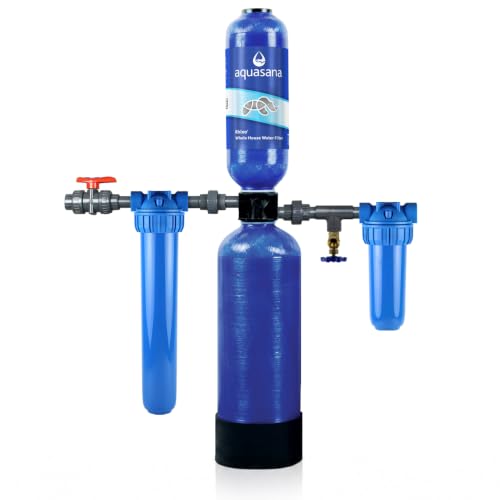
The Aquasana Rhino is a point-of-entry system built around a big 1,000,000-gallon, ten-year main media set: a sediment pre-filter, a copper-zinc (KDF) and mineral stone stage, and activated carbon, followed by a post-filter. It does the core whole-house job well, reducing up to 97% of chlorine along with the taste, odor, and sediment that come with it, at every tap. Current versions ship as a complete kit for 3/4-inch or 1-inch main lines, including Schedule 80 PVC components, an integrated drain valve, a shut-off valve, tank connections, and both filter housings, which removes a lot of the parts-hunting that used to come with these installs. See where it sits in our roundup of the best whole-house water filters.
The evidence behind that chlorine figure deserves precision, because Aquasana’s own marketing is inconsistent about it. Amazon’s listing for this system states it plainly: the system is independently tested to NSF/ANSI Standard 42 to remove up to 97% of chlorine, and the Rhino tank is WQA certified to NSF/ANSI/CAN Standard 61 for material safety. Tested for performance, certified for materials. Aquasana’s European FAQ meanwhile attributes that testing to Pace Analytical, a laboratory, while elsewhere describing the product as certified by NSF International. Independent auditors who check the certification registries find Aquasana’s Claryum under-sink line and SmartFlow RO listed with WQA or IAPMO, but the Rhino whole-house line tested rather than listed.
That is better documentation than many rivals offer, and a published data sheet from a named lab is worth something. It is not the same as a certifying body listing the finished system for performance. We score it accordingly: we credit the tested chlorine reduction and the certified materials, and we do not credit the lead and PFAS reduction Aquasana markets, because neither is certified here.
Check your household size first. Aquasana states the Rhino and Rhino Chloramines are designed for homes with up to 2.5 bathrooms and four people or fewer. That ceiling is easy to miss on a system marketed as whole-house. Larger households and homes running several fixtures at once should look at a higher-flow system; owners with four or more bathrooms report noticeable pressure drop at peak demand.
Chlorine or chloramine? Check which your utility uses; it is in your annual water report. The base Rhino targets chlorine. For chloramine you want Aquasana’s catalytic-carbon Rhino Chloramines version, or a catalytic-carbon system like the SpringWell CF1.
Don’t carry Aquasana’s other certifications over to this one. Several roundups credit “the Aquasana Rhino” with NSF/ANSI 42, 53 and 401. Those belong to Aquasana’s Claryum under-sink filters and the OptimH2O, which are different products. The Rhino’s own documentation covers NSF/ANSI 42 testing and NSF/ANSI/CAN 61 materials, nothing more.
How it scored, category by category
Each category is weighted into the overall score. Its tested chlorine reduction and brand support carry it; the frequent pre-filter changes, the chlorine-only focus of the base model, and the absence of a listed system performance certification are what hold it back.
What it removes, and what it doesn’t
The Rhino is built around chlorine, taste, odor, and sediment. We credit the independently tested chlorine reduction and the certified materials, and report everything else without crediting it.
| Contaminant | Aquasana Rhino | Evidence |
|---|---|---|
| Chlorine (taste & odor) | Up to 97% | Tested to NSF/ANSI 42 |
| Tank material safety | Yes | WQA / NSF 61 |
| Sediment | Yes | Pre-filter stage |
| Some heavy metals (via KDF) | Reduced | Not certified |
| Lead | Claimed | Not certified |
| PFAS | Claimed | Not certified |
| Chloramine | Limited (base model) | See Rhino Chloramines |
| Hardness / scale | No | Not a softener |
Source: Amazon’s listing for this system and Aquasana’s published performance data, both of which state the system is independently tested to NSF/ANSI Standard 42 and that the tank is WQA certified to NSF/ANSI/CAN Standard 61. The Rhino whole-house line does not appear on an NSF, WQA or IAPMO performance certification listing. Lead and PFAS reduction are manufacturer claims. For chloramine, Aquasana sells a catalytic-carbon Rhino Chloramines version; for softening, an optional salt-free conditioner. For certified lead or PFAS reduction, see our lead and PFAS guides.
Pros and cons
What we liked
- Published third-party performance data sheet, not just marketing claims
- Tank WQA-certified to NSF/ANSI/CAN 61 for material safety
- Complete install kit: PVC components, valves, housings, both filters
- 1,000,000-gallon / 10-year main media life and a 10-year warranty
Worth considering
- Sized for up to 2.5 bathrooms and four people; larger homes will feel it
- Pre-filter every 2–3 months; roughly $80–$150 a year in replacements
- Base model is chlorine-focused and weaker on chloramine
- Tested to NSF/ANSI 42, but not on a system performance certification listing
What actual owners report
Our score reflects tested and certified performance. Owner sentiment, summarized from verified buyer and independent long-term reviews, shows a well-liked system with two steady gripes.
Owners are happy with the water and the brand: better taste at every tap and solid support behind the ten-year warranty. The recurring complaints are the pre-filter routine and, in larger homes, pressure at peak demand.
Owners consistently praise
- Chlorine smell and taste gone throughout the house
- Trusted brand, ten-year warranty, and responsive support
- Manageable install now that the kit includes the fittings
Common complaints
- Pre-filter changes every 2–3 months add cost and hassle
- Pressure dips in homes with four or more bathrooms
- Salt-free conditioner struggles above about 25 grains per gallon
Qualitative summary of recurring themes across verified buyer and independent long-term reviews, current as of August 2026. Note that Aquasana relists the Rhino under new SKUs periodically, so review counts on any single listing understate the product’s track record. We report the patterns we see, positive and negative, and never cherry-pick.
The details
The tank is WQA certified to NSF/ANSI/CAN Standard 61 for material safety, and the system carries a 10-year limited warranty. The current price is pulled live from Amazon.com and refreshes automatically, which matters here more than most: Aquasana runs near-permanent discounting, MSRP has risen in recent years, and optional add-ons such as the salt-free conditioner or UV stage can push the installed cost well past the headline figure.
Common questions
Is the Aquasana Rhino NSF certified?
Not for performance, despite what some of its marketing implies. Both Amazon’s listing and Aquasana’s own product pages say the system is independently tested to NSF/ANSI Standard 42, and its European FAQ names Pace Analytical, a laboratory, as the tester. What is certified is the tank: WQA certified to NSF/ANSI/CAN Standard 61 for material safety. The Rhino whole-house line does not appear on an NSF, WQA or IAPMO performance certification listing. Published third-party test data is meaningful, but it is a step below a listed system certification.
EQ-1000 or WH-1000: what’s the difference?
Nothing. They are the same system under two SKU names. Aquasana’s own replacement-tank page confirms the tank fits the Rhino main tank listed as “EQ-1000/WH-1000”. Amazon listings tend to use WH-1000 while Aquasana’s site uses EQ-1000. Watch for the suffixes, though: an R (EQ-1000R) means a replacement tank only, AST adds the salt-free conditioner, and UV is the well-water bundle. The separate EQ-600 is a genuinely smaller system at 600,000 gallons and about six years.
Is it big enough for my house?
Check before you buy. Aquasana specifies the Rhino for homes with up to 2.5 bathrooms and four people or fewer, with a rated 7 GPM flow. Most homes draw only 2 to 3 GPM most of the time, so that is fine for typical use, but owners with four or more bathrooms or heavy simultaneous demand report pressure drops. If that describes your home, look at a higher-flow system rather than this one.
Aquasana Rhino or SpringWell CF1?
Closer than the marketing on either side suggests. Neither holds a listed whole-system performance certification: Aquasana publishes third-party test data to NSF/ANSI 42 plus a WQA materials certification on the tank, while SpringWell publishes third-party media testing and describes its components as NSF-certified. The practical differences matter more. SpringWell uses catalytic carbon, which handles chloramine better, is rated for one to three bathrooms at 9 GPM, needs its pre-filter changed every 6 to 9 months rather than every 2 to 3, and carries a lifetime warranty on tanks and valves. Aquasana is easier to buy, ships with a complete install kit, and has clearer published test data.
What’s included, and how hard is the install?
Current versions ship with everything needed for a 3/4-inch or 1-inch main line: Schedule 80 PVC components, an integrated drain valve for flushing and draining, a shut-off valve, tank connections, and both the pre- and post-filters with housings. That is a meaningful improvement on older versions, where owners often had to buy extra fittings. It is still a main-line plumbing job, so many buyers hire a plumber, but the parts-hunting is largely gone.
Should you buy it?
If you are on city water using chlorine, your home has two or three bathrooms, and you want a whole-house filter from a trusted brand with published third-party test data, a complete install kit, and the convenience of buying on Amazon, the Aquasana Rhino will noticeably improve the water at every tap. Just go in clear-eyed on three points: the 2.5-bathroom sizing ceiling, the every-two-to-three-months pre-filter routine, and the fact that its chlorine performance is independently tested rather than listed on a certification register. If your utility uses chloramine, your home is larger, or you would rather change filters far less often, the SpringWell CF1 is the closer match. If you need documented lead or PFAS reduction, neither whole-house carbon system is the answer, and a certified point-of-use system like the AquaTru Carafe is the better route. For mainstream whole-house chlorine and taste filtration in an average-sized home, though, this Aquasana earns its popularity.
Check price on Amazon ›