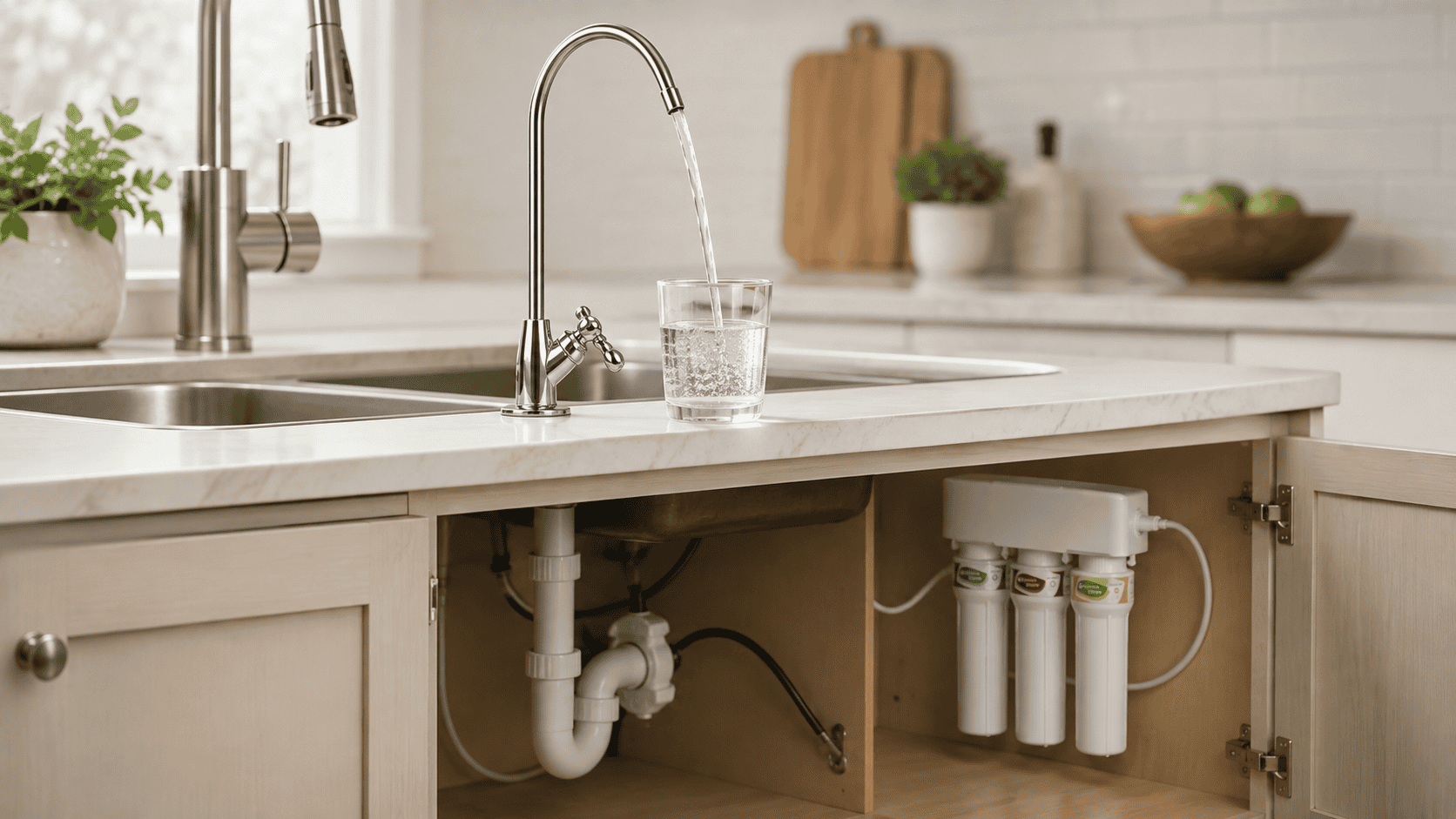
The best under-sink filter for people who don’t want reverse osmosis. It’s certified to reduce a broad list, including lead and PFAS, while keeping healthy minerals and wasting no water. The catch is the filter cost, and that it skips the jobs only RO can do.
We may earn a commission if you buy through our links, at no extra cost to you. It never affects our scores.
The broad-spectrum filter that isn’t reverse osmosis
The Aquasana AQ-5300+ is a three-stage under-sink carbon system (Aquasana’s Claryum filtration), and it answers a specific question well: how do you remove a lot of contaminants without the downsides of reverse osmosis? It is WQA-certified to NSF/ANSI Standards 42, 53, 401, and P473 to reduce around 77 contaminants, including lead (99% or more) and PFAS (about 96%), plus chloramine, mercury, pesticides, and pharmaceuticals. Crucially, it does all that while retaining the beneficial minerals RO strips out, and it produces no wastewater. Add a genuinely fast flow rate and tool-free filter changes, and it’s one of the easiest broad-spectrum filters to live with.
The honest limits are two. First, it’s a carbon filter, so it deliberately does not remove fluoride, total dissolved solids, arsenic, or nitrates, the jobs that need reverse osmosis. Second, its replacement filters are expensive, roughly $150 a year, which is the priciest part of ownership and higher than many RO systems cost to run. Judge it as a certified, mineral-keeping, no-waste alternative to RO for city water, and it’s excellent; expect it to match RO on everything, and it won’t.
Best for: city-water homes that want certified reduction of lead, PFAS, chlorine, and more at the tap, with the minerals kept and no wastewater, and that don’t need to remove fluoride, TDS, or arsenic.
How it scored, category by category
Each category is weighted into the overall score. Its broad certified reduction and fast flow carry it; the high ongoing filter cost is what holds it back.
What it removes, and what it keeps
The figures below come from the AQ-5300+’s WQA certification to NSF/ANSI methods. Unlike reverse osmosis, it’s designed to leave beneficial minerals in the water, which is why some contaminants are intentionally out of scope.
| Contaminant | Reduction | Certified? |
|---|---|---|
| Lead | 99%+ | WQA / NSF 53 |
| PFAS (PFOA / PFOS) | ~96% | WQA / NSF P473 |
| Chlorine & chloramine | Yes | WQA / NSF 42 |
| Pharmaceuticals & pesticides | Reduced | WQA / NSF 401 |
| Beneficial minerals (Ca, Mg) | Kept | By design |
| Fluoride | No | Needs RO |
| TDS, arsenic, nitrates | No | Needs RO |
Source: Aquasana product data and WQA certification listings. The AQ-5300+ is certified to NSF/ANSI 42, 53, 401, and P473 for roughly 77 contaminants; WQA is a legitimate third-party certifier testing to the same NSF standards. It does not reduce fluoride, TDS, arsenic, or nitrates. For those, you need reverse osmosis, see the iSpring RCC7AK or our fluoride guide.
Pros and cons
What we liked
- Broad certified reduction, including lead (99%+) and PFAS (~96%)
- Keeps beneficial minerals and produces no wastewater
- Fast 0.72 GPM flow with no tank wait; tool-free 5-minute filter swaps
- Simpler to own than RO: no tank, no drain connection
Worth considering
- High ongoing filter cost, roughly $150 a year
- Doesn’t remove fluoride, TDS, arsenic, or nitrates (RO territory)
- Install drills a dedicated faucet hole; filters change every ~6 months
- Certified via WQA to NSF methods rather than carrying an NSF mark
What actual owners report
Our score reflects certified performance. Owner sentiment, summarized from verified buyer and independent long-term reviews, shows a well-liked filter with one steady gripe.
Owners describe an immediate, noticeable jump in taste, and they like keeping the minerals and wasting no water. The complaint that comes up again and again is the cost of the replacement filters.
Owners consistently praise
- Big, immediate improvement in taste and smell
- No wastewater and water that still tastes “full,” not flat
- Fast flow and quick, tool-free filter changes
Common complaints
- Replacement filters are expensive over a year
- Install means drilling a hole for the dedicated faucet
- Occasional leaks at the fittings if not tightened well
Qualitative summary of recurring themes across verified buyer and independent long-term reviews, current as of August 2026. We report the patterns we see, positive and negative, and never cherry-pick.
The details
Common questions
Is the Aquasana AQ-5300+ certified?
Yes. It’s WQA-certified to NSF/ANSI Standards 42, 53, 401, and P473 to reduce roughly 77 contaminants, including lead (99%+) and PFAS (about 96%). WQA is a legitimate third-party certifier that tests to the same NSF/ANSI standards NSF itself uses, so these are verified reductions, not marketing claims.
Does it remove fluoride, arsenic, or TDS?
No. The AQ-5300+ is a carbon filter that intentionally keeps beneficial minerals, so it does not reduce fluoride, total dissolved solids, arsenic, or nitrates. Those require reverse osmosis, see the iSpring RCC7AK or our fluoride guide.
AQ-5300+ or a reverse-osmosis system?
Choose the AQ-5300+ if you want broad certified reduction (including lead and PFAS) while keeping minerals, with no wastewater, faster flow, and a simpler install. Choose RO if you also need fluoride, TDS, or arsenic removed, or want the lowest running cost, RO removes more but strips minerals and wastes some water.
How much do the filters cost, and how often?
Replacement filters run roughly $150 a year, changed every six months or 800 gallons. It’s the priciest part of ownership and higher than many RO systems cost to run, so factor it into your budget.
Does it remove PFAS and lead?
Yes, and it’s certified for both: about 96% PFAS (PFOA/PFOS) reduction under NSF/ANSI P473, and 99% or more lead reduction under NSF/ANSI 53. That combination, without reverse osmosis, is the main reason to choose it.
Should you buy it?
If you’re on city water and you want certified reduction of lead, PFAS, chlorine, and more at the kitchen tap, but you’d rather keep your minerals and skip reverse osmosis’s wastewater, slow flow, and tank, the Aquasana AQ-5300+ is the best under-sink filter for the job. Just budget for the filters. If you also need fluoride, TDS, or arsenic removed, or you want the lowest long-term running cost, a reverse-osmosis system like the iSpring RCC7AK or the no-install AquaTru Carafe is the better fit. For a broad-spectrum, mineral-keeping filter that isn’t RO, though, this Aquasana is the one to beat.
Check price on Amazon ›