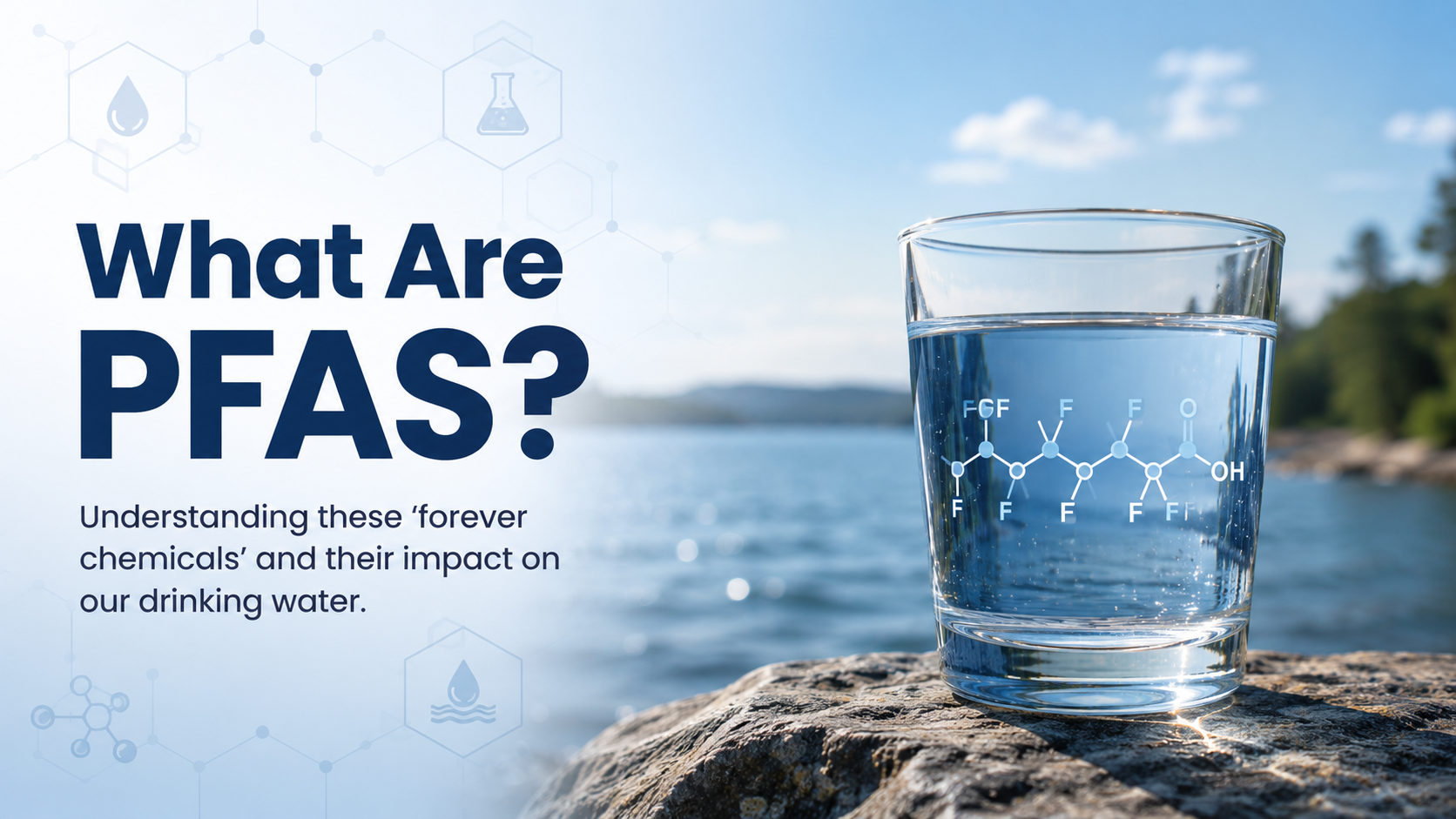
PFAS, short for per- and polyfluoroalkyl substances, are a class of thousands of synthetic chemicals that have been used in manufacturing and consumer products since the late 1940s. They’ve earned the nickname “forever chemicals” because they don’t break down in the environment or in the human body, and over the past few decades they’ve spread into water systems, soil, food, wildlife, and human blood across the planet.
If you’ve heard about PFAS in news coverage and want a clear, level-headed explanation of what they are, where they come from, why they matter for your health, and what the science actually shows, this guide is for you. We’ll keep the chemistry simple, the claims sourced, and the takeaways practical.
What PFAS Actually Are
At a chemical level, PFAS are characterized by chains of carbon atoms bonded to fluorine atoms. The carbon-fluorine bond is one of the strongest bonds in organic chemistry. That single chemical feature is the reason PFAS are useful, and it’s also the reason they’re a problem.
Because the carbon-fluorine bond is so stable, PFAS resist heat, water, oil, stains, and grease. That’s exactly why manufacturers have used them in nonstick cookware coatings, waterproof clothing, stain-resistant carpets and upholstery, grease-resistant food packaging, firefighting foam, cosmetics, dental floss, and thousands of industrial applications. The same stability, however, also means these chemicals don’t degrade. They persist in the environment for decades or longer, and they accumulate in living organisms rather than breaking down and passing through.
There are thousands of distinct PFAS compounds. The two with the most research behind them are PFOA (perfluorooctanoic acid) and PFOS (perfluorooctane sulfonate). Both were phased out of U.S. production in the 2000s after their health risks became clear, but they remain widespread in water and soil because of decades of prior use. Newer-generation PFAS like GenX (HFPO-DA) and PFBS were marketed as safer replacements, but research has since identified health concerns with several of those compounds as well.
Why They’re Called Forever Chemicals
The “forever chemicals” nickname isn’t marketing. It’s a description of how PFAS behave in the real world.
In soil and water, PFAS resist the natural processes that break down most synthetic chemicals. Sunlight, microbes, oxidation, and temperature shifts that would degrade other compounds barely touch PFAS. PFAS, widely used in consumer goods like nonstick cookware and stain-resistant fabrics, have been linked to cancer, thyroid disease and other serious illnesses, and once they’re in groundwater they can persist for decades.
In the human body, PFAS accumulate in the bloodstream and concentrate in the liver, kidneys, and blood serum. The half-life for some PFAS in humans is measured in years, meaning it takes years for the body to clear half of a given exposure. With ongoing exposure from drinking water, food, and consumer products, levels build over time. Most people have some level of perfluoroalkyls in their blood, which reflects how widespread environmental contamination has become.
Where PFAS Come From
PFAS contamination in drinking water typically traces back to a handful of source categories.
Industrial manufacturing sites are the largest single source. Factories that produced PFAS or used them in manufacturing, particularly chemical plants, textile mills, paper mills, electronics manufacturers, and metal plating facilities, have released the chemicals into the air, soil, and water for decades. Communities downstream or downgradient from these sites often show the highest contamination levels.
Military bases and airports are another major source. Firefighting foam known as AFFF (aqueous film-forming foam) contains high concentrations of PFAS and has been used for decades in fire training exercises and emergency response. Bases where AFFF was regularly used have produced some of the most severe PFAS contamination in the country, affecting both base personnel and surrounding communities.
Wastewater treatment plants and landfills act as secondary distribution points. They receive PFAS from countless consumer products and industrial discharges, and they generally aren’t designed to remove these chemicals. Treated wastewater discharged into rivers, and leachate from landfills, can carry PFAS into surface and groundwater supplies. A 2025 Waterkeeper Alliance analysis found PFAS in 98% of tested U.S. waterways across 19 states, with significant increases observed downstream of wastewater treatment plants.
Biosolids, the solid byproduct of wastewater treatment that’s often applied to agricultural land as fertilizer, are an emerging concern. PFAS that enter wastewater treatment plants concentrate in biosolids, and when those biosolids are spread on farmland, the chemicals can leach into groundwater or be taken up by crops.
Consumer products contribute too, though typically at lower per-unit levels. Nonstick pans, waterproof outdoor gear, stain-resistant carpets, microwave popcorn bags, fast-food wrappers, and cosmetics can all contain PFAS, and these chemicals migrate into household dust, food, and ultimately our bodies.
How They Got Into Drinking Water
The path from manufacturing site to kitchen tap is straightforward, even if the timeline is long.
PFAS released into the environment, whether from a factory smokestack, a fire training site, or a landfill, eventually reach the ground. From there, they migrate through soil and into groundwater. Groundwater feeds wells and recharges aquifers, and aquifers feed many municipal water systems. Surface water sources like rivers and lakes receive PFAS directly through industrial discharges, treated wastewater, and runoff.
Conventional drinking water treatment was not designed with PFAS in mind. The standard processes used by most municipal utilities, including coagulation, sedimentation, filtration through sand or anthracite, and disinfection with chlorine or chloramine, do not effectively remove PFAS. The chemicals pass through these treatment steps and end up in finished drinking water, where they reach homes, schools, and businesses.
Removing PFAS at the utility level requires advanced treatment technologies like granular activated carbon (GAC), ion exchange resins, or reverse osmosis. These are effective but expensive to install and operate, which is why most utilities have not deployed them at scale, and why the EPA’s enforceable drinking water standards trigger such significant infrastructure costs.
How Widespread the Contamination Is
The scope of PFAS contamination in U.S. drinking water has come into sharper focus over the past several years as federal monitoring data has been collected and released.
Under the EPA’s Unregulated Contaminant Monitoring Rule (UCMR 5), public water systems are required to test for 29 PFAS compounds. Results released throughout 2024 and 2025 have painted a sobering picture. As of August 2025, EPA data showed that more than 172 million Americans face the risk of drinking PFAS-contaminated water. Even more people might be affected than estimated, since the EPA monitoring program excludes many smaller water systems.
The Environmental Working Group’s interactive PFAS contamination map, which combines federal monitoring data with state records and other sources, documents thousands of contamination sites across all 50 states. Almost everywhere we look, we find more PFAS contamination, in the words of EWG’s acting chief science officer.
Geographic patterns matter. Contamination tends to cluster around military bases, industrial corridors, airports, and certain agricultural regions. The Mid-Atlantic, parts of the Midwest, and California’s Central Valley have been heavily affected. But isolated rural communities with no obvious industrial neighbors have also tested positive, in some cases due to upstream sources or biosolid applications on nearby farmland. The takeaway is that PFAS contamination isn’t confined to obvious “hot spots,” and individual testing remains the only reliable way to know what’s in a specific water supply.
Private wells are a particular blind spot. Well owners don’t receive Consumer Confidence Reports, their water isn’t subject to municipal treatment, and they’re not covered by federal drinking water standards. If a private well is in an area with known PFAS sources, direct testing is the only way to assess risk.
What the Health Research Actually Shows
This is the section where alarmist headlines and dismissive rebuttals tend to do the most damage. The actual scientific picture is more nuanced and, in many ways, more concerning than the soundbite version.
The U.S. Agency for Toxic Substances and Disease Registry (ATSDR) is the federal agency responsible for assessing the health effects of toxic substances. Its evaluations of PFAS epidemiology have identified associations between exposure to specific PFAS compounds and a defined set of health outcomes. Epidemiological evidence suggests associations between increases in exposure to specific PFAS and certain health effects, such as increases in cholesterol levels, lower antibody response to some vaccines, changes in liver enzymes, pregnancy-induced hypertension and preeclampsia, small decreases in birth weight, and kidney and testicular cancer.
The EPA’s current understanding aligns with this. Current peer-reviewed scientific studies have shown that exposure to certain levels of PFAS may lead to reproductive effects such as decreased fertility or increased high blood pressure in pregnant women, developmental effects or delays in children including low birth weight, accelerated puberty, bone variations, or behavioral changes, and increased risk of some cancers including prostate, kidney, and testicular cancers.
A few important caveats are worth being clear about. First, “association” is not the same as “proven cause.” Most PFAS research relies on epidemiological studies that compare exposed populations to less-exposed ones, and these studies are powerful but can’t always establish that PFAS directly caused a given health outcome. Second, the strongest evidence applies to high-exposure populations, such as workers at PFAS manufacturing plants and residents of severely contaminated communities. Lower-level exposure effects are harder to quantify. Third, the body of research is growing rapidly, and conclusions are being refined as more data comes in.
That said, the direction of evidence has been remarkably consistent. The International Agency for Research on Cancer has classified PFOA as carcinogenic to humans, and PFOS as possibly carcinogenic. There is no known safe level of exposure for several PFAS compounds, which is why the EPA’s 2024 drinking water standards were set at 4 parts per trillion, near the limit of what laboratories can reliably detect.
One practical consideration that often gets overlooked: there are no approved medical treatments available to reduce PFAS in the body. Once these chemicals are in your blood, the only way out is the body’s slow natural clearance over years. Reducing ongoing exposure, especially through drinking water, is the most actionable intervention available to most people.
The Regulatory Picture
PFAS regulation in the United States is in active flux as of 2026.
In April 2024, the EPA finalized the first legally enforceable federal drinking water standards for PFAS, setting maximum contaminant levels (MCLs) of 4 parts per trillion for both PFOA and PFOS, with additional limits for PFHxS, PFNA, HFPO-DA (GenX), and a Hazard Index mixture covering combinations of those three plus PFBS. Public water systems were originally required to comply by April 2029.
In May 2026, the EPA published proposed changes that would scale back this framework. The proposed rules would extend the PFOA/PFOS compliance deadline to April 2031 and rescind the federal limits for PFHxS, PFNA, GenX, and the Hazard Index mixture, on procedural grounds. One proposed rule upholds the NPDWR for PFOA and PFOS while strengthening practical implementation by providing an option for drinking water systems to request two additional years to 2031 to comply with enforceable limits, while a second proposes to rescind the regulations for the other four compounds. The proposals are under public comment through July 2026, with a final rule expected later in the year. For a detailed analysis of what these changes mean, see our coverage of PFAS regulations in 2026.
At the state level, the picture varies significantly. At least 20 states currently have regulatory standards for at least one PFAS in drinking water, and several states maintain limits that are stricter than federal standards. States including North Carolina, New Jersey, Michigan, and California have set their own PFAS MCLs, some of which would remain in force even if the federal rescission goes through.
For homeowners, the regulatory shifts matter less than the underlying contamination reality. Whether the federal limit on GenX is 10 ppt or unregulated entirely, the chemical itself doesn’t change. If PFAS are in your water and you want them out, certified filtration at the tap is the most reliable solution.
How to Find Out If PFAS Are in Your Water
There are four reliable ways to assess PFAS in your specific water supply.
If you are in the United States, check the EWG Tap Water Database at ewg.org/tapwater. Enter your zip code and you’ll see what contaminants have been detected in your local water supply, along with concentrations and health-based benchmarks. EWG aggregates data from federal monitoring, state programs, and utility reports, and the database is updated as new data becomes available.
Read your Consumer Confidence Report. Every public water utility publishes an annual water quality report, and PFAS data has been included in most reports since the 2024 federal monitoring requirements took effect. You can typically find your CCR on your utility’s website or by request.
Test your water directly. For the most precise picture, particularly if you’re on a private well, an at-home PFAS testing kit from a certified lab like Tap Score or SimpleLab provides a detailed profile. Tests typically cost $100 to $200 and return results within one to two weeks.
Consider your location and history. PFAS contamination is more likely if you live near a military base where AFFF firefighting foam was used, an industrial manufacturing facility, a major airport, an area with documented historical contamination, or farmland where biosolids have been applied. Your state environmental agency typically maintains a list of known contamination sites.
For a step-by-step walkthrough of water quality testing options, see our guide on what contaminants are in tap water.
What You Can Do About PFAS in Your Water
If you’ve confirmed PFAS in your water, or if you want to take a precautionary approach without testing, certified filtration is the most reliable intervention available.
Three filtration technologies have demonstrated effective PFAS removal: reverse osmosis (RO), high-quality carbon block filters certified to NSF/ANSI 53 with specific PFAS claims, and ion exchange systems. Of these, reverse osmosis is the most comprehensive because it physically blocks PFAS molecules by size and consistently removes the broadest range of PFAS compounds, including the newer-generation chemicals that carbon filters struggle with.
What doesn’t work: basic pitcher filters not specifically certified for PFAS (most Brita and PUR models), most refrigerator filters, standard whole-house carbon systems without specific PFAS certification, and boiling water. Boiling actually concentrates PFAS rather than removing them, since the water evaporates but the chemicals remain.
The key is verification. Many filters claim to remove PFAS without independent certification to back up the claim. Look specifically for NSF/ANSI 53 (carbon filters) or NSF/ANSI 58 (RO systems) with PFOA/PFOS reduction claims, or NSF P473 certification. For comprehensive PFAS protection covering compounds beyond PFOA/PFOS, look for “Total PFAS” certification or independently verified lab data.
For specific product recommendations across every filter type, from under-sink RO systems to budget pitchers, see our guide to the best water filters that remove PFAS.
Frequently Asked Questions
Are PFAS only in drinking water? No. Drinking water is one major exposure route, but PFAS are also found in food (particularly fish from contaminated waters, dairy from farms with contaminated soil, and food packaged in PFAS-containing materials), consumer products (nonstick cookware, waterproof gear, stain-resistant treatments), house dust, and indoor air. Filtering drinking water addresses one significant pathway but doesn’t eliminate exposure entirely.
Can my body get rid of PFAS once they’re in there? Slowly. The body clears PFAS gradually through urine and feces, but the process takes years for some compounds. There is no approved medical treatment to accelerate PFAS clearance. The most actionable step is reducing ongoing exposure so levels gradually decline over time.
Should I get a PFAS blood test? Blood tests can confirm exposure but typically don’t change clinical management, since there are no targeted treatments. ATSDR provides guidance for clinicians considering PFAS testing for individual patients. For most people, testing your water and reducing exposure is more practical than testing your blood.
Are newer PFAS like GenX safer than PFOA and PFOS? They were marketed as safer when they replaced legacy PFAS in the 2010s, but subsequent research has identified health concerns with several of them, including GenX. The “safer alternative” framing has not held up well to scrutiny.
Will boiling my water remove PFAS? No. Boiling concentrates PFAS rather than removing them, because the water evaporates but the chemicals remain in what’s left. Filtration with certified technology is the only effective home solution.
Are PFAS in bottled water? Some bottled water contains PFAS, since manufacturers are not federally required to test for or remove these chemicals. Bottled water is not a reliable PFAS-avoidance strategy unless the brand specifically discloses testing data showing non-detect results.
The Bottom Line
PFAS are a class of synthetic chemicals that don’t break down, accumulate in the human body, and have been linked through extensive epidemiological research to a range of health effects including certain cancers, immune system effects, developmental impacts, and metabolic changes. They’ve spread through the environment over the past 80 years and are now present in the drinking water of more than 172 million Americans, in surface waters across nearly every U.S. state, and in the blood of nearly every person tested.
Federal regulation is real but limited and currently being scaled back. The most actionable response for individual households is verification and filtration: check whether your water supply has detected PFAS, test directly if you’re on a well or want certainty, and use a certified filter to reduce ongoing exposure.
PFAS aren’t a problem you can solve once and forget about. They’re a problem you manage, by reducing ongoing exposure where you can and letting your body’s slow natural clearance do the rest over years. Drinking water is the single largest exposure route most people have meaningful control over. Addressing it is the highest-leverage step available.