Well water is a different problem than city water. Municipal supplies arrive at your home already treated for bacteria, chlorinated for disinfection, and tested for a defined set of regulated contaminants. Well water is whatever your aquifer contains, untreated and unmonitored, delivered straight to your plumbing.
That makes filter selection harder. You can’t just buy “the best well water filter” and call it done, because the right system depends entirely on what’s in your specific well. Iron, sulfur, manganese, sediment, bacteria, hardness, arsenic, nitrates, PFAS, and radon are all common well water issues, and they require different filtration technologies to address. A system that handles iron and sulfur won’t address bacteria. A UV purifier won’t remove arsenic. An RO system won’t fix hard water staining throughout your house.
This guide walks through the only approach that actually works for well water: test first, then build a system matched to what your test results show. We’ll cover what to test for, how to interpret the results, the major filter types and what each does, and the best products for the most common well water scenarios in 2026.
Test Your Water First. No Exceptions.
Before any filter recommendation makes sense, you need to know what’s in your water. Private wells aren’t tested or regulated by the EPA. The water from your well is whatever the geology, surrounding land use, and history of your specific area produced, and it can vary significantly even between neighboring properties.
The minimum test panel for a private well should include:
Bacteria. Total coliform and E. coli at a minimum. Some labs also test for iron bacteria, which can foul iron filters and cause persistent biofilm issues.
Heavy metals. Lead, arsenic, manganese, and iron are the most common. Arsenic is particularly important because it’s tasteless, odorless, and naturally occurring in groundwater across many regions of the United States.
Inorganic chemicals. Nitrates and nitrites (especially in agricultural areas), fluoride, sulfate, and chloride.
General chemistry. pH, hardness, total dissolved solids (TDS), and alkalinity. These don’t represent health threats but determine which filtration technologies will work.
Aesthetic indicators. Hydrogen sulfide (rotten egg smell), tannins, and sediment levels.
PFAS. If you live near a military base, industrial facility, airport, or area with known historical contamination, add PFAS testing. Federal monitoring requirements don’t cover private wells, so testing is the only way to know.
The two reliable testing services for homeowners are Tap Score (SimpleLab) and the EPA-certified labs in most states. Tap Score’s Essential Well Water test runs about $200 and covers the standard panel; their Advanced Well Water test adds PFAS and additional contaminants for closer to $400. Results come back within one to two weeks with health-based context for what each result means.
For ongoing peace of mind after installing a filtration system, retest annually at minimum, and immediately after any nearby construction, flooding, or unusual changes in water taste, smell, or appearance.
For a deeper walkthrough of water testing options, see our guide on what contaminants are in tap water.
How Well Water Filtration Actually Works
Most well water households end up with a layered system rather than a single filter. The reason is that no single technology addresses every well water issue. Each contaminant type requires a specific approach, and trying to handle everything with one device usually means handling everything poorly.
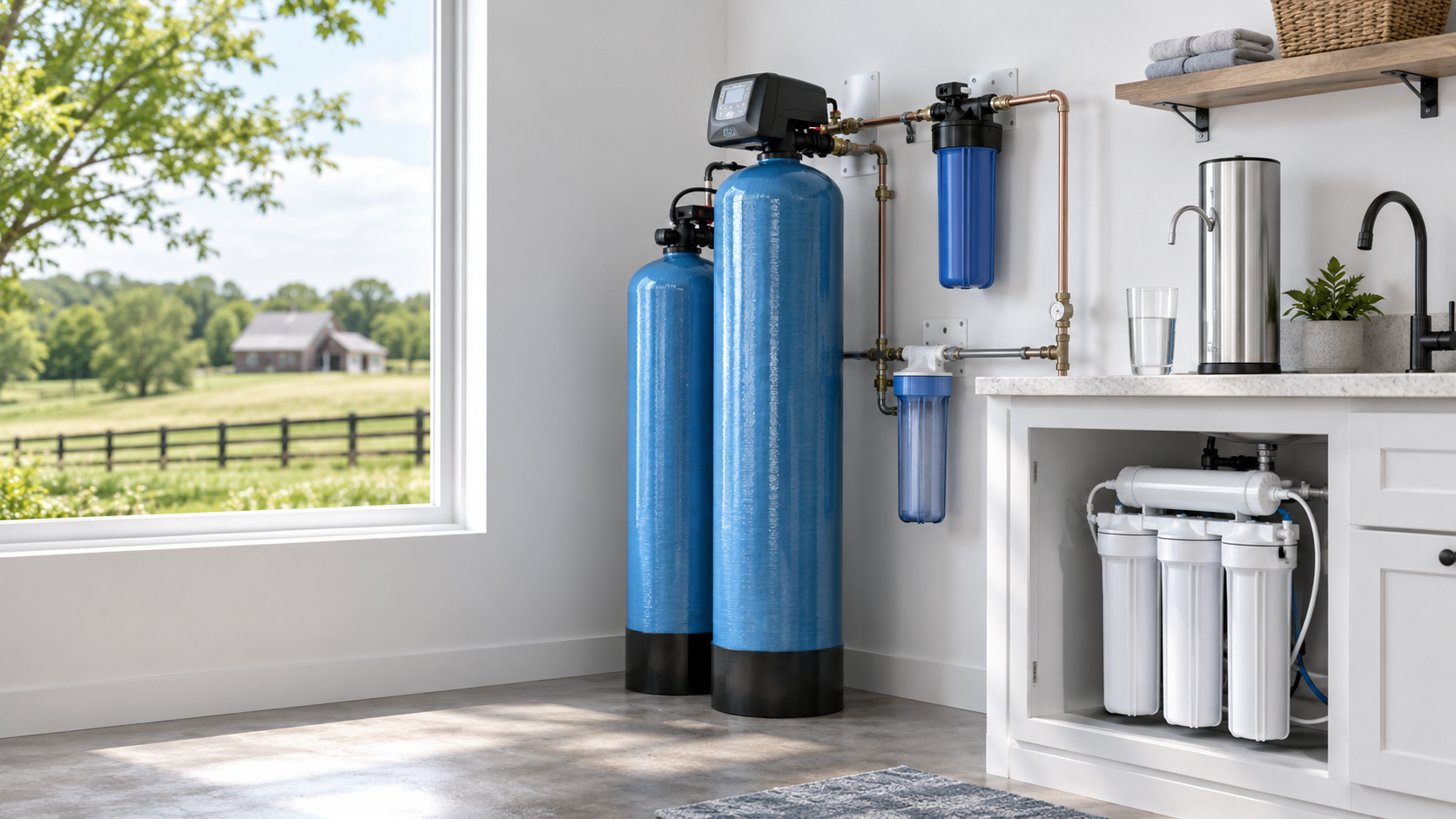
A complete well water setup typically follows this structure:
Stage 1: Sediment pre-filter. Removes sand, silt, rust, and large particles before they reach downstream equipment. Protects everything that follows from clogging or damage. Required for almost every well.
Stage 2: Specialized contaminant removal. This is where you address whatever your test results revealed. Iron filter, water softener, UV system, arsenic removal, or some combination. This stage is where most of the cost and complexity lives.
Stage 3: Carbon filtration. Removes organic chemicals, improves taste, and addresses chemical contaminants that pre-filters miss. Typically a whole-house carbon system.
Stage 4 (optional): Point-of-use drinking water filter. Most well water households add a separate reverse osmosis system at the kitchen sink for drinking and cooking water. The whole-house system protects appliances and improves shower and laundry water; the under-sink RO delivers the cleanest possible water specifically for consumption.
This layered approach matters because the alternative — relying on a single product to do everything — usually fails. A whole-house carbon filter alone won’t remove iron. A UV system alone won’t help with hardness. Pairing systems lets each one do what it’s actually designed for.
The Seven Best Filtration Systems for Well Water
Each system below is matched to a specific well water scenario. The “best” choice depends on what your water test shows, not on which product has the most reviews.
1. SpringWell WS1 — Best Overall for Iron, Sulfur, and Manganese
Filter type: Whole-house air injection oxidation (AIO) system
The SpringWell WS1 is the strongest single-purchase upgrade for the most common well water complaints: orange staining (iron), rotten-egg smell (hydrogen sulfide), and black residue (manganese). It uses air injection oxidation rather than chemical treatment, which means no salt, no chlorine, and no consumable filter cartridges to replace.
How it works: water enters the tank and contacts a compressed air pocket that oxidizes dissolved iron, sulfur, and manganese into solid particles. A greensand filter bed traps the particles, and an automatic backwash cycle flushes them to drain every few days. The WS1 handles up to 7 ppm iron, 8 ppm hydrogen sulfide, and 1 ppm manganese at a flow rate of 12 GPM, sufficient for most single-family homes with up to four bathrooms.
The Bluetooth-enabled control head lets you monitor system status and adjust backwash settings from a phone app. SpringWell backs the system with a lifetime warranty on tanks and valves, which is unusual in this price range.
- Best for: Wells with confirmed iron, sulfur, or manganese above aesthetic thresholds
- Removes: Iron up to 7 ppm, hydrogen sulfide up to 8 ppm, manganese up to 1 ppm
- Does not remove: Bacteria, hardness, arsenic, PFAS
- Price range: $1,900 to $2,400
- Flow rate: 12 GPM
2. Aquasana Rhino EQ-WELL-UV-PRO-AST — Best for Bacteria + Comprehensive Treatment
Filter type: Whole-house multi-stage with UV disinfection
If your well water test came back positive for bacteria, you need disinfection in addition to filtration. The Aquasana Rhino EQ-WELL-UV-PRO-AST bundles a high-capacity carbon and KDF whole-house filter with a UV sterilization stage in one package, addressing the broadest range of well water issues in a single system.
The carbon and KDF stages handle chlorine, herbicides, pesticides, VOCs, and heavy metals. The UV chamber inactivates bacteria, viruses, and protozoa including E. coli, Giardia, and Cryptosporidium. The included sediment pre-filter and post-filter protect both the main system and your downstream plumbing.
The Rhino’s main appeal is comprehensiveness. For a well water household that wants to address bacteria, chemical contaminants, and aesthetic issues with one purchase, it’s hard to beat. The trade-off is that it’s not the strongest iron or sulfur removal system; if iron is your primary concern, the SpringWell WS1 outperforms it.
- Best for: Wells with confirmed bacterial contamination plus chemical concerns
- Removes: Bacteria, viruses, protozoa (UV stage); chlorine, VOCs, heavy metals (carbon/KDF)
- Does not remove: High iron (above 0.3 ppm), hardness, arsenic without add-on
- Price range: $2,800 to $3,500
- Filter life: 5 years or 500,000 gallons (main media); UV lamp annually
3. iSpring WGB32BM — Best Budget Whole-House for Mild Well Water
Filter type: 3-stage cartridge-based whole-house filter
The iSpring WGB32BM is the best entry-level option for well water households without severe iron, sulfur, or bacteria issues. It uses three large 20-inch cartridges in series: a 5-micron sediment filter, a manganese and iron reduction filter, and a granular activated carbon filter for chlorine, VOCs, and organic chemicals.
It’s not a heavy-duty system. The cartridge-based design means it can’t handle iron above about 3 ppm or significant sulfur, and there’s no UV stage for bacteria. But for wells with moderate iron and manganese (under 3 ppm combined), normal sediment, and no confirmed bacterial contamination, it delivers solid filtration at a fraction of the cost of tank-based systems.
Annual filter costs run $150 to $200, with cartridge replacements every six to twelve months depending on water quality. Installation is DIY-friendly for anyone comfortable with basic plumbing.
- Best for: Wells with moderate iron and manganese (under 3 ppm combined), no bacteria
- Removes: Sediment, iron and manganese (up to 3 ppm combined), chlorine, VOCs, organic chemicals
- Does not remove: Bacteria, hardness, arsenic, PFAS, high iron
- Price range: $400 to $550
- Flow rate: 15 GPM
4. SoftPro Iron Master AIO — Best for Severe Iron Contamination
Filter type: Whole-house air injection oxidation with Katalox Light media
For wells with iron levels above the SpringWell WS1’s 7 ppm capacity, the SoftPro Iron Master is the heavy-duty option. It uses Katalox Light filter media, which can remove up to 30 ppm iron, 10 ppm hydrogen sulfide, and 15 ppm manganese — multiples of what most consumer systems handle.
Like the SpringWell, it uses air injection oxidation rather than chemicals, with an automatic backwash cycle that flushes captured contaminants. The Katalox media is also longer-lived than standard greensand, with a typical replacement interval of six to eight years.
It’s overkill for mild well water and the price reflects that. But for households with documented severe iron staining, fouled appliances, and persistent rotten-egg odor that lighter systems can’t keep up with, it’s the right tool. The investment pays back through preserved plumbing, appliances, and water heater lifespan.
- Best for: Wells with iron above 7 ppm or manganese above 1 ppm
- Removes: Iron up to 30 ppm, hydrogen sulfide up to 10 ppm, manganese up to 15 ppm
- Does not remove: Bacteria, hardness, arsenic, PFAS
- Price range: $1,800 to $2,800
- Flow rate: 15 to 20 GPM
5. Viqua VH200 — Best Dedicated UV Purifier
Filter type: Point-of-entry UV disinfection
When bacteria is the only concern, or when you’re adding UV to an existing filtration system, the Viqua VH200 is the industry standard. It carries NSF/ANSI 55 Class A certification, meaning it’s verified to deliver a UV dose of at least 40 mJ/cm², the threshold needed to inactivate the broadest range of waterborne pathogens including viruses (which lower-dose UV systems struggle with).
Viqua has been in UV water treatment for nearly four decades and is widely considered the most reliable manufacturer in the category. The VH200 handles up to 12 GPM, sufficient for most single-family homes, and includes a controller with lamp life tracking and alarm signaling.
Critical caveat: UV requires clear water to work. If your water has visible sediment, iron, or cloudiness, the UV chamber needs adequate pre-filtration (typically 5-micron sediment minimum) to function properly. A UV system installed on dirty water will appear to work while actually failing to disinfect, because particles shield bacteria from the UV light.
- Best for: Wells with confirmed bacteria; pairing with existing whole-house filtration
- Removes: Bacteria, viruses, protozoa (including E. coli, Giardia, Cryptosporidium, Legionella)
- Does not remove: Any chemical contaminants, sediment, iron, hardness
- Price range: $700 to $900
- Flow rate: 12 GPM
- Certification: NSF/ANSI 55 Class A
6. Waterdrop G3P800 — Best Drinking Water RO for Well Water Households
Filter type: Tankless under-sink reverse osmosis
Whatever whole-house system you choose, most well water households also benefit from a dedicated drinking water filter at the kitchen sink. Reverse osmosis is the right technology because it physically blocks contaminants by size, and it consistently removes the broadest range of remaining issues that whole-house filtration may have missed.
The Waterdrop G3P800 is the strongest point-of-use option for well water households. It’s NSF/ANSI 58 certified for PFOA/PFOS reduction, removes arsenic, fluoride, nitrates, lead, chromium, and 1,000+ other contaminants, and includes a built-in UV sterilizer for added bacterial protection at the drinking water tap. The tankless design provides on-demand filtered water at 800 gallons per day with no storage tank to contaminate.
For well water specifically, the G3P800’s arsenic and nitrate removal matter most. These are two of the most concerning well water contaminants that whole-house carbon systems don’t address. Pairing the G3P800 with a whole-house system designed for your specific iron, sulfur, or bacterial profile creates comprehensive protection.
- Best for: Drinking and cooking water for any well water household
- Removes: PFAS, arsenic, fluoride, nitrates, lead, chromium, 1,000+ contaminants
- Does not address: Hardness or whole-house issues (use as point-of-use only)
- Price range: $350 to $450
- Annual filter cost: $120 to $150
- Certifications: NSF/ANSI 42, 53, 58
7. Home Master HMF3SDGFEC — Best Mid-Range All-in-One
Filter type: 3-stage whole-house cartridge system
The Home Master HMF3SDGFEC sits between the budget iSpring and the premium tank systems. It uses oversized radial-flow cartridges that maintain high flow rates with minimal pressure drop, addressing one of the biggest complaints about cartridge-based whole-house systems.
The three stages handle sediment down to 1 micron, iron and manganese up to 3 ppm combined, hydrogen sulfide up to 1 ppm, and herbicides/pesticides/organic chemicals through coconut shell activated carbon. Cartridge replacement is annual for most households, simpler and less expensive than tank-based systems with electronic valves.
It’s not the right choice for severe iron or bacterial contamination, but for the broad middle of well water issues — moderate iron, mild sulfur, sediment, and organic chemical concerns — it delivers more performance per dollar than most alternatives.
- Best for: Moderate well water issues without bacteria; households wanting cartridge simplicity
- Removes: Sediment, iron up to 3 ppm, sulfur up to 1 ppm, manganese, organic chemicals
- Does not remove: Bacteria, hardness, arsenic, PFAS
- Price range: $900 to $1,200
- Annual filter cost: $200 to $300
- Flow rate: Up to 15 GPM
How to Match a System to Your Water Test
Use this decision framework to translate test results into product choices.
Sediment only (clear water, no other issues): Single-stage sediment filter housing with a 5-micron cartridge. Inexpensive, easy to install, and may be all you need.
Moderate iron/manganese, no bacteria, no severe issues: iSpring WGB32BM or Home Master HMF3SDGFEC. Add a kitchen RO system (Waterdrop G3P800) for drinking water.
Heavy iron, sulfur, or manganese: SpringWell WS1 for moderate levels, SoftPro Iron Master for severe. Add a kitchen RO for drinking water.
Confirmed bacteria plus other contaminants: Aquasana Rhino EQ-WELL-UV-PRO-AST as an all-in-one, or pair the Viqua VH200 UV system with a whole-house carbon filter. Add a kitchen RO.
Bacteria only, water otherwise clean: Viqua VH200 with adequate sediment pre-filtration. Add a kitchen RO.
Arsenic in water: Whole-house filtration doesn’t reliably remove arsenic. The right solution is a dedicated point-of-use RO system for drinking and cooking water (Waterdrop G3P800), since arsenic exposure through showering and laundry is minimal. Confirm with your water test that arsenic is below the showering safety threshold.
Hard water staining and scale (above 7 grains per gallon): A water softener is a separate product category from filtration. Salt-based softeners use ion exchange to remove calcium and magnesium; salt-free conditioners change crystal structure to prevent scale without removing minerals. For most well water households, a softener is added in series with the filtration system.
PFAS confirmed in well water: A point-of-use RO system with verified PFAS removal is essential. The Waterdrop G3P800 is certified for PFOA/PFOS and tested for the broader PFAS panel. See our guide on the best water filters for PFAS for the full product breakdown.
Maintenance and Long-Term Costs
Well water systems require more maintenance than city water filters because they’re processing untreated water. Expect annual attention to multiple components.
Tank-based whole-house systems (SpringWell, SoftPro) typically need:
- Backwash cycle monitoring monthly
- Filter media replacement every 6 to 8 years
- Air injector inspection annually
- Control valve service every 5 to 10 years
Cartridge-based whole-house systems (iSpring, Home Master) need:
- Sediment cartridge changes every 3 to 6 months
- Iron/carbon cartridge changes every 6 to 12 months
- Housing seal replacement every 2 to 3 years
UV systems need:
- UV lamp replacement annually (even if it still appears to work)
- Quartz sleeve cleaning every 6 to 12 months
- Sensor calibration as recommended by manufacturer
Under-sink RO systems need:
- Pre-filter replacement every 6 to 12 months
- Post-filter replacement annually
- RO membrane replacement every 2 to 5 years
For a complete schedule covering every filter type, see our guide on how often to change your water filter.
Annual operating costs for a complete well water system typically run $300 to $600 in filters and consumables, plus the electricity for UV systems (minimal, around $30 to $50 per year). Compared to bottled water costs for a family of four ($500 to $1,200 per year) or the cost of replacing iron-damaged appliances, even premium systems pay back quickly.
Frequently Asked Questions
Do I need a water softener and a filtration system? They serve different functions. Softeners remove hardness minerals (calcium and magnesium) that cause scale and reduce soap effectiveness. Filtration systems remove other contaminants like iron, sulfur, bacteria, and chemicals. Most well water households with hard water need both, installed in series with the softener typically going after the filtration system. Check your hardness test result; above 7 grains per gallon usually warrants softening.
Will a whole-house filter remove bacteria? Most won’t. Standard carbon and sediment filters don’t disinfect water. If your test shows coliform or E. coli, you need either a UV system or a chemical disinfection approach (chlorine injection). UV is generally preferred for residential use because it doesn’t change water taste or chemistry.
Can I install a well water system myself? Cartridge-based systems are typically DIY-friendly for anyone comfortable with basic plumbing. Tank-based systems with electronic valves and backwash drains are more complex and often benefit from professional installation, especially if you don’t have an existing floor drain near the installation location. UV systems are straightforward but require electrical work for power supply.
How long should a well water system last? Tank-based systems typically last 10 to 20 years for the tank itself, with media replacements every 6 to 8 years. Control valves may need service or replacement after 5 to 10 years. Cartridge-based systems last as long as the housings remain intact, often 10 to 15 years, with regular cartridge replacements throughout that time. UV chambers typically last 10 to 15 years with annual lamp replacements.
Does well water need to be tested for PFAS? If you live near a military base, industrial facility, airport, fire training site, or area with known historical contamination, yes. Federal monitoring doesn’t cover private wells, so testing is the only way to know. PFAS contamination is increasingly being detected in rural and agricultural wells far from obvious industrial sources, often due to past biosolid applications on farmland.
What if my well water test shows multiple problems? This is the normal scenario. Most well water has several issues at once: hardness, sediment, mild iron, perhaps some sulfur or organic chemicals. The right approach is to address the worst issue first (whichever poses the greatest health or property risk), then layer additional treatment. A water treatment professional can help design a complete system, or you can start with a strong whole-house filter and add components based on what remaining issues persist.
Are well water filters NSF certified? Some are, particularly UV systems (NSF/ANSI 55), RO systems (NSF/ANSI 58), and carbon stages (NSF/ANSI 42 and 53). Many tank-based whole-house systems carry NSF/ANSI 372 certification for low-lead materials but lack performance certification for the specific media. This isn’t necessarily a red flag — the certification process is expensive and some excellent well water systems skip it — but verifying certification when it’s available is worthwhile. For more on certification, see our guide on NSF certification for water filters.
The Bottom Line
Well water filtration is more complex than city water filtration because the contaminants are more variable and untreated water requires more thorough handling. The right system depends entirely on your specific water test results, not on which product has the most reviews.
The decision sequence is straightforward: test your water first, identify your primary issues, select a whole-house system matched to your dominant contaminants, add UV if bacteria is present, and install a point-of-use RO at the kitchen sink for drinking water. This layered approach delivers comprehensive protection that no single product can match.
For most well water households, a complete system runs $2,500 to $5,000 installed, with annual maintenance costs of $300 to $600. It’s a significant investment, but it protects your health, your appliances, and your home’s plumbing for fifteen to twenty years. Compared to the alternative — drinking untreated water of unknown quality, replacing rust-damaged fixtures, and continuously buying bottled water — it pays back many times over.
The systems above represent the best options across every common well water scenario in 2026. Match the system to your test results, install with appropriate pre-filtration, and maintain on schedule. Done right, you’ll have water as clean as anything coming out of a municipal supply, often cleaner.