The Best Water Filters for Apartments in 2026

Last Updated May 29, 2026 · Marcus Chen

If you rent, the hard part of buying a water filter is not the water. It is the lease. You cannot drill the granite, you cannot cut into the supply line for a dedicated faucet, and you cannot leave a hole in the cabinet when you move out. That single constraint quietly rules out most of the systems that get recommended to homeowners, and it is why so many renters give up and settle for an unfiltered tap or a slow pitcher that never quite keeps up.

The good news is that the install-free category has gotten dramatically better. A renter in 2026 can get reverse osmosis purity from an appliance that plugs into a wall outlet, or documented PFAS and lead reduction from a pitcher that lives in the fridge door. Nothing here gets drilled, bolted, or plumbed, which means nothing here is your landlord’s business. Below are the picks we stand behind, organized by the way apartment dwellers actually choose: by space, budget, and how serious your water concerns are.

What Actually Matters in a Rental

Homeowners optimize for filtration first and worry about installation second. Renters have to flip that order, because a system you cannot install is useless no matter how well it performs. Four factors decide whether a filter belongs in an apartment.

The first is installation. Anything that requires drilling a counter hole, tapping the cold water line, or mounting hardware to the cabinet is a non-starter in most leases. Pitchers, faucet mounts, countertop units, and freestanding dispensers all qualify as zero-modification. Under-sink systems are a gray area worth a careful read of your lease, and traditional reverse osmosis with a dedicated faucet is almost always off the table.

The second is portability. The whole point of a renter-friendly filter is that it leaves with you. Unplug it, empty it, pack it, and reinstall it in the next place with no tools and no patching. A filter you have to abandon at move-out is a filter you overpaid for.

The third is footprint. Apartment kitchens are small, and counter space is currency. A pitcher that fits a fridge door costs you nothing on the counter. A countertop reverse osmosis unit asks for roughly a square foot of real estate, which is the trade you make for its purity. Be honest about what you can spare before you buy.

The fourth is your water itself. A newer building on treated city water has very different needs than a 1920s walk-up with original plumbing. We come back to this below, because matching the filter to the building matters more than chasing the longest contaminant list.

The Four Formats That Work in an Apartment

Every renter-friendly filter falls into one of four buckets. Each makes a different trade between purity, effort, and space.

Pitcher filters are the easiest place to start. They require no tools and no permission, they fit in the fridge, and the better ones now carry real certifications. The trade is throughput. A pitcher makes water in small batches, and heavy drinkers get tired of refilling.

Faucet-mount filters screw onto the end of your tap in under a minute and switch between filtered and unfiltered with a toggle, which saves your cartridge for drinking and cooking. The catch is fit. They thread onto standard faucets but will not attach to the pull-down sprayers and commercial-style faucets that are common in newer apartments, so check your faucet before you buy.

Countertop reverse osmosis units are the serious option. They look and behave like a kitchen appliance: fill a tank, press a button, and an internal pump forces water through an RO membrane. They deliver the kind of purity that used to require an under-sink install, and they plug into a standard outlet with zero plumbing. The trade is counter space, a small amount of wastewater, and a higher upfront price.

Gravity filters sit on the counter and pull water through ceramic or carbon elements with no power and no plumbing. They have a devoted following, but for a typical apartment they are tall, slow, and not consistently certified for the contaminants renters care about most. We treat them as a niche choice rather than a default, for reasons covered further down.

Best Overall for Apartments: Countertop Reverse Osmosis

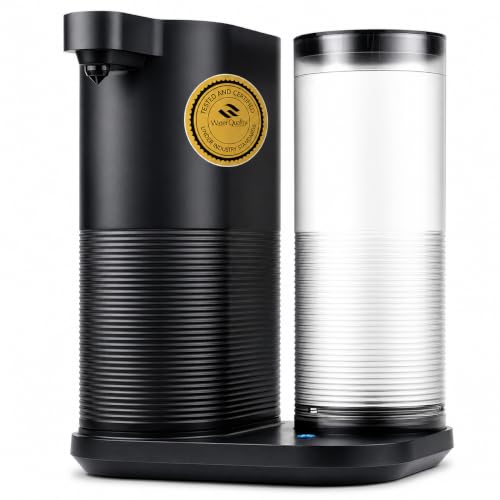
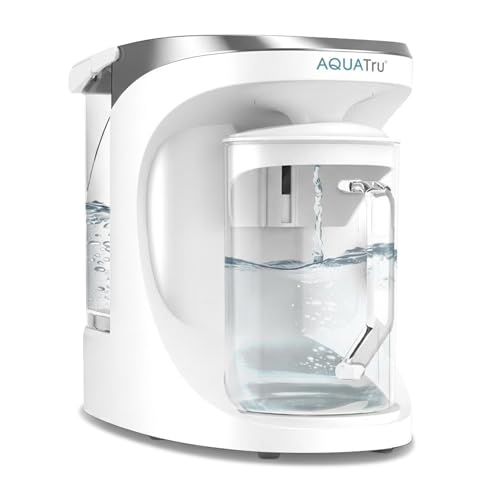
For renters who want the most thorough filtration possible without touching the plumbing, a countertop reverse osmosis system is the clear winner, and the AquaTru is the unit we point people to first. It is a four-stage system that sits on the counter, fills from a removable tank, and runs on a standard wall outlet. There are no hoses, no valves, and no chance of a leak under the sink.

What sets it apart is the certification. The AquaTru is independently certified to NSF/ANSI Standards 42, 53, 58, and 401 to reduce more than 80 substances, including PFAS, lead, fluoride, chromium-6, arsenic, and a long list of pharmaceuticals. That is roughly fifteen times the contaminant coverage of an average pitcher, and the performance data is verified by a third party rather than self-reported. In independent lab testing it has driven PFAS down to non-detect levels.

The trade-offs are real and worth naming. It occupies about a square foot of counter, it produces some wastewater during the RO process, it needs an outlet, and it carries the highest sticker price in this guide. The batch model also means planning ahead: a full tank takes ten to fifteen minutes, so most owners fill it after dinner and keep cold water ready in the fridge. If you live in an older building, worry about lead or PFAS, or simply want the cleanest possible water in a rental, this is the system to beat.

Best Pitcher for Small Spaces: Clearly Filtered

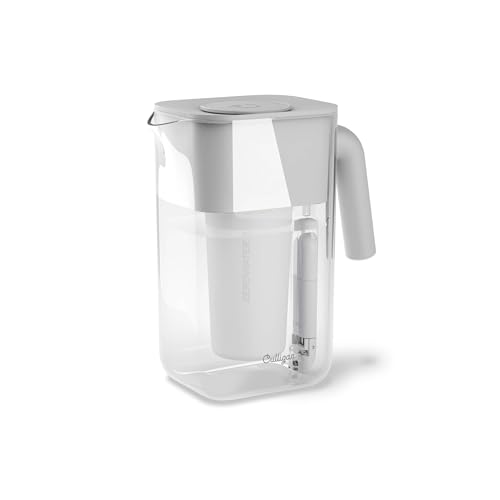
When counter space is genuinely nonexistent, the answer is a pitcher that disappears into the fridge, and the Clearly Filtered pitcher is the one we trust most. Most pitchers reduce chlorine taste and little else. This one is among the very few that carries NSF certification to Standards 42 and 53 plus P473, the standard that covers PFOA and PFOS. In practice that means documented reduction of lead and PFAS from a format you can carry from room to room.

The premium shows up in two places: the pitcher costs more than a drugstore model, and its filters need replacing roughly every 100 gallons, which is more often than cheaper rivals. For a renter who wants verified contaminant removal without surrendering any counter space, that is a fair price to pay. It is also an excellent companion to a countertop RO unit, since some households keep the pitcher in the fridge for cold drinking water and use the RO for cooking volume.

Best Budget Purification: ZeroWater

If your concern is total dissolved solids, fluoride, or simply getting your water as close to pure as a pitcher can manage on a tight budget, ZeroWater earns its place. It is the gravity pitcher that consistently drives water down toward zero parts per million, and it ships with a TDS meter so you can verify the filter is still working rather than guessing.

The honest caveat is cost over time. In hard-water areas above roughly 300 TDS, the filters exhaust quickly and the running cost can climb to two or three times that of a basic Brita. In a low-TDS area it is one of the cheapest serious options available. Test your water or check your utility’s report before committing, because ZeroWater is a great deal in soft water and an expensive habit in hard water.

Best Value Pitcher: Epic Pure

For renters who want strong everyday filtration without the premium-pitcher price, the Epic Pure is the standout value. It is third-party tested against more than 200 contaminants and reduces a notably wide range for its price, including chlorine, certain heavy metals, and a meaningful share of fluoride and nitrate. It is also one of the smaller pitchers we like, which suits a cramped fridge or a single-person household.

It will not match a reverse osmosis unit on the hardest contaminants, and like all pitchers it works in small batches. But as a low-cost first filter that genuinely outperforms the drugstore default, it is hard to argue with.

Best Faucet-Mount: PUR FM-3700

When you want filtered water straight from the tap with no pitcher to refill, a faucet mount is the move, and the PUR FM-3700 is the one we recommend. It threads onto a standard faucet in about thirty seconds with no tools, and a toggle lets you switch between filtered water for drinking and cooking and unfiltered water for dishes, which stretches the cartridge. It is certified to reduce lead along with a long list of other contaminants, which is more than most pitchers manage.

The limitation is purely mechanical. Faucet mounts do not fit pull-down sprayers or commercial-style faucets, and those are increasingly standard in newer apartments. Look at your faucet before you order. If it has a fixed spout with a standard threaded aerator, this is an excellent low-effort choice. If it has a pull-down sprayer, skip the faucet mount entirely and put your money toward a pitcher or a countertop unit.

A Word on Gravity Filters

Gravity systems like Berkey and ProOne come up constantly in renter discussions, and they do have legitimate strengths: no power, no plumbing, no wastewater, and the ability to move with you. For off-grid or emergency use they are genuinely useful. For a typical apartment, though, we think they are usually the wrong call.

They are tall, often around twenty inches, which fights with upper cabinets. They are slow, frequently taking thirty to sixty minutes per batch. And their certification picture is murkier than the RO and pitcher options above, since several rely on self-commissioned testing rather than full NSF certification for the contaminants renters most often worry about. For the same counter footprint, a countertop RO unit gives you faster, better-documented filtration. We would only steer a renter toward a gravity filter if power independence is a specific requirement.

Match the Filter to Your Building

The single most useful thing a renter can do is stop shopping by brand and start shopping by water. The right filter depends on what is actually coming out of your tap, and that varies enormously from one building to the next.

If you live in an older building, lead is the contaminant to take seriously. Municipal water leaves the treatment plant within EPA limits, but it can pick up lead from aging service lines and interior plumbing on the way to your unit, and older apartment buildings are the most likely culprits. In that case, prioritize a filter with a genuine NSF 53 lead certification: a countertop RO unit, the Clearly Filtered pitcher, or the PUR faucet mount, rather than a basic carbon pitcher.

If you are on treated city water in a newer building and mostly want better taste, a standard carbon pitcher or faucet mount will handle chlorine, odor, and the everyday complaints just fine. There is no need to overbuy.

If fluoride or PFAS is your concern, know that most ordinary pitchers and faucet mounts do not meaningfully reduce either. Removing them reliably takes reverse osmosis or a specifically certified filter. That points you to the AquaTru, or to the Clearly Filtered pitcher among non-RO options. When in doubt, a home water test or your utility’s annual consumer confidence report will tell you what you are actually dealing with, which beats guessing every time.

What Your Lease Lets You Do

The reassuring part: almost everything in this guide is entirely your call. A landlord has no say over whether you keep a pitcher in the fridge, screw a filter onto the faucet, or plug an appliance into the wall. Pitchers, faucet mounts, countertop units, and freestanding dispensers are all modification-free and require no permission.

The one category to think twice about is under-sink systems. Because they tap into the cold water supply line, and because a true reverse osmosis setup usually adds a dedicated faucet that means a new hole in the counter, they sit in a gray zone. Some direct-connect under-sink filters avoid the extra faucet and are easier to reverse, but any system that touches the supply line is worth running past your landlord and your lease first. When you move out, you want to leave the kitchen exactly as you found it.

Apartment Water Filters Compared

Here is how the formats stack up against the factors that actually decide a renter’s choice.

Pick Format Best For Key Certification Footprint Watch Out For
AquaTru Countertop RO Serious purity, lead, PFAS, fluoride NSF 42, 53, 58, 401 ~1 sq ft counter Price, wastewater, needs an outlet
Clearly Filtered Pitcher No counter space, documented PFAS and lead NSF 42, 53, P473 Fridge door Filter cost, ~100-gallon life
ZeroWater Pitcher Low TDS, fluoride, budget purification NSF 42, 53 Fridge or shelf Fast filter wear in hard water
Epic Pure Pitcher Best value everyday filtration Third-party tested, 200+ Fridge door Small batches, not RO-level
PUR FM-3700 Faucet mount Filtered water from the tap, low effort NSF certified for lead On the faucet Will not fit pull-down sprayers

The Bottom Line

For most apartments, the choice comes down to how much you care about your water and how much counter space you can give up. If you want the cleanest possible water and can spare a square foot, the AquaTru countertop reverse osmosis system is the strongest renter-friendly pick on the market, with certified removal of PFAS, lead, and fluoride and no plumbing whatsoever. If counter space is sacred, the Clearly Filtered pitcher delivers documented contaminant reduction from the fridge door. On a budget, ZeroWater handles purification in soft-water areas and the Epic Pure is the best everyday value. And if you simply want filtered water from a standard tap, the PUR faucet mount is a thirty-second upgrade, provided your faucet will take it.

Whatever you choose, the principle is the same: pick for your building and your water, not for the longest spec sheet. A renter who matches a certified filter to a real contaminant will end up with cleaner water than one who buys the most expensive unit on the shelf and never checks what it is actually removing.

Photo of author

Marcus Chen

Marcus Chen is a water quality engineer with over 12 years of experience in residential and municipal water treatment systems.
  • How to Choose a Water Filter: The Complete Buying Guide

    How to Choose a Water Filter: The Complete Buying Guide

    Most people buy a water filter backwards, choosing a brand before knowing what is in their water. This complete buying guide flips the order: test your water first, target the contaminants that matter, decode NSF certifications, and match the right filter type to your home, lease, and budget.

  • Best Water Filters for Well Water: Complete 2026 Buyer’s Guide

    Best Water Filters for Well Water: Complete 2026 Buyer’s Guide

    Well water filtration depends entirely on what your water test shows. Here's how to match a system to your specific contaminants, the best whole-house and point-of-use options for 2026, and what most well water guides get wrong.

  • How Often Should You Change Your Water Filter?

    How Often Should You Change Your Water Filter?

    Filter replacement schedules vary by type: pitchers every 2 months, refrigerators every 6 months, RO membranes every 2 to 5 years. Here's the complete schedule, signs your filter is overdue, and what happens if you skip a replacement.