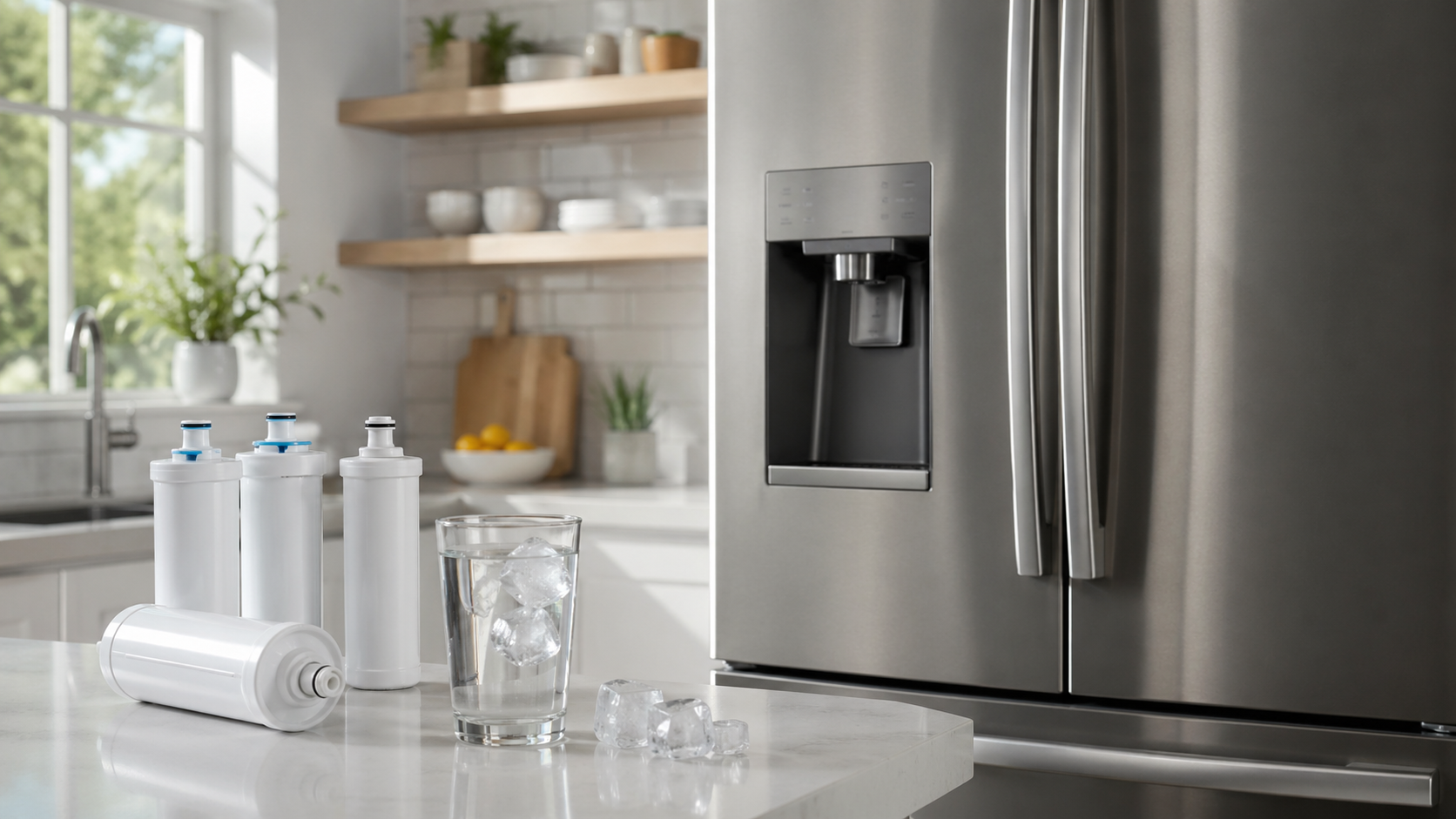
Your refrigerator’s built-in water dispenser and ice maker are only as clean as the filter behind them. Most fridge filters are rated for 200–300 gallons — roughly six months of average use — but millions of households run them well past that, at which point the filter stops doing its job and can actually become a source of contamination rather than a solution to it.
The good news: replacement filters are inexpensive, easy to swap, and make a noticeable difference in the taste and safety of your water and ice. The challenge is that compatibility matters enormously — the wrong cartridge won’t fit, won’t seal, and could leak. There’s also a meaningful performance gap between brand-name OEM filters and generic replacements.
We’ve researched filters across every major refrigerator brand — Whirlpool, GE, Samsung, LG, Frigidaire, and Bosch — to give you the best options at every price point.
Quick Picks: Best Refrigerator Water Filters at a Glance
| Pick | Best For | Compatible With | Price |
|---|---|---|---|
| Everydrop EDR1RXD1 | Best overall | Whirlpool, Maytag, KitchenAid | $40–$50 |
| GE XWFE | Best for GE fridges | GE (French door & side-by-side) | $45–$55 |
| Samsung HAF-QIN/EXP | Best for Samsung | Samsung (square filter bay) | $45–$55 |
| LG LT1000P | Best for LG | LG (most 2016+ models) | $40–$50 |
| Clearly Filtered Universal Inline | Best contaminant removal | Any fridge with ¼” water line | $65–$75 |
| Waterdrop Inline Filter | Best budget inline | Any fridge with ¼” water line | $25–$35 |
| Frigidaire FPPWFU01 | Best for Frigidaire | Frigidaire (most models) | $30–$40 |
OEM vs. Generic: Which Should You Buy?
This is the first decision every refrigerator filter buyer faces, and it’s worth understanding clearly.
OEM (Original Equipment Manufacturer) filters are made by or for your refrigerator brand — Everydrop for Whirlpool, XWFE for GE, HAF-QIN for Samsung, and so on. They’re engineered to fit your specific filter housing, are certified to NSF/ANSI standards, and come with manufacturer warranties. The downside is cost: OEM filters typically run $40–$55 each, and at two per year, that adds up.
Generic/aftermarket filters are third-party cartridges designed to be compatible with OEM housings. Quality varies significantly. The best generics — from brands like Waterdrop, ICEPURE, and Waterspecialist — use coconut-shell carbon block media, carry NSF/ANSI 42 and 53 certifications, and perform comparably to OEM filters on chlorine and lead removal. Budget generics with no independent certification are a different story — skip those.
Our recommendation: Use OEM filters if you can afford them, particularly for GE and Whirlpool where genuine filters have the strongest certification data. If you’re buying aftermarket, insist on NSF/ANSI 42 and 53 certification at minimum, and buy from established brands with independent test results published on their website.
One important note: using a generic filter does not void your refrigerator’s warranty under the Magnuson-Moss Warranty Act, regardless of what your appliance manufacturer’s marketing may imply.
The 7 Best Refrigerator Water Filters of 2026
1. Everydrop EDR1RXD1 — Best Overall
Compatible with: Whirlpool, Maytag, KitchenAid side-by-side refrigerators
The Everydrop EDR1RXD1 is the OEM filter for a large range of Whirlpool-family refrigerators, and it’s among the most rigorously tested fridge filters available. It’s certified to NSF/ANSI Standards 42, 53, and 401, meaning it’s verified to reduce chlorine, lead, and a range of emerging contaminants including pharmaceuticals and pesticides. It also reduces microplastics by 99% — one of the few fridge filters to specifically address this.
Filter life is rated at 200 gallons (about 6 months for an average family), and installation is a simple quarter-turn — no tools required.
- Certifications: NSF/ANSI 42, 53, 401
- Contaminants reduced: Lead, chlorine, microplastics, pharmaceuticals, pesticides, VOCs (70+ total)
- Filter life: 200 gallons / ~6 months
- Best for: Whirlpool, Maytag, and KitchenAid owners who want comprehensive OEM performance
2. GE XWFE — Best for GE Refrigerators
Compatible with: GE French door and side-by-side refrigerators (XWFE series)
The GE XWFE is GE’s most advanced built-in filter, and a notable upgrade from older GE filter models. It uses activated carbon block media to reduce 50+ contaminants including chlorine, chloramines, lead, PFOS, and VOCs, with NSF/ANSI 42 and 53 certification. A standout feature: it includes a built-in RFID chip that communicates with compatible GE refrigerators to track filter life and remind you when to replace it — no manual tracking required.
Installation is tool-free and takes under a minute. GE also offers a text reminder service for filter replacement, which is a small but genuinely useful touch.
- Certifications: NSF/ANSI 42, 53
- Contaminants reduced: Chlorine, chloramines, lead, PFOS, VOCs, 50+ total
- Filter life: 300 gallons / ~6 months
- Best for: GE refrigerator owners, especially those with smart/connected models
3. Samsung HAF-QIN/EXP — Best for Samsung Refrigerators
Compatible with: Samsung refrigerators with a square filter bay
The Samsung HAF-QIN/EXP is the genuine OEM filter for Samsung models that use a square filter cartridge. It uses ultra-high-grade carbon block media to reduce 99% of harmful contaminants including chlorine, heavy metals, and sediment, and is NSF 401 certified for emerging contaminants. Each filter comes with an authentication tag — a safeguard against counterfeit cartridges, which are unfortunately common in the Samsung aftermarket.
If your Samsung uses a round filter (DA29-00020B style), look for the HAF-CIN instead — the housing shape differs between model families.
- Certifications: NSF 401
- Contaminants reduced: Chlorine, heavy metals, sediment, emerging contaminants
- Filter life: ~6 months
- Best for: Samsung refrigerator owners with square-bay filter housings
4. LG LT1000P — Best for LG Refrigerators
Compatible with: Most LG refrigerators manufactured from 2016 onward
The LG LT1000P is a strong OEM option covering a wide range of LG models. It carries NSF/ANSI 42, 53, and 401 certifications — making it one of the most comprehensively certified in-fridge filters available — and reduces cysts, asbestos, lead, chlorine, and emerging contaminants. The push-button installation snaps in without tools, and LG’s filter indicator light is compatible with this cartridge for hassle-free tracking.
- Certifications: NSF/ANSI 42, 53, 401
- Contaminants reduced: Lead, cysts, asbestos, chlorine, pharmaceuticals, emerging contaminants
- Filter life: 200 gallons / ~6 months
- Best for: LG refrigerator owners with 2016 or newer models
5. Clearly Filtered Universal Inline Filter — Best Contaminant Removal
Compatible with: Any refrigerator or ice maker with a ¼” water supply line
If contaminant removal is your top priority and you’re not satisfied with what a standard in-fridge cartridge can do, an inline filter is the answer. Rather than replacing the cartridge inside your fridge, an inline filter installs on the water supply line behind or beneath the unit.
The Clearly Filtered Universal Inline is the most thorough option in this category — independently tested to remove 99.99% of 230+ contaminants including PFAS, fluoride, chloroform, uranium, lead, and heavy metals. It uses the same advanced carbon block technology as Clearly Filtered’s under-sink system, in a compact inline form factor. It’s NSF 42 and 53 certified and lasts up to 365 gallons — nearly double a standard fridge filter.
The upside is exceptional filtration that far exceeds any OEM fridge filter. The trade-off is a slightly more involved one-time installation (cutting and splicing the water line) and a higher price point.
- Certifications: NSF/ANSI 42, 53 (independently lab tested for 230+ contaminants)
- Contaminants reduced: PFAS, fluoride, lead, chloroform, uranium, heavy metals, 230+ total
- Filter life: 365 gallons / ~12 months
- Best for: Anyone with serious water quality concerns who wants the best possible filtration from their fridge water
6. Waterdrop Inline Filter — Best Budget Inline
Compatible with: Any refrigerator or ice maker with a ¼” water supply line
For those who want an inline filter without the Clearly Filtered price tag, the Waterdrop Inline is a solid entry-level option. It uses coconut-shell activated carbon block media, is NSF 42 and 372 certified, and reduces chlorine by 97.6% along with sediment, rust, and odor. Installation uses standard ¼” compression or push-to-connect fittings and takes about five minutes.
It won’t match the Clearly Filtered’s breadth of contaminant removal — it doesn’t claim PFAS or fluoride reduction — but for households on city water with primarily taste and odor concerns, it’s an efficient and affordable upgrade.
- Certifications: NSF/ANSI 42, 372
- Contaminants reduced: Chlorine, sediment, rust, taste/odor compounds
- Filter life: ~12 months
- Best for: Budget buyers who want an inline upgrade for taste and odor improvement
7. Frigidaire FPPWFU01 PurePour — Best for Frigidaire Refrigerators
Compatible with: Most Frigidaire refrigerators
The Frigidaire FPPWFU01 is the genuine OEM filter for most Frigidaire models. It uses premium carbon fiber media, is NSF 401 certified for emerging contaminants, and reduces up to 99% of contaminants while preserving natural mineral taste. It comes in a convenient 2-pack, which covers a full year of replacements at once and typically saves money over buying individual cartridges.
Installation is simple and tool-free. The slim 2.5 × 2.5 × 9.5-inch design fits most in-fridge housings without issue.
- Certifications: NSF 401
- Contaminants reduced: Chlorine, heavy metals, emerging contaminants, 99% contaminant reduction claimed
- Filter life: ~6 months per filter (2-pack covers 1 year)
- Best for: Frigidaire owners who want genuine OEM performance and year-round convenience
How to Find the Right Filter for Your Refrigerator
Compatibility is everything with fridge filters. Here’s how to identify the right one without guessing:
Check the existing filter. The easiest method — open the filter compartment (typically inside the fridge, upper right corner, or in the bottom grille) and look for the model number printed on the cartridge itself. Search that number directly.
Check your owner’s manual. The manual will list the recommended OEM filter part number. If you’ve misplaced it, most manufacturers have digital manuals searchable by refrigerator model number on their websites.
Use your refrigerator’s model number. The model number sticker is typically on the interior wall of the fridge (left side, near the top) or on the door jamb. Most filter brand websites have a “filter finder” tool where you enter your model number and get the compatible cartridge.
Know your filter housing type. Refrigerator filters come in two main physical formats: twist-and-lock cartridges (installed inside the fridge) and push-button cartridges (installed in the lower grille). Samsung models also distinguish between round and square housing types. Getting the wrong physical format means it simply won’t fit.
NSF Certifications for Refrigerator Filters: What to Look For
Fridge filters carry several NSF/ANSI standards. Here’s what each means:
NSF/ANSI 42: Reduces chlorine, taste, odor, and particulates. The baseline certification — present on virtually all quality filters. Important for water that tastes or smells like chlorine.
NSF/ANSI 53: Reduces health-relevant contaminants including lead, VOCs, cysts, and MTBE. Essential if you have any lead concerns (older pipes, pre-1986 plumbing, or confirmed detection in your water report).
NSF/ANSI 401: Reduces emerging contaminants — pharmaceuticals, pesticides, herbicides, and other compounds for which there are no current EPA regulatory limits. Increasingly common on newer OEM filters.
NSF/ANSI 473: The PFAS certification. Rare in fridge filters as of 2026 — most in-fridge cartridges do not carry this certification. If PFAS removal from refrigerator water is a priority, an inline filter like the Clearly Filtered Universal is a better solution.
How Often Should You Replace Your Refrigerator Water Filter?
Most refrigerator water filters are rated for 200–300 gallons, which works out to roughly every 6 months for an average household of four. Larger families who use the dispenser heavily may need to replace sooner; smaller households might stretch to 9 months.
Don’t rely solely on the indicator light. Fridge filter indicators are typically timer-based, not usage-based — they count months, not gallons. If you use the dispenser heavily, your filter may be exhausted before the light comes on. Conversely, in a low-use household, the light may trigger before the filter is actually spent.
Signs your filter needs replacing sooner than scheduled: water or ice with a noticeable chlorine taste or odd smell, slower-than-normal dispenser flow, or cloudy ice cubes.
Running an expired filter isn’t just a performance issue — a saturated carbon filter can harbor bacteria and actually release previously captured contaminants back into your water. Replace on schedule.
Do Refrigerator Filters Remove PFAS?
This is one of the most common questions we receive, and the answer matters: most standard refrigerator filters do not reliably remove PFAS.
The majority of in-fridge OEM filters are certified to NSF/ANSI 42 and 53, which cover chlorine and lead. PFAS removal requires NSF/ANSI 473 certification or independently verified testing — and very few built-in fridge filters have this. The carbon media in most cartridges provides some incidental PFAS reduction, but the contact time is too short and the media volume too small for reliable, consistent removal.
If PFAS is a concern in your water, the most effective solutions are an inline filter with verified PFAS reduction (like the Clearly Filtered Universal Inline) or an under-sink reverse osmosis system that treats the water before it reaches your fridge’s supply line. See our guide on Best Water Filters That Remove PFAS for a full breakdown.
Frequently Asked Questions
Are generic refrigerator filters as good as OEM? The best generics — NSF 42 and 53 certified, from brands with published independent test results — perform comparably to OEM filters for chlorine and lead removal. Budget generics with no certifications are a gamble. If cost is a concern, a quality certified generic is a reasonable choice; just verify the certification before buying.
Can I use a generic filter without voiding my warranty? Yes. The Magnuson-Moss Warranty Act protects your right to use compatible third-party parts without voiding your appliance warranty. Your manufacturer cannot legally require you to use their branded filter as a warranty condition.
What happens if I don’t replace my fridge filter? An overdue filter stops reducing contaminants effectively and can actually harbor bacteria or release previously captured contaminants back into your water. You may also notice reduced flow from the dispenser and deteriorating water taste. Replace on schedule — every 6 months or 200–300 gallons, whichever comes first.
My fridge doesn’t have a built-in filter. What are my options? If your refrigerator has a water dispenser or ice maker but no built-in filter, an inline filter is the solution. It installs on the ¼” water supply line behind the fridge and provides filtration without any modification to the appliance itself.
Can I drink tap water instead of using the fridge filter? That depends entirely on your local water quality. Refrigerator filters improve taste and remove a meaningful range of contaminants, but they’re not the most comprehensive solution available. If you have specific concerns about lead, PFAS, or other contaminants, a dedicated point-of-use filter (under-sink or countertop) will outperform any refrigerator cartridge.
The Bottom Line
For most households, an OEM replacement filter — Everydrop for Whirlpool, XWFE for GE, HAF-QIN for Samsung, LT1000P for LG — is the simplest and most reliable choice. They’re certified, compatible, and easy to install. Budget for two per year and set a calendar reminder so you don’t let them run past their service life.
If you have specific PFAS or contamination concerns, an inline filter like the Clearly Filtered Universal gives you substantially better contaminant removal than any built-in cartridge, and is worth the one-time installation effort.
Whatever you choose: replace on schedule. A filter that’s past its service life is worse than no filter at all.
Related Guides
- How to Replace a Refrigerator Water Filter
- Best Drinking Water Filters
- Best Water Filters That Remove PFAS
- Best Water Filters for Lead Removal
- NSF Certification: What It Means for Water Filters
- How Often Should You Change Your Water Filter?
About Marcus Chen